 Khyati Sharma 2026-10-03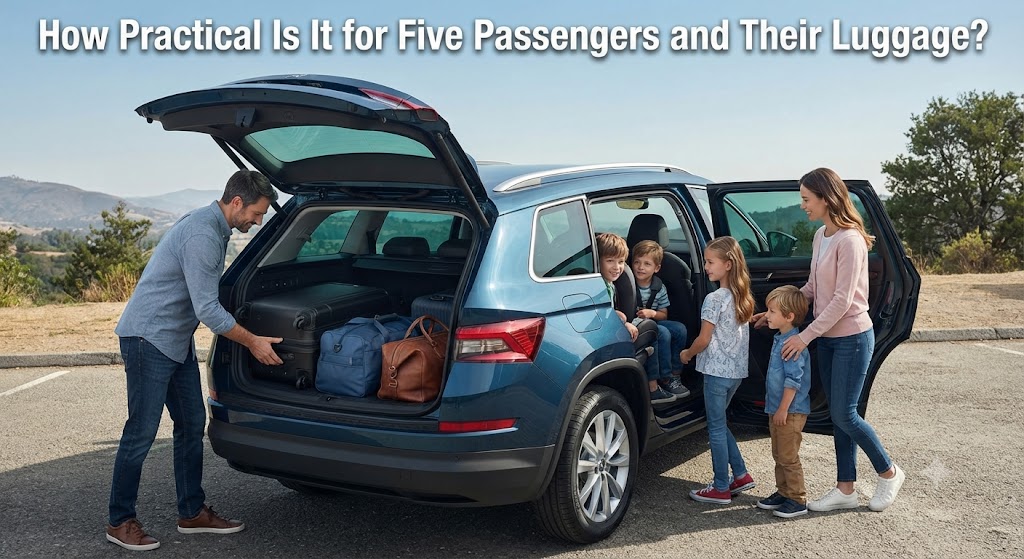
When choosing a car for family use, seating capacity is only part of the equation. A vehicle may officially accommodate five passengers, but the real question is whether five adults can travel comfortably while carrying their luggage.
For families, weekend trips and everyday commuting, cabin space, rear-seat comfort and boot capacity can make a major difference. So, how practical is a typical five-seater car when all five seats are occupied?
A five-seater is designed to carry two people in the front and three in the rear. However, comfort depends heavily on the vehicle's width, rear-seat design and available legroom.
For short city journeys, most modern five-seater cars can accommodate five occupants without major issues. On longer trips, things such as:
become more important.
The middle rear passenger can also have a different experience depending on the design of the rear seat and floor. A flat floor generally makes it easier for three people to sit in the back.
This is where practicality can vary significantly between cars.
With five passengers inside, the luggage space needs to accommodate bags, backpacks and other travel items without making the cabin uncomfortable. A large boot can make a five-seater much more useful for family trips.
For everyday use, the boot should ideally be capable of carrying several small bags or a combination of luggage and shopping items.
For a weekend trip involving five people, however, larger suitcases can quickly consume available boot space.
For a family of five, a five-seater can work well for weekend travel if the luggage is packed carefully.
Soft bags and backpacks are generally easier to accommodate because they can use the available space more efficiently. Large hard-shell suitcases may take up significantly more room.
A practical approach is to place:
However, luggage should never obstruct the driver's visibility or interfere with passenger safety.
A car can have a generous boot but still feel cramped with five passengers.
For longer journeys, rear-seat passengers need enough legroom and shoulder room to remain comfortable. If three adults regularly travel in the second row, checking the rear bench physically before buying the car is particularly important.
Families with children may find a five-seater more accommodating because children generally require less shoulder room than three adults.
For occasional long-distance trips, a well-designed five-seater can be perfectly adequate for five occupants.
The experience will depend on the vehicle's overall dimensions and equipment. Features such as rear AC vents, USB charging ports, comfortable seats and good cabin storage can make longer journeys easier.
However, if five adults frequently travel with substantial luggage, buyers may want to consider a larger vehicle with more cabin and luggage space.
A five-seater can be practical for airport runs, but luggage quantity is the deciding factor.
Five passengers with only backpacks and small cabin bags may have no major problem. Five passengers carrying multiple large suitcases can make the boot considerably more difficult to manage.
In such situations, the number and size of bags should be considered rather than relying solely on the manufacturer's seating capacity.
For daily commuting, school runs and shopping trips, a five-seater is usually a practical configuration.
With fewer than five occupants, the unused rear seat can also provide additional flexibility for carrying bags. The boot can handle regular shopping and everyday items without requiring a larger vehicle.
The situation changes when the car is consistently used by five adults and their luggage. In that case, buyers should pay closer attention to the vehicle's actual interior and boot dimensions.
If you're considering a five-seater for a family of five, don't look at seating capacity alone. Check these factors during a showroom visit:
1. Sit in All Five Seats
Have five people sit inside the car simultaneously. This gives a much better idea of real-world comfort than simply reading the specification sheet.
2. Check the Boot With Real Luggage
If possible, take your usual suitcases or estimate their dimensions and see how easily they fit.
3. Check Rear Legroom
Ask the front occupants to adjust their seats to their normal driving positions and then check the space available behind them.
4. Examine Storage Spaces
Door pockets, centre-console storage and cupholders can make a difference when travelling with multiple passengers.
5. Consider Your Typical Journey
A car that works perfectly for five people around town may feel different during a six-hour highway journey.
The difference is important.
Five passengers without much luggage: Generally manageable in most five-seater cars.
Five passengers with small bags: Usually practical for daily use and short trips.
Five passengers with weekend luggage: Depends heavily on boot capacity and luggage size.
Five adults with multiple large suitcases: May be challenging in a compact five-seater.
A five-seater can be a practical family car for five passengers and their luggage, but its real-world usability depends on the balance between cabin space and boot capacity.
For regular city driving, school runs and occasional family trips, a well-packaged five-seater can offer a good combination of comfort and practicality. For frequent long-distance travel with five adults and several large bags, a larger vehicle may provide greater flexibility.
Ultimately, the best way to judge practicality is to test the car with five occupants and the type of luggage your family normally carries. That real-world check can reveal more than the seating capacity or boot-size figure alone.