When buying a new car, many people look at its safety rating before making a final decision. A five-star rating is often considered a sign that a vehicle offers excellent protection in an accident. Manufacturers also highlight these ratings in advertisements to demonstrate how safe their cars are.
However, there is an important question that every car buyer should understand: Does a five-star safety rating mean you cannot get seriously injured in a crash?
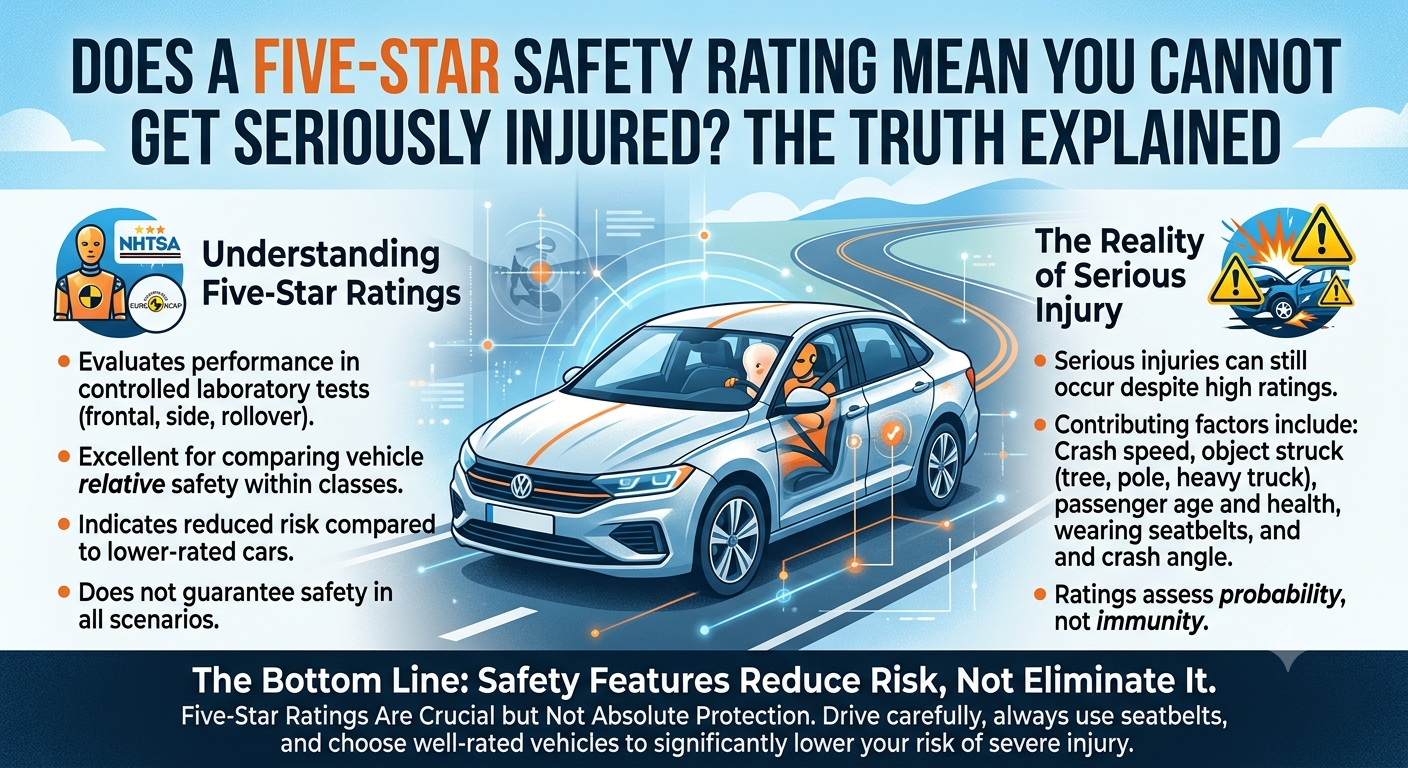
The answer is no. A five-star safety rating indicates that a vehicle performed well under the specific crash tests and safety assessments used by the rating organisation. It does not guarantee that occupants will escape every accident without injuries.
Even a car equipped with airbags, electronic stability control, advanced driver-assistance systems and a strong body structure cannot completely eliminate the forces involved in a collision. The severity of an accident, the direction of impact, vehicle speed, seatbelt use and many other factors influence the outcome.
In this article, we explain what a five-star safety rating really means, how crash tests work, why serious injuries can still occur in highly rated cars, and what drivers can do to improve their safety on the road.
Hatchback vs Sedan vs SUV: Which Car Type Suits You Best?
What Does a Five-Star Safety Rating Actually Mean?
A car safety rating is an assessment of how well a vehicle performs in a series of safety tests. Independent assessment programmes evaluate different aspects of vehicle safety and award ratings according to their own testing procedures and scoring systems.
In India, Bharat NCAP evaluates eligible vehicles through crash tests and other safety assessments. Global NCAP has also conducted vehicle safety assessments relevant to Indian consumers. Other organisations, such as Euro NCAP, use their own testing protocols for vehicles sold in their markets.
A five-star rating generally represents strong performance under the applicable assessment programme. However, the exact requirements vary depending on the organisation, vehicle category and year in which the vehicle was tested.
A safety rating may consider areas such as:
-
Protection offered to adult occupants.
-
Protection offered to child occupants.
-
Protection for pedestrians and other vulnerable road users.
-
The performance of active safety technologies.
-
The vehicle's structural behaviour during specified crash tests.
-
The effectiveness of seatbelts, airbags and other restraint systems.
Not every programme evaluates every area in exactly the same way. Therefore, buyers should check which organisation awarded the rating, when the vehicle was tested and what the score actually covers.
A five-star rating is a valuable indicator of safety performance, but it is not a promise that injuries are impossible.
How Are Cars Tested for Safety?
Crash testing involves deliberately crashing a vehicle under controlled conditions to study how its structure and safety systems protect occupants.
Testing organisations use specialised equipment, crash-test dummies, sensors and cameras to measure the forces experienced during a collision. The results help assess the likelihood and severity of certain injuries in the tested scenarios.
1. Frontal Crash Tests
Frontal crash tests examine how a vehicle protects occupants when the front of the car collides with an obstacle or another vehicle under specified conditions.
These tests can assess how the front structure absorbs crash energy, whether the passenger compartment remains sufficiently intact and how restraint systems protect occupants.
However, not every frontal accident occurs in the same way. An offset collision, a full-width impact and a crash involving a vehicle of a different size can produce different results.
2. Side-Impact Tests
In a side-impact collision, the area between the occupant and the striking vehicle may be relatively small. This can make protecting occupants particularly challenging.
Side-impact tests assess how the vehicle's structure and restraint systems respond to specified impacts. Some assessments also consider additional scenarios, such as collisions involving a pole.
A strong result in one side-impact test does not guarantee identical protection in every possible side collision.
3. Child Occupant Protection
Safety assessments may examine how well a vehicle accommodates child restraints and protects child occupants in specified crash scenarios.
The correct child seat, proper installation and suitability for the child's age, height and weight are important. Even a highly rated vehicle cannot provide the intended protection if a child restraint is incorrectly fitted or used.
How Many Airbags Do You Really Need? A Safety Primer
4. Safety Assistance Systems
Depending on the assessment programme, testing may include technologies designed to help prevent accidents or reduce their severity.
Examples include autonomous emergency braking, lane-support systems, electronic stability control and seatbelt reminders.
These technologies can be valuable, but their availability and performance vary by vehicle. Driver-assistance systems may not detect every hazard or prevent every collision.

Why Can You Still Get Seriously Injured in a Five-Star Car?
A five-star rating does not mean that a vehicle is invincible. Several factors can lead to serious injuries even when a car has performed well in safety tests.
1. The Severity of the Accident
Crash-test ratings are based on defined testing conditions. Real-world accidents can occur at much higher speeds or involve more severe impacts than those covered by a particular test.
As speed increases, the energy involved in a collision rises substantially. A vehicle may protect occupants effectively in a tested crash but still be unable to prevent severe injuries in an extremely high-energy collision.
The vehicle's safety systems have physical limits, and no passenger car can guarantee survival in every accident.
2. The Direction of Impact
Cars may be involved in frontal, rear, side, rollover and multiple-vehicle collisions. Each type of accident presents different challenges.
A vehicle might perform particularly well in the frontal and side-impact tests used by a rating programme, but a real-world crash may involve a different impact angle, unusual deformation or several impacts in quick succession.
A rating should therefore be understood as an assessment of tested performance rather than a guarantee covering every crash configuration.
3. Not Wearing a Seatbelt
Seatbelts are among the most important vehicle safety features. They help restrain occupants and work with airbags to reduce the risk of certain injuries.
If a person does not wear a seatbelt, they may move violently inside the cabin or be ejected from the vehicle during a serious crash.
Airbags are designed to work alongside seatbelts, not replace them. Even a car with an excellent crash rating cannot provide the intended occupant protection if its restraints are not used correctly.
Every occupant should wear a properly fitted seatbelt, including passengers in the rear seats.
4. Incorrect Seating Position
The way an occupant sits can affect how safety systems work during a crash.
For example, sitting too close to the steering wheel may increase the risk of injury from an airbag deploying. A seatbelt positioned incorrectly across the abdomen or neck may also provide less effective restraint.
Drivers should maintain an appropriate distance from the steering wheel, adjust their head restraints correctly and ensure that the seatbelt lies across the shoulder and pelvis.
Children should use suitable child restraints according to the manufacturer's instructions and applicable safety guidance.
5. Vehicle Size and Crash Compatibility
A safety rating does not mean every car offers identical protection in every collision.
When vehicles of different sizes and weights collide, the interaction between their structures can affect the forces experienced by occupants. Vehicle design and structural compatibility also matter.
A smaller car with a strong safety rating can perform well in its own crash tests, but that does not guarantee that its occupants will experience the same outcomes in every collision with a much larger vehicle.
This is one reason why safe driving, appropriate speed and maintaining a safe following distance remain essential regardless of a car's rating.
6. Injuries That Crash Ratings Cannot Eliminate
Even when the passenger compartment remains intact, occupants may experience injuries due to the rapid deceleration of the body.
These can include fractures, chest injuries, head injuries and damage to internal organs. The exact injuries depend on the collision, occupant characteristics, restraint use and many other factors.
A vehicle's safety systems aim to reduce the likelihood and severity of injuries. They cannot guarantee that every occupant will remain completely unharmed.
New Car Dealer Negotiation Tips That Actually Work
Five-Star Safety Rating vs Real-World Protection
|
Safety factor
|
What a five-star rating indicates
|
What it does not guarantee
|
|
Frontal crash protection
|
Strong performance in specified frontal tests
|
No injuries in every head-on collision
|
|
Side-impact protection
|
Good performance in the side-impact scenarios assessed
|
Complete protection in every side collision
|
|
Airbags and seatbelts
|
The restraint system performs according to the tested requirements
|
Safety if occupants do not use restraints correctly
|
|
Child occupant protection
|
Good performance under the programme's child-safety assessments
|
Protection from incorrectly installed child seats
|
|
Driver-assistance systems
|
Performance of selected technologies under specified conditions
|
Prevention of every accident
|
|
Vehicle structure
|
Strong performance in the structural assessments conducted
|
The cabin will remain intact in every possible crash
|
|
Overall safety
|
High performance under the applicable rating programme
|
Zero risk of serious injury or death
|
Do All Five-Star Cars Offer the Same Level of Safety?
No. A five-star rating from one assessment programme should not automatically be treated as identical to a five-star rating from another.
Different organisations may use different crash-test procedures, scoring systems and minimum requirements. Their protocols can also change over time as safety technology and research develop.
For example, a vehicle tested under an older protocol may not have been assessed against all the requirements used for a newer model. Two vehicles with the same star rating may also achieve different individual scores for adult protection, child protection and safety assistance.
When comparing cars, check:
-
Which safety organisation tested the vehicle.
-
The year and protocol of the test.
-
Whether the rating applies to the exact model and variant you are considering.
-
The individual scores, not just the overall star count.
-
Which airbags and active safety features are included in the particular variant.
A five-star result is encouraging, but looking at the details provides a clearer picture of the vehicle's strengths and limitations.
How to Improve Your Safety Even in a Five-Star Car
A highly rated vehicle can reduce certain risks, but driver behaviour remains a major part of road safety.
1. Always Wear Your Seatbelt
The driver and every passenger should wear a seatbelt on every journey. Make sure the belt is correctly positioned and is not twisted.
2. Follow Speed Limits
Driving at a sensible speed gives you more time to react and generally reduces the energy involved if a collision occurs. Adjust your speed further when visibility, weather or road conditions are poor.

3. Maintain a Safe Following Distance
Avoid tailgating. Keeping enough distance from the vehicle ahead gives you more time to respond to sudden braking and unexpected hazards.
4. Avoid Distracted Driving
Do not use a handheld phone while driving. Set navigation, music and other controls before starting your journey whenever possible.
5. Maintain Your Vehicle
Check tyres, brakes, lights and other essential components regularly. Ensure that airbags and seatbelt systems are not damaged or improperly modified.
6. Use Child Seats Correctly
Select a suitable child restraint and install it according to its instructions. Never assume that a high vehicle safety rating makes an incorrectly fitted child seat safe.
7. Understand Your Car's Safety Features
Read the owner's manual to learn how airbags, electronic stability control, automatic emergency braking and other systems operate. Understand their limitations rather than relying on them to prevent every accident.
Final Verdict: Does a Five-Star Safety Rating Guarantee You Will Not Get Seriously Injured?
No. A five-star safety rating means that a vehicle achieved a high level of performance under the applicable safety assessment programme. It does not guarantee that occupants will escape every accident without serious injuries.
The actual outcome depends on factors such as collision severity, impact direction, vehicle compatibility, seatbelt use, seating position and road conditions. Safety technologies can reduce risks, but no vehicle can eliminate them completely.
When buying a car, choose a model with a strong, relevant safety assessment and examine its individual scores and equipment. Then combine that protection with responsible driving, proper seatbelt use and regular maintenance.

 Khyati Sharma 2026-10-18