 Khyati Sharma 2026-09-20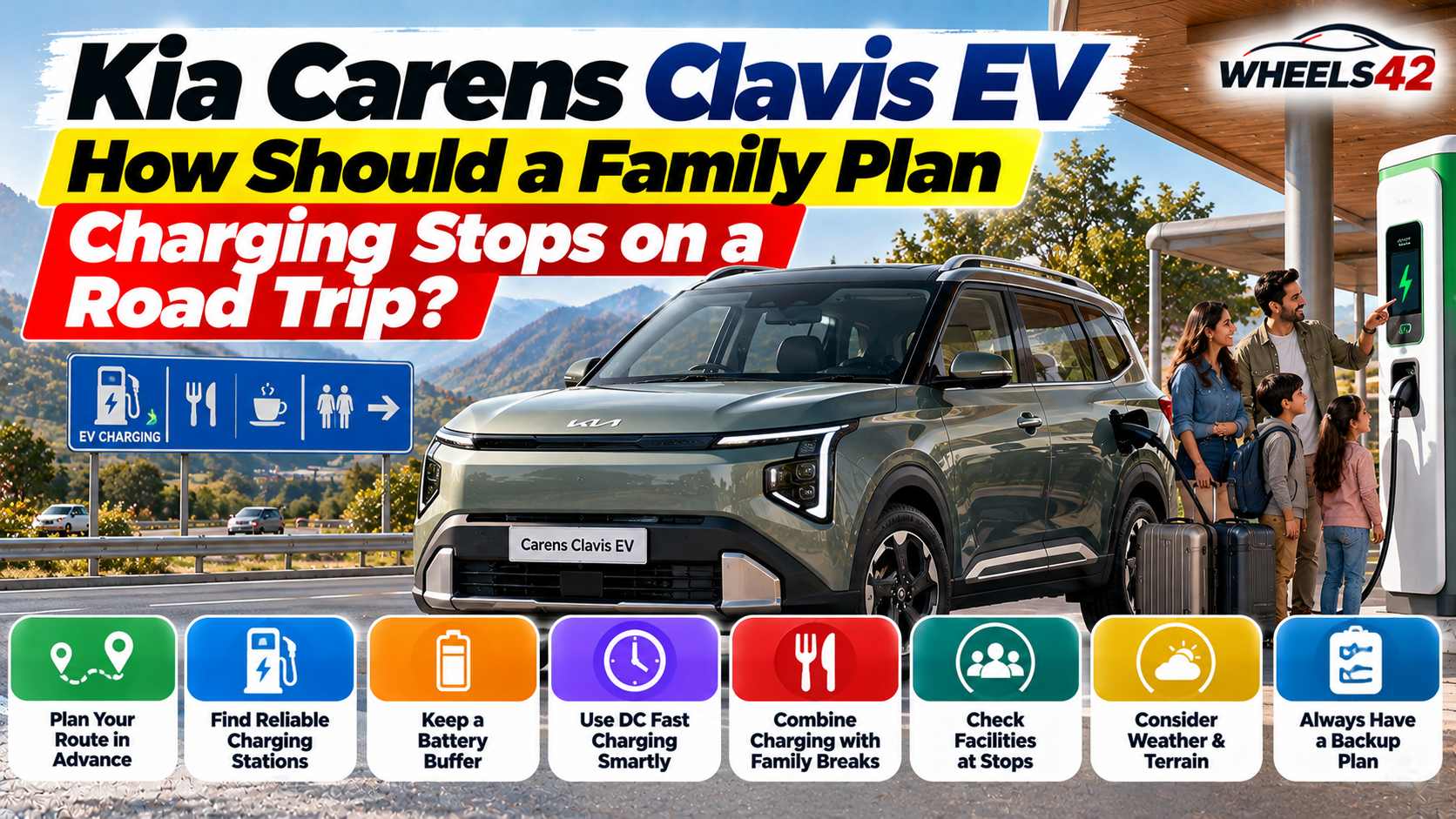
Taking a long road trip in an electric family vehicle requires a slightly different approach from travelling in a petrol or diesel car. Instead of simply watching the fuel gauge, EV owners need to plan charging locations, battery levels, travel distance and possible delays along the route.
The Kia Carens Clavis EV is designed with family travel in mind, offering two battery options and access to a large charging network. The 42kWh version has an ARAI-claimed range of up to 404 km, while the 51.4kWh Extended Range version offers up to 490 km under the ARAI test cycle.
But those figures should not be treated as the exact distance a family will achieve on every road trip. Speed, weather, terrain, traffic, passengers and air-conditioning use can all affect real-world range.
The first step in planning a road trip is to map the entire journey.
Instead of deciding to charge whenever the battery becomes low, identify suitable charging locations along the route before leaving.
A family should check:
Total journey distance
Highway route
Available DC fast chargers
Charger locations near food or rest stops
Alternative charging points
Destination charging availability
Return-trip charging requirements
This approach is particularly useful when travelling with children or elderly passengers, because charging stops can be combined with meal and rest breaks.
Petrol vs Diesel vs CNG vs Electric Cars: How to Choose the Right Fuel Type
The Clavis EV's maximum claimed range of 490 km applies to the 51.4kWh version, while the 42kWh model has a claimed range of 404 km.
In real-world driving, families should leave a safety margin rather than assuming they can cover the entire claimed range.
Highway speeds, air-conditioning, steep climbs, heavy luggage and multiple passengers can increase energy consumption. Kia also notes that speed, outside temperature, topography and the use of electrical equipment can affect real-world range.
For this reason, it is better to think in terms of usable trip range rather than maximum advertised range.
One of the most important rules for an Electric car road trip is avoiding extremely low battery levels before searching for a charger.
A sensible family road trip plan should aim to reach a charging station with a comfortable battery reserve.
For example, if the next reliable charger is some distance away, don't wait until the battery is nearly empty before heading there. Unexpected traffic, road diversions, rain, hills or a crowded charging station can increase the required range.
The Clavis EV's manual specifically advises drivers to check whether the battery has sufficient charge before highway driving.
For long-distance travel, DC fast charging is generally more suitable than waiting for a slower AC charger.
The Carens Clavis EV supports DC fast charging, with Kia quoting approximately 39 minutes for a 10-80% charge using a 100kW DC charger.
This makes a typical charging stop easier to combine with a family break.
Instead of treating charging as wasted time, families can use the stop to:
Have lunch
Use the washroom
Stretch their legs
Give children a break
Check luggage
Have a short rest
This can make the overall journey feel less interrupted.

On a long journey, it may not always be efficient to wait for a full charge at every charging stop.
If another reliable fast charger is available later on the route, charging enough to comfortably reach that location can save time.
For example, a family may arrive at a fast charger with a relatively low battery, charge during a meal break and continue once enough range has been added for the next leg.
The ideal charging strategy depends on charger availability, distance between stops and the family's planned breaks.
One of the biggest advantages of travelling with a family is that charging stops can be integrated into the journey.
Instead of stopping only when the battery requires it, choose charging locations that offer useful facilities.
A good charging stop could have:
Restaurant or café
Clean washrooms
Safe parking
Children's facilities
Shopping options
Comfortable waiting areas
This can make EV travel much easier for families.
Hatchback vs Sedan vs SUV: Which Car Type Suits You Best?
Kia says its K-Charge system, integrated into the MyKia app, provides access to more than 20,000 charging points across India and integrates multiple charge-point operators.
This can simplify trip preparation because families can use the available charging information to identify potential stops before starting their journey.
However, drivers should still check charger availability and operational status as close to departure as possible.
A common mistake is planning a trip around only one charging station at each stage.
If that charger is occupied, unavailable or malfunctioning, the next station may be much farther away.
A better approach is to identify:
Primary charger → Backup charger → Next reliable charger
This is particularly important on less-developed highway routes where charging infrastructure may be spread out.
The Clavis EV can take around 39 minutes to charge from 10% to 80% using a 100kW DC charger, according to Kia's specifications.
However, families should not plan their entire journey assuming every charging stop will take exactly 39 minutes.
Actual charging time can vary because of:
Battery temperature
Starting state of charge
Charger output
Charger availability
Vehicle conditions
Weather
Charging infrastructure
It is therefore sensible to keep some additional time in the itinerary.
Temperature can influence EV efficiency and charging behaviour.
Using the air-conditioner or heater extensively can increase energy consumption, while extreme temperatures can affect battery performance.
For Indian road trips, especially during hot summer months, families should avoid calculating their journey using the maximum claimed range alone.
Keeping a reasonable battery reserve provides additional flexibility.
Mountain trips require particular attention.
Climbing steep roads consumes more energy, and the actual range can fall faster than it does on a flat highway.
Regenerative braking can recover some energy during descents, but drivers should not rely on this to compensate for insufficient battery charge.
If the route includes significant elevation changes, plan shorter charging intervals and keep a larger reserve.
Apart from normal travel luggage, a family travelling in the Clavis EV should prepare for charging-related situations.
Useful items include:
Charging cables where applicable
Phone charging equipment
Navigation access
Payment options for charging
Emergency contact details
Basic first-aid kit
Water and snacks
Offline route information
Keeping a backup payment method is also sensible in case a particular charging station has connectivity or payment issues.
|
Stage |
Charging Strategy |
|
Before departure |
Start with a high battery level |
|
First highway leg |
Drive normally while monitoring consumption |
|
First stop |
Use a reliable DC fast charger |
|
Break |
Combine charging with food/rest |
|
Second leg |
Keep checking estimated range |
|
Backup point |
Identify an alternative charger |
|
Destination |
Charge if required for local travel |
|
Return trip |
Plan the reverse route in advance |
For families who frequently undertake long-distance journeys, the 51.4kWh Extended Range version has an obvious advantage because its claimed range is up to 490 km compared with 404 km for the 42kWh version.
The larger battery can provide more flexibility between charging stops, particularly on routes where fast chargers are less frequent.
The 42kWh version can still work well for road trips, but route planning becomes more important when travelling through areas with fewer charging options.
The Clavis EV has several characteristics that make it suitable for family travel, including three-row seating, two battery choices and access to a broad charging network.
The larger Extended Range battery is particularly useful for families that regularly travel between cities.
However, the key to a successful EV road trip is not simply having a large battery. Charging infrastructure, route planning and maintaining a sensible battery reserve are equally important.