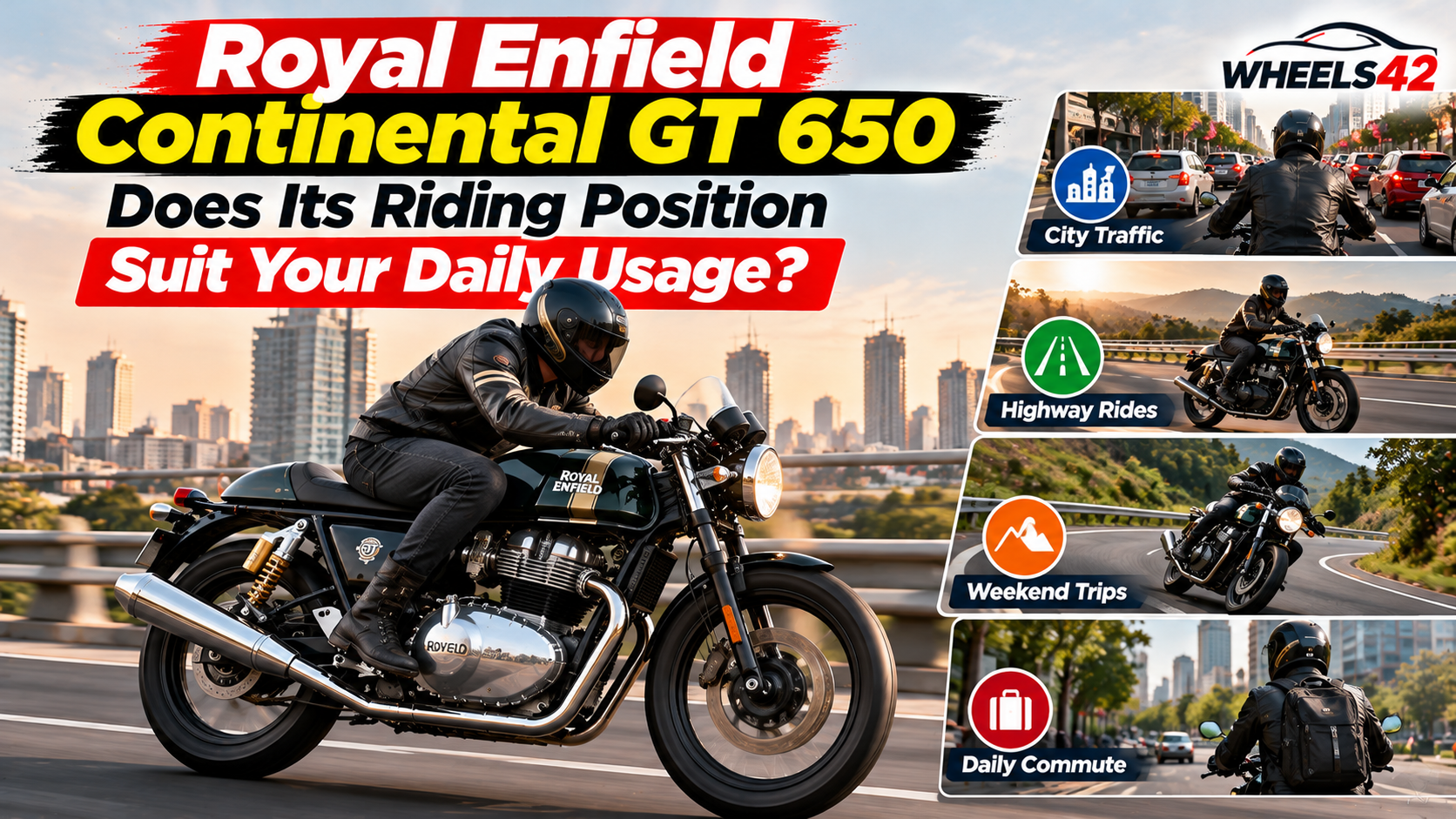
The Royal Enfield Continental GT 650 is one of the most distinctive motorcycles in the brand’s line-up. Its café-racer styling, twin-cylinder engine and sporty Bikes character give it an appeal that is quite different from a conventional commuter or roadster.
But there is an important question to consider before buying one: Does the Continental GT 650’s riding position actually suit your daily usage?
The answer depends on where you ride, how long you stay in the saddle and what you expect from your motorcycle. Its sporty riding posture can feel engaging on an open road, but daily traffic and longer commutes can expose some compromises.
What Is the Continental GT 650 Riding Position Like?
The Continental GT 650 follows a café-racer-inspired layout. Instead of the upright riding position found on many roadsters, the rider sits in a noticeably sportier posture.
The key characteristics include:
-
Low-set clip-on-style handlebars
-
Rear-set footpegs
-
Forward-leaning upper body
-
Relatively sporty rider triangle
-
Sculpted fuel tank that encourages the rider to grip the motorcycle with the knees
Together, these elements create a riding position that makes the Continental GT 650 feel more focused and engaging.
However, this is also why its ergonomics need careful consideration if you intend to use it every day.
Is the Riding Position Comfortable in City Traffic?
This is where the Continental GT 650 may divide opinion.
For shorter city journeys, its riding position should be manageable for many riders. The forward lean can even make the motorcycle feel engaging when moving through flowing roads.
Things can become less comfortable in slow-moving traffic.
Frequent braking, crawling traffic and repeated stop-and-go riding can place additional pressure on the wrists, shoulders and lower back. The motorcycle's weight can also become more noticeable when constantly manoeuvring at low speeds.
If your daily commute involves 20 to 30 minutes of relatively free-flowing roads, the GT 650 may work reasonably well.
If you regularly spend an hour or more in dense traffic, an upright motorcycle could be considerably easier to live with.

How Much Pressure Does It Put on Your Wrists?
One of the biggest questions potential GT 650 buyers should consider is wrist comfort.
Because the handlebars are positioned relatively low, riders naturally lean forward. If you support too much of your upper-body weight through your arms, pressure can build around the wrists and palms.
Riding technique makes a significant difference.
Keeping your elbows slightly relaxed, gripping the fuel tank with your knees and supporting your upper body through your core can reduce the amount of weight transferred to the handlebars.
New riders who are unfamiliar with sporty motorcycles may require some time to adjust.
What About Back and Shoulder Comfort?
The forward-leaning riding position can affect different riders differently.
Your height, arm length, flexibility and riding experience all influence how comfortable the Continental GT 650 feels.
|
Area
|
Daily Riding Impact
|
|
Wrists
|
Can feel pressure during prolonged slow-speed riding
|
|
Shoulders
|
Forward posture may become tiring over longer periods
|
|
Lower Back
|
Comfort depends heavily on rider height and flexibility
|
|
Knees
|
Sportier peg position creates a more bent-knee posture
|
|
Neck
|
Longer rides may cause some fatigue due to forward lean
|
|
Core
|
More involvement than on an upright motorcycle
|
Is the Continental GT 650 Good for Office Commutes?
It can be, but the answer depends heavily on the commute.
Imagine two different riders.
The first travels around 15 km to work, mostly using wide roads with limited congestion. For this rider, the Continental GT 650 can make the daily commute enjoyable.
The second rider travels 30 km through dense urban traffic every morning and evening. In this situation, the riding posture, motorcycle weight and engine heat in slow-moving conditions could make everyday use more demanding.
Therefore, commuting distance alone does not determine suitability. Traffic conditions matter just as much.
Does It Feel Better on Open Roads?
This is where the café-racer riding position starts making more sense.
At moderate and higher road speeds, the forward lean can feel natural because the airflow helps reduce some pressure from the rider's upper body.
The riding position also gives the rider a stronger sense of connection with the motorcycle.
On winding roads, the sporty ergonomics can make direction changes and cornering more engaging compared with a relaxed commuter-style riding position.
For weekend rides involving open highways and curving roads, the Continental GT 650's character becomes much easier to appreciate.
Is It Suitable for Highway Riding?
The Continental GT 650's twin-cylinder engine makes highway riding one of its strengths.
The motorcycle has enough performance for cruising and overtaking, while its riding position can work well at highway speeds.
However, highway performance and touring comfort are two different things.
Spending several hours continuously in a forward-leaning position may become tiring. Riders planning long journeys should take regular breaks and assess whether the riding posture works for their body type.
For occasional weekend highway trips, this may not be a major concern. For frequent long-distance touring, a more relaxed motorcycle could be a better fit.
What About the Pillion?
The Continental GT 650 is primarily a rider-focused motorcycle.
While carrying a pillion is possible, the overall design does not prioritise two-up comfort in the same way as a conventional roadster or touring motorcycle.
If your daily routine regularly involves carrying a passenger, both rider and pillion should experience the motorcycle during a test ride before buying.
This becomes particularly important if you expect to use the motorcycle for longer two-up journeys.
Rider Height Can Make a Big Difference
There is no universal answer to whether the Continental GT 650 is comfortable because rider proportions vary considerably.
A taller rider may experience more knee bend, while someone with shorter arms may need to stretch more towards the handlebars. Riders with longer arms may find the forward reach more natural.
This is why specifications alone cannot determine whether its ergonomics will suit you.
A proper test ride should include traffic, U-turns, stop-and-go riding and, if possible, a short stretch of faster road.
Continental GT 650 Daily Usage: Where Does It Work Best?
|
Usage
|
Suitability
|
|
Short city commute
|
Good
|
|
Heavy stop-and-go traffic
|
Average
|
|
Open urban roads
|
Very Good
|
|
Weekend rides
|
Excellent
|
|
Highway riding
|
Very Good
|
|
Long-distance touring
|
Moderate
|
|
Daily pillion use
|
Moderate
|
|
Café-racer experience
|
Excellent
|
Should You Choose the Interceptor 650 Instead?
This is an important comparison if daily comfort is a priority.
The Continental GT 650 and Interceptor 650 share the broader appeal of Royal Enfield's 650cc twin-cylinder platform, but their riding experiences are different.
The Interceptor uses a more conventional roadster-style riding position. Its handlebars encourage a more upright posture, making it potentially easier to manage during daily commuting and relaxed journeys.
The Continental GT 650 offers the sportier experience.
If style, café-racer character and an involved riding position matter most, the GT 650 has the advantage.
If comfort, everyday versatility and a relaxed riding position are higher priorities, the Interceptor 650 deserves serious consideration.
Who Should Consider the Continental GT 650?
The Continental GT 650 makes the most sense for someone who:
-
Loves café-racer styling
-
Wants an engaging riding experience
-
Has a relatively short or moderate daily commute
-
Frequently rides on open roads
-
Enjoys weekend rides
-
Does not regularly carry a pillion
-
Is comfortable with a forward-leaning riding position
It may be less suitable if your priority is maximum comfort in dense traffic, frequent pillion use or long-distance touring.
What Should You Check During the Test Ride?
Don't test the Continental GT 650 only for acceleration and engine performance.
Spend some time examining how your body reacts to the riding position.
Check whether your wrists feel loaded, whether reaching the handlebars feels natural and whether your knees remain comfortable around the fuel tank.
Also perform slow U-turns and spend some time in traffic. These situations reveal much more about everyday usability than a short ride on an empty road.
If possible, ride continuously for at least 20 to 30 minutes. Ergonomic discomfort that isn't noticeable during the first five minutes can become much clearer after a longer period.

 Khyati Sharma 2026-09-21