 Khyati Sharma 2026-09-15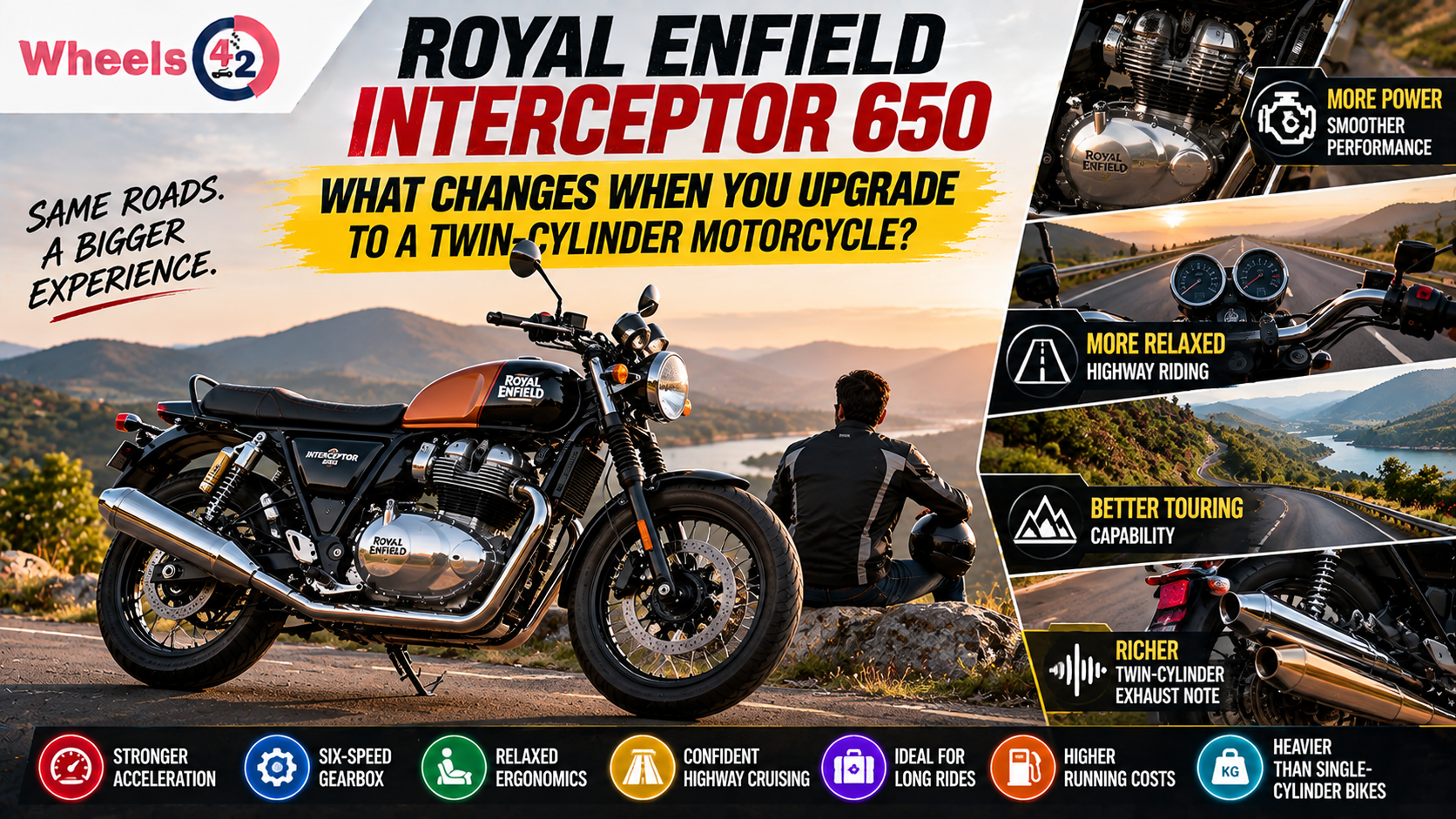
Moving from a single-cylinder motorcycle to a twin-cylinder machine can change much more than the engine note. The Royal Enfield Interceptor 650 offers a different kind of riding experience, combining a 648cc parallel-twin engine with relaxed ergonomics, a comfortable chassis and strong road presence.
For riders considering an upgrade, the biggest question is whether the additional performance and refinement of a twin-cylinder motorcycle make a meaningful difference in everyday riding.
Here is what changes when you move to the Interceptor 650.
The most obvious difference is the engine. The Interceptor 650 uses a 648cc parallel-twin, air-oil-cooled engine paired with a six-speed gearbox.
It produces around 47 PS of maximum power and 52 Nm of peak torque. Rather than relying primarily on low-end punch, the engine builds power progressively and feels increasingly relaxed as speeds rise.
|
Specification |
Royal Enfield Interceptor 650 |
|
Engine |
648cc parallel-twin |
|
Maximum Power |
47 PS |
|
Peak Torque |
52 Nm |
|
Gearbox |
6-speed |
|
Cooling |
Air-oil cooled |
|
Fuel System |
Fuel injection |
|
Front Brake |
Disc |
|
Rear Brake |
Disc |
|
ABS |
Dual-channel |
|
Fuel Tank |
13.7 litres |
One of the biggest advantages of upgrading to a twin-cylinder motorcycle is improved highway performance.
Royal enfield the Interceptor 650 can maintain higher cruising speeds without feeling like the engine is working as hard as a smaller single-cylinder motor. The six-speed gearbox also helps keep engine speeds under control during highway riding.
This makes the motorcycle better suited to:
The motorcycle still has a relaxed character rather than a highly aggressive one, making it suitable for riders who enjoy covering distance without constantly chasing performance.
A twin-cylinder engine generally delivers a different level of refinement compared with a typical single-cylinder motor.
The Interceptor 650's parallel-twin engine delivers a smoother power delivery and a more substantial exhaust note. At cruising speeds, the engine feels composed, while acceleration is more progressive.
This is particularly noticeable when moving from a smaller single-cylinder motorcycle to the Interceptor.
The difference is not simply about maximum power. It is about how the power is delivered.

With 52 Nm of torque and a larger displacement, the Interceptor 650 offers stronger performance when accelerating on open roads.
When overtaking another vehicle, the rider has more performance available without necessarily needing to make frequent gear changes.
This can make highway riding feel more confident, especially when travelling with a passenger or luggage.
However, riders should still select the appropriate gear and maintain safe speeds rather than treating the additional power as a reason to ride aggressively.
The upgrade to a larger twin-cylinder motorcycle comes with an increase in weight.
The Interceptor 650 weighs around 213 kg kerb, making it considerably heavier than most 150cc, 160cc or 200cc single-cylinder motorcycles.
This difference becomes noticeable when:
Once moving, however, the weight contributes to a planted feel on the highway.
The Interceptor 650 can certainly be used as a daily motorcycle, but it does not feel as effortless as a lightweight commuter.
Its wider proportions, heavier weight and larger engine require more effort in dense traffic.
For riders coming from a lightweight motorcycle, the first few weeks may involve an adjustment period.
However, the engine's tractable nature means it does not demand aggressive riding. Once the rider becomes familiar with the motorcycle's weight and dimensions, it can work effectively as an everyday machine.
The Interceptor 650 follows a classic roadster design with an upright riding position.
The relatively wide handlebar and neutral footpeg position make it suitable for longer rides, although comfort can vary depending on the rider's height and preferred riding posture.
This is important because upgrading to a bigger motorcycle should not be viewed only through the engine specification. The ergonomics also determine whether the motorcycle feels comfortable after several hours on the road.
The larger engine is supported by a chassis and braking setup designed to handle the motorcycle's performance.
The Interceptor 650 gets disc brakes at both ends along with dual-channel ABS. Its chassis offers a stable feel at highway speeds while retaining predictable handling.
The suspension setup is aimed more towards road riding than aggressive off-road use.
For touring, this balance makes sense because the motorcycle is designed primarily for paved roads and well-maintained routes.
For riders upgrading specifically for long-distance touring, the Interceptor 650 makes a strong case.
Its combination of:
makes it considerably more capable for long road trips than many smaller single-cylinder motorcycles.
However, touring comfort also depends on accessories, luggage setup, seat comfort and riding style.
Moving to a 648cc twin-cylinder engine also means fuel consumption becomes a bigger consideration.
A larger engine generally uses more fuel than a smaller commuter-oriented motorcycle, particularly when ridden aggressively.
For someone upgrading from a 100cc, 125cc, 160cc or 200cc motorcycle, the increase in fuel expenditure should therefore be included in the ownership budget.
The trade-off is access to significantly stronger performance and better highway ability.
A twin-cylinder motorcycle also has a more substantial mechanical package than a basic single-cylinder commuter.
Owners should consider:
The Interceptor 650 remains relatively straightforward compared with many more sophisticated premium motorcycles, but running costs will naturally be higher than those of a smaller commuter motorcycle.
The Interceptor 650 makes the most sense for riders who have outgrown the performance of a smaller motorcycle and want something capable of both everyday riding and long-distance touring.
The biggest improvement is not simply the jump in horsepower. It is the overall riding experience. The twin-cylinder engine provides smoother acceleration, stronger highway performance and a more relaxed character when covering long distances.
At the same time, buyers need to accept the additional weight, higher running costs and larger physical dimensions.