An electric car doesn't have to be large to become the main car in a household. For many families, the most important requirements are simple: easy city driving, enough space for daily passengers, convenient charging and sufficient range for regular trips.
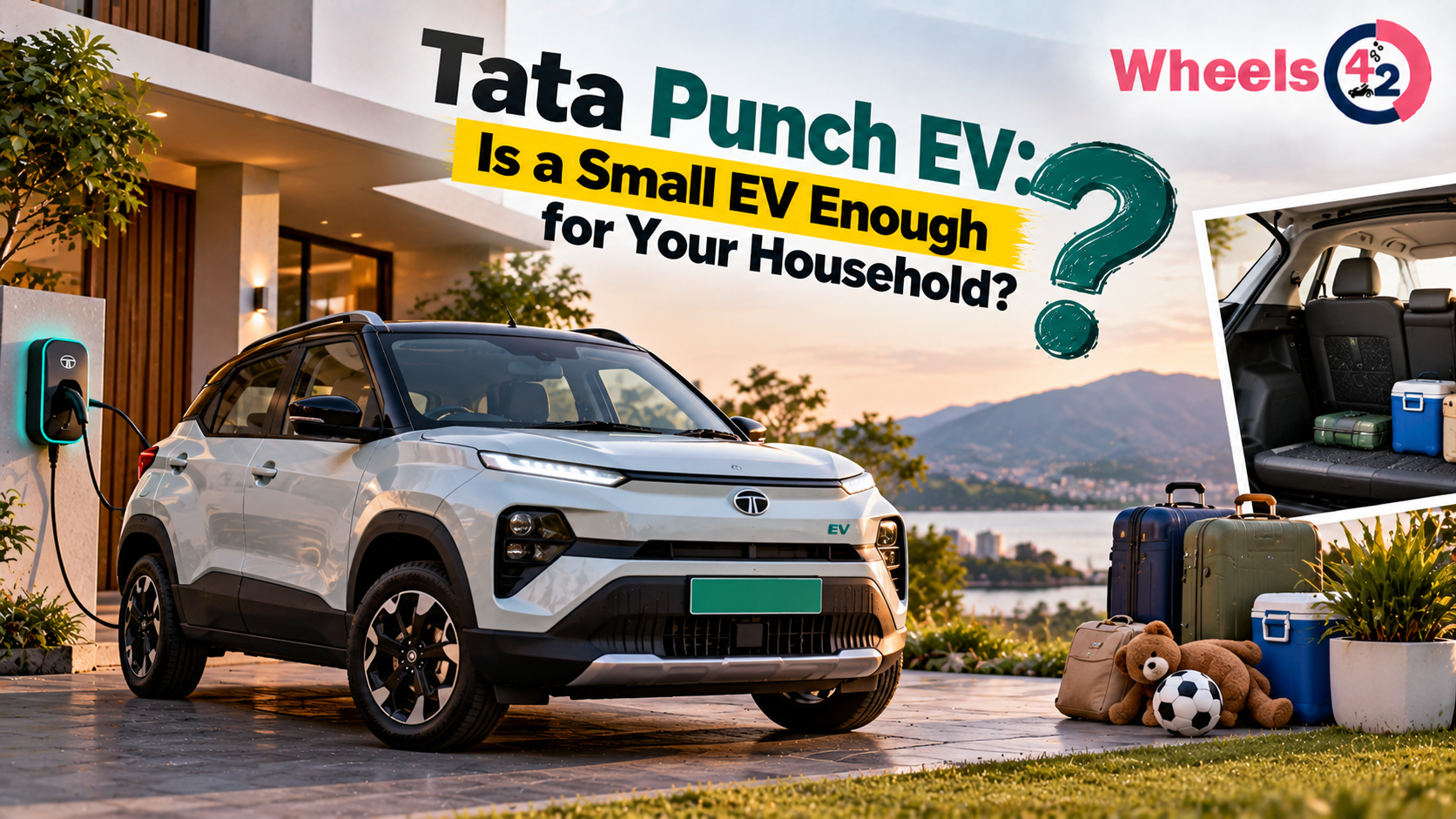
The Tata Punch EV takes a compact approach to electric mobility. Its size makes it easier to use in crowded cities, while its electric powertrain offers the quiet and smooth driving experience associated with EVs.
But there is an important question to answer before buying one:
Can a small electric SUV handle everything your household actually needs?
Let's look at the Punch EV through everyday family situations.
The Monday Morning Test
Imagine a typical weekday.
One person needs to go to work, another has an errand to complete, and the car may also be used for school or shopping.
This is where a compact EV can make sense.
The Punch EV is easier to manoeuvre through congested roads than a larger SUV, while its electric powertrain provides instant response at low speeds.
For households where most daily journeys are within the city, this combination can be convenient.
Where It Fits Well
|
Daily Requirement
|
Punch EV Consideration
|
|
Office commute
|
Easy city-oriented driving
|
|
School runs
|
Compact dimensions
|
|
Grocery shopping
|
Practical for everyday loads
|
|
Shopping areas
|
Easier parking than larger SUVs
|
|
Short family trips
|
EV powertrain suits urban use
|
|
Weekend travel
|
Depends on route and charging access
|
How Much Space Does Your Family Need?
The Punch EV has a compact footprint, but that doesn't automatically mean the cabin is unsuitable for a family.
Before buying, take your regular passengers along for a test drive.
Check:
- Front-seat comfort
- Rear-seat legroom
- Headroom
- Ease of entry and exit
- Door opening
- Child-seat requirements
- Boot usability
The most important question is not whether the Punch EV is technically a four- or five-person car.
It's whether your family is comfortable inside it.
The Grocery Test
Here's an easy way to judge practicality.
Instead of imagining how much luggage you carry, take a few real shopping bags and put them in the boot.
Think about your normal weekly routine:
Vegetables + groceries + backpacks + shopping bags + everyday items.
If everything fits without requiring you to rearrange the cabin every time, the car is likely to work well for your household.
For larger holiday luggage, however, a compact EV naturally has less flexibility than a larger SUV.
The Most Important Question: Where Will You Charge It?
For an EV buyer, charging convenience can be more important than the vehicle's claimed range.
Before purchasing the Punch EV, ask yourself:
Can I charge it conveniently at home?
If you have a dedicated parking space with suitable electrical access, daily charging can become a straightforward routine.
If you depend entirely on public chargers, ownership requires more planning.
Home Charging vs Public Charging
|
Charging Situation
|
Everyday Convenience
|
|
Dedicated home charger
|
High convenience
|
|
Apartment charger
|
Depends on building facilities
|
|
Workplace charging
|
Useful if consistently available
|
|
Public charging only
|
Requires more planning
|
|
Long-distance travel
|
Needs route and charger planning
|
|
This is why an EV should be chosen based on your charging situation, not just its battery specification.
What About Range?
Range is one of the first numbers buyers look at when considering an EV.
But your real requirement depends on how much you drive every day.
If your household covers relatively short distances during the week, a compact EV can potentially handle most of your routine without requiring frequent charging.
If you regularly travel hundreds of kilometres between cities, you need to plan charging stops and compare the car's real-world range with your typical routes.
Weather, traffic, speed, passenger load and driving style can all affect actual range.
The City Traffic Advantage
The Punch EV's electric powertrain can be particularly useful in stop-and-go traffic.
There is no conventional gear-changing experience, and electric motors provide immediate torque.
This can make repeated:
Stop → move → brake → stop
cycles easier and quieter than traditional petrol-car driving.
For households that spend a lot of time in urban traffic, this can become one of the most noticeable advantages of owning an EV.
What Happens on a Highway?
The Punch EV shouldn't be judged only on city driving.
Take it onto a highway during the test drive if possible.
Check:
- Acceleration when joining traffic
- Overtaking response
- High-speed stability
- Cabin noise
- Seat comfort
- Energy consumption
- Driving range at highway speeds
Highway driving can use more energy than slow urban driving, so the range you experience on longer journeys may differ from your regular city usage.
Is It Suitable for a Family of Four?
For a small household, the Punch EV can make sense if the car's cabin and luggage capacity meet your needs.
A family of four should test the car with everyone seated.
Don't simply place two adults in the front and assume the rear will be comfortable.
Put children or regular rear passengers in their normal seats and check the space yourself.
What About a Family of Five?
This requires a more careful evaluation.
If five people regularly travel together, especially adults, spend extra time checking the rear seating area.
Pay attention to:
- Shoulder room
- Legroom
- Seat width
- Entry and exit
- Luggage requirements
For occasional five-person trips, it may be perfectly manageable depending on your family's size and expectations.
For frequent long-distance travel with five adults and substantial luggage, a larger vehicle may be worth comparing.
The Weekend Trip Test
This is where EV ownership becomes different from petrol-car ownership.
Before a weekend trip, you may need to think about:
Distance → charging point → destination charging → return journey.
If your destination has reliable charging, the planning becomes easier.
If not, you need to know where you can recharge along the route.
This doesn't necessarily make an EV inconvenient—it simply makes energy planning part of the journey.
Is the Punch EV Practical for Apartment Living?
This is one of the most important questions for urban buyers.
If you live in an apartment, check:
- Whether you have an allocated parking space.
- Whether EV charging is permitted.
- Whether the building can provide a suitable electrical connection.
- Who pays for installation and electricity.
- How charging is managed if multiple residents own EVs.
A compact EV can be an excellent city car, but convenient charging remains a key part of the ownership equation.
Punch EV Household Checklist
|
Question
|
Why It Matters
|
|
Can I charge at home?
|
Determines daily convenience
|
|
How far do I drive daily?
|
Helps assess range needs
|
|
How many people travel regularly?
|
Determines cabin suitability
|
|
How much luggage do I carry?
|
Tests practicality
|
|
Do I take highway trips?
|
Determines charging requirements
|
|
Is public charging available nearby?
|
Useful for backup
|
|
Do I live in an apartment?
|
Charging access needs checking
|
|
Do I need a second family car?
|
Could change the EV's role
|
When Does a Small EV Make the Most Sense?
The Punch EV can fit particularly well into a household where:
- Most driving happens in the city.
- Daily distances are predictable.
- Home or workplace charging is available.
- The family usually has two to four occupants.
- Parking space is limited.
- Quiet and smooth urban driving is important.
It may require more planning if your household frequently undertakes long highway journeys or regularly carries five adults with significant luggage.

 Khyati Sharma 2026-09-26