SUVs have become the default choice for many Indian car buyers, but that does not mean a sedan has become irrelevant.
The Hyundai Verna makes a strong case for the traditional three-box car by focusing on things that matter to a different type of buyer: highway comfort, a low driving position, boot space, road manners and a more car-like driving experience.
So, who should actually consider a sedan such as the Verna instead of automatically choosing an SUV?
The answer depends less on the current trend and more on where and how you drive.
Start With Your Daily Route
Before comparing body styles, look at your regular roads.
If most of your driving happens on:
a sedan can make plenty of sense.
If your daily route includes broken roads, steep ramps, large speed breakers and rough surfaces, the additional ground clearance of an SUV may become more useful.
The Simple Choice
| Your Driving Pattern |
Body Style to Consider |
| Mostly smooth city roads |
Sedan can work well |
| Frequent highways |
Sedan can be a strong option |
| Poor/broken roads |
SUV may be more suitable |
| Tight urban parking |
Compare actual dimensions |
| Long-distance travel |
Test sedan comfort |
| Frequent rough-road driving |
Consider ground clearance |
1. Choose the Verna If Highway Comfort Matters
One of the strongest reasons to consider a sedan is highway driving.
The Verna's low-slung body gives it a different driving character from a typical SUV.
For someone who regularly drives between cities, pay attention to:
-
Straight-line stability
-
Steering response
-
Seat comfort
-
Cabin noise
-
High-speed confidence
-
Overtaking response
A sedan can feel more connected to the road, particularly on well-paved highways.
If your weekend routine involves long highway drives rather than rough trails, don't dismiss a sedan simply because SUVs are more popular.
2. Think About Your Parking Situation
SUV doesn't automatically mean difficult to park, and sedan doesn't automatically mean easy.
What matters is the actual size of the vehicle and how familiar you are with it.
Before buying the Verna, test it in your usual parking environment.
Try:
Basement parking → narrow slot → reverse parking → tight turn → exit
If you are replacing a small hatchback, both a sedan and an SUV may require some adjustment.
A proper test drive is more useful than judging the body style alone.
3. The Boot Can Be a Sedan's Secret Advantage
A sedan's separate boot can be extremely useful for certain families.
The Verna's traditional three-box design gives you a dedicated luggage compartment.
Think about what you normally carry:
-
Suitcases
-
Office bags
-
Grocery bags
-
Travel luggage
-
Children's items
-
Shopping bags
If your family frequently carries luggage but doesn't need a tall cargo area, a sedan can still be a practical choice.
4. Who Needs an SUV's Extra Height?
This is where the decision becomes clearer.
SUVs generally offer a higher seating position, which many drivers prefer.
That can be useful if you want:
-
Easier entry and exit
-
A commanding view
-
More confidence over uneven roads
-
Additional ground clearance
-
A more upright driving position
If these are high priorities, an SUV may suit you better.
But if you prefer a lower driving position and don't regularly deal with poor roads, the Verna's sedan format deserves consideration.
5. Don't Choose a Car Because Everyone Else Has an SUV
This is perhaps the biggest mistake buyers can make.
A vehicle should fit your usage, not the current trend.
Ask yourself:
How much of my driving actually requires an SUV?
If the answer is "very little," a sedan may be worth putting on your shortlist.
The Verna is particularly relevant for buyers who want a comfortable family car but don't necessarily need the raised stance of an SUV.
6. What About Family Comfort?
A sedan can work extremely well as a family car, but you should test the rear seat personally.
Take your family to the showroom and check:
Don't decide based only on wheelbase or exterior dimensions.
The person who spends the most time in the rear seat should have a say in the purchase.
7. Verna vs SUV: The Driving Experience
| Area |
Hyundai Verna-Type Sedan |
Typical SUV |
| Driving position |
Lower |
Higher |
| Road presence |
Sleek |
Upright |
| Highway character |
Car-like |
SUV-like |
| Ground clearance |
Lower |
Usually higher |
| Entry/exit |
Lower seating |
Generally more upright |
| Boot design |
Separate boot |
Often taller cargo area |
| Rough-road confidence |
Needs more care |
Often more forgiving |
| City manoeuvrability |
Depends on size |
Depends on size |
8. Performance Can Change the Decision
The Verna is available with different petrol powertrain choices, including naturally aspirated and turbo-petrol configurations depending on the variant.
If driving enjoyment is important to you, don't compare only engine displacement.
Test:
-
Initial acceleration
-
Mid-range response
-
Overtaking
-
Gearbox behaviour
-
Highway cruising
-
Engine refinement
A sedan can offer a very different driving experience from an SUV even when both have similar power figures.
9. When an SUV Is the More Logical Choice
The Verna isn't the answer for everyone.
An SUV may make more sense if you:
-
Frequently drive on poor roads
-
Need more ground clearance
-
Prefer a higher seating position
-
Regularly use steep ramps
-
Want easier entry and exit
-
Frequently travel with larger groups
-
Prefer an upright SUV driving position
In these situations, the SUV format can offer practical benefits.
10. When the Verna Makes More Sense
A sedan should be on your shortlist if you:
-
Drive mainly on paved roads
-
Spend significant time on highways
-
Prefer a lower driving position
-
Value a conventional boot
-
Want a more car-like driving experience
-
Don't need extra ground clearance
-
Prefer sleek sedan styling
The important point is that choosing a sedan isn't necessarily choosing less. It is choosing a different set of priorities.
The 5-Question Sedan Test
Before deciding between a Verna and an SUV, answer these five questions:
1. How often do I drive on broken roads?
2. Do I prefer a high or low seating position?
3. How frequently do I travel long distances?
4. How much luggage do I normally carry?
5. Do I genuinely need extra ground clearance?
If most of your answers favour paved roads, highway travel and a lower driving position, the Verna deserves serious consideration.
Final Take
The Hyundai Verna is worth considering for buyers who want a comfortable, highway-friendly sedan and don't have a strong need for an SUV's additional ground clearance or high seating position.
SUVs offer clear advantages for certain lifestyles, but the sedan format still has its own strengths.
The smartest approach is not to ask whether sedans or SUVs are better.
Instead, ask:
"Which body style matches the roads I drive, the people I carry and the way I use my car?"
For a buyer whose daily life revolves around paved city roads, highways, family travel and conventional luggage needs, the Verna can remain a relevant alternative to the SUV trend.

 Khyati Sharma 2026-09-26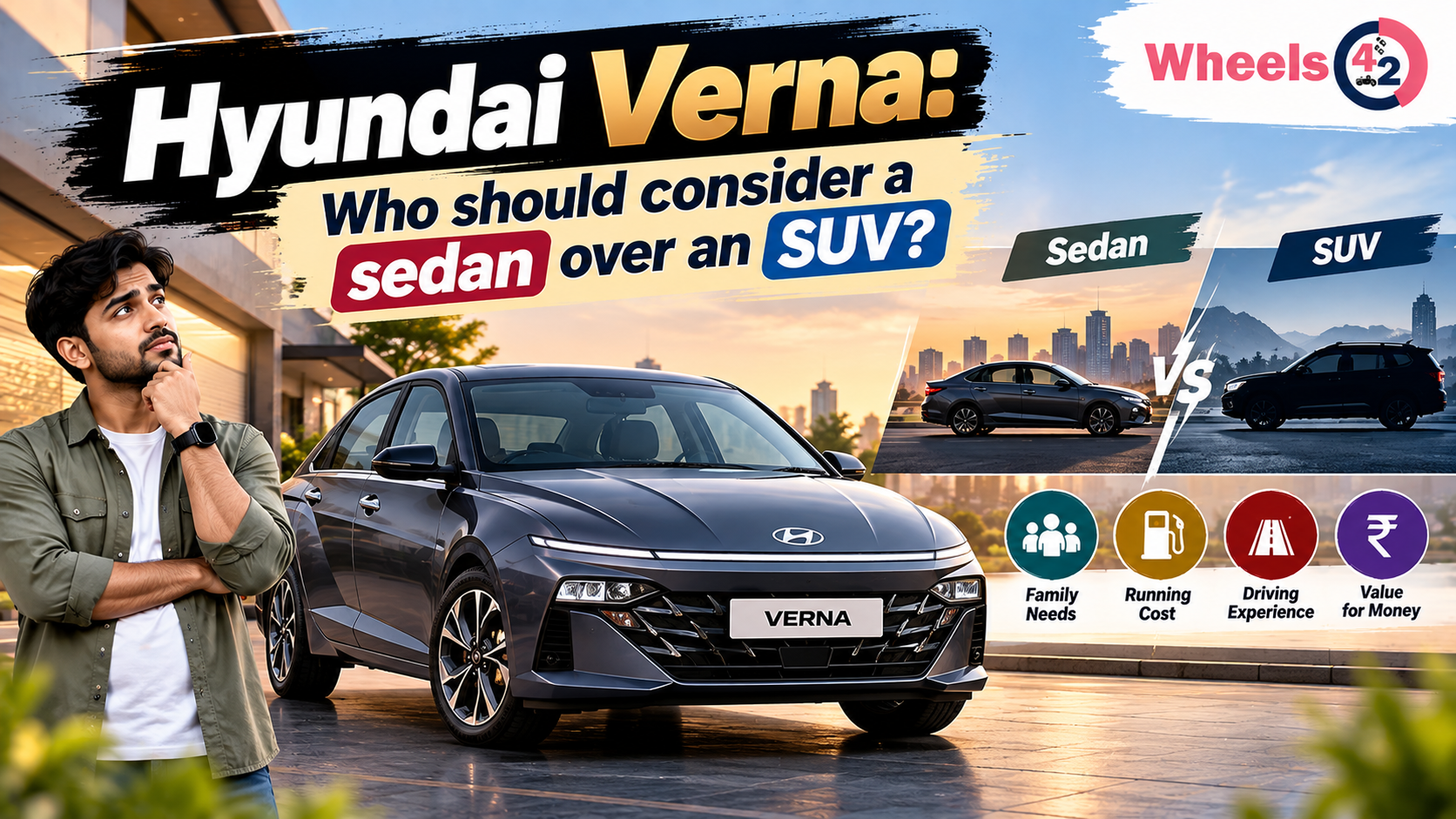



-90.avif)