 Khyati Sharma 2026-09-02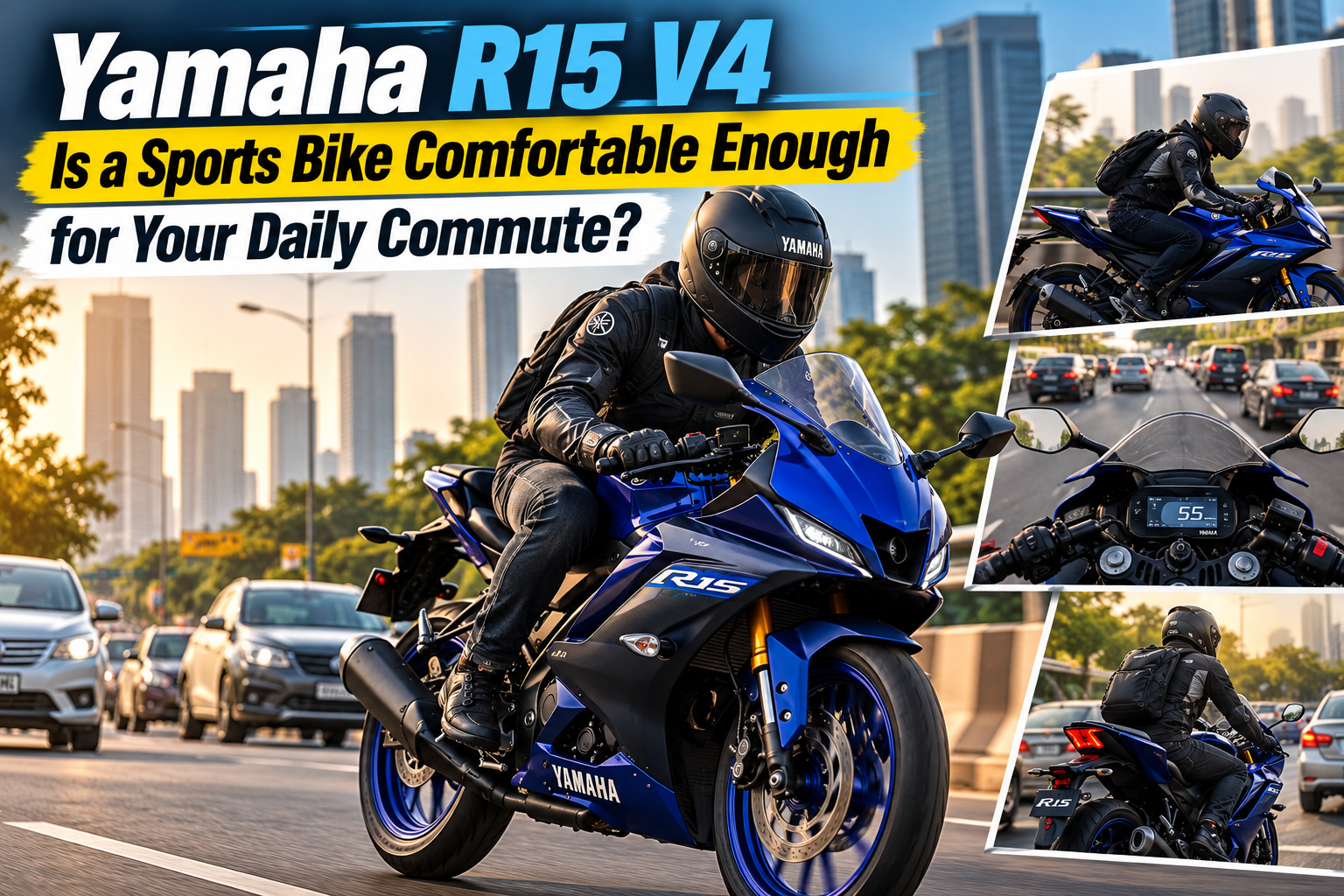
The Yamaha R15 V4 is one of the most recognisable entry-level sports motorcycles in India. Its sharp styling, fully-faired design, high-revving 155cc engine and sporty riding position make it look much closer to a track-focused motorcycle than a conventional commuter.
But looks are only one part of the equation.
For someone who plans to ride a motorcycle every day, the more important question is: Is the Yamaha R15 V4 actually comfortable enough for daily commuting?
The answer is yes — but with an important qualification. The R15 V4 can handle everyday city riding quite well, but its committed riding position means it is not as effortless as an upright motorcycle such as the Yamaha MT-15 v2.0 Riders who enjoy a sporty riding experience are likely to accept the compromise, while commuters looking purely for comfort may prefer a more relaxed motorcycle.
Unlike a typical commuter motorcycle, the R15 V4 has been designed around the idea of a lightweight sports bike.
It gets a 155cc liquid-cooled, single-cylinder engine with Variable Valve Actuation (VVA), a six-speed gearbox and an assist-and-slipper clutch. The engine produces around 18.4PS and 14.2Nm, giving the motorcycle considerably more performance-oriented character than a conventional 150cc commuter.
The motorcycle also uses a Deltabox frame and upside-down front forks. These components are primarily aimed at providing stability and sharper handling rather than simply making the ride soft and comfortable.
That difference becomes particularly noticeable when you use the R15 every day.
This is the biggest consideration before buying an R15 V4 for commuting.
The motorcycle uses clip-on handlebars positioned below the top triple clamp, while the footpegs are relatively rear-set. This creates a forward-leaning riding position that feels natural when cornering but places more weight on the rider's wrists and upper body. The seat height is around 815mm.
For a short city commute, most riders should be able to adapt to the riding position.
The problem becomes more noticeable when traffic is slow and congested.
During stop-and-go riding, you cannot always maintain the ideal sporty posture. Constantly balancing the motorcycle at low speeds while using the clutch and brakes can make the R15 feel more demanding than an upright street bike.
Therefore, if your daily commute is around 10-20km, the R15 can be perfectly manageable.
If you spend an hour or more every day in heavy traffic, the more aggressive ergonomics deserve serious consideration.
The R15 V4 is considerably more comfortable than the image of a hardcore supersport motorcycle might suggest, but it is still a sports bike.
The latest version has a slightly improved riding position and a slimmer seat area, but the basic ergonomics remain sporty. Long highway rides can place additional pressure on the wrists, neck and back.
There is a simple way to reduce some of this fatigue: avoid putting all your body weight on your hands.
The rider should support the body with the legs and core muscles and keep a relaxed grip on the handlebars. This makes a noticeable difference during longer rides.
However, no riding technique can completely change the fundamental character of the R15.
If you want an upright, relaxed riding position, the R15 is not the ideal choice.

The R15's engine might be sporty, but that does not mean it is difficult to use in the city.
The 155cc VVA engine has usable low- and mid-range performance, while its character becomes much more exciting as the revs rise.
This makes the motorcycle reasonably easy to ride in normal traffic.
The six-speed gearbox also gives the rider plenty of flexibility. You can keep the engine relaxed in higher gears when traffic opens up, while dropping down through the gearbox gives you stronger acceleration when required.
The engine's tractability is one reason why the R15 can work as a daily motorcycle despite its sporty positioning.
Fuel efficiency is another area where the R15 V4 makes sense as a daily motorcycle.
The motorcycle has an ARAI-certified mileage figure of around 51.4kmpl, while real-world figures naturally vary depending on traffic, riding style and road conditions. Autocar India's testing has recorded roughly 37kmpl in city conditions and close to 50kmpl on the highway.
This means the R15 does not necessarily have to become an expensive motorcycle to run simply because it is a sports bike.
A rider who keeps the engine within reasonable revs during normal commuting can achieve respectable fuel economy.
Of course, frequent high-rpm riding will increase fuel consumption.
This is where the R15 V4 makes up for its compromises.
Once traffic clears and the road becomes twisty, the motorcycle's sporty setup starts making much more sense.
The Deltabox frame, USD front fork, relatively light weight and sporty geometry allow the R15 to change direction quickly and hold a line confidently through corners. Autocar's road testing has particularly praised the motorcycle's handling and stability.
This is a major advantage for commuters who also enjoy weekend rides.
Instead of owning one motorcycle for commuting and another for occasional fun, the R15 can perform both roles reasonably well.
Yamaha R15: Is It Still a Good Sportbike for Young Riders?
The R15 V4 is not designed to float over broken roads like a traditional commuter.
Its suspension setup is focused on stability and handling, so sharp potholes, rough patches and badly broken surfaces can be felt more directly.
The 170mm ground clearance is adequate for normal Indian roads, but riders still need to be careful around large potholes and aggressive speed breakers.
On reasonably maintained city roads, however, the motorcycle remains manageable.
The important point is that buyers should not expect scooter-like comfort from the R15.
This is arguably the R15's biggest weakness as a practical daily motorcycle.
The pillion seat is relatively small and high-set, while the sporty design does not provide the same relaxed seating experience as a commuter or street motorcycle.
For occasional short rides, it is usable.
For carrying a passenger every day, particularly over longer distances, the R15 is not the most comfortable choice.
Therefore, if your motorcycle regularly carries two people, you should take the pillion along for a proper test ride before making a decision.
The R15 V4's sporty character is supported by a strong safety package.
It gets dual-channel ABS and traction control, while Yamaha bikes also equips it with an assist-and-slipper clutch. The traction-control system is designed to reduce the possibility of rear-wheel spin, which can be useful on slippery roads.
The upside-down front fork also improves front-end rigidity and stability during braking and cornering.
For everyday Indian riding, these features can provide an additional layer of confidence, particularly during wet-weather conditions.
Yes, but it is not effortless.
The R15 V4 has several qualities that make it suitable for regular commuting:
Compact dimensions
Relatively light weight
Smooth 155cc engine
Six-speed gearbox
Good fuel efficiency
Strong braking hardware
Dual-channel ABS
Traction control
Good handling
Excellent highway stability
Strong reliability and resale appeal
However, it also has compromises:
Aggressive riding posture
More wrist pressure
Limited pillion comfort
Sporty suspension setup
Less convenient in heavy traffic
Requires more physical involvement than an upright street bike
The decision therefore comes down to what you want from your commute.
If daily comfort is your biggest priority, an upright motorcycle makes more sense.
A motorcycle such as the Yamaha MT-15 provides a more relaxed riding position because of its wider handlebar and relatively more upright ergonomics. This makes it easier to manoeuvre through traffic and reduces pressure on the wrists and back.
The R15 V4, on the other hand, gives you a more engaging riding experience.
It feels more special when you take it onto a winding road, while its aerodynamic fairing and sporty chassis make it enjoyable at higher speeds.
So the choice is essentially:
|
Requirement |
|
|
City commuting |
Good |
|
Heavy traffic |
Average |
|
Short daily commute |
Very good |
|
Long highway rides |
Moderate |
|
Weekend rides |
Excellent |
|
Cornering |
Excellent |
|
Fuel efficiency |
Good |
|
Pillion comfort |
Average to poor |
|
Sporty experience |
Excellent |
|
Rider comfort |
Moderate |
|
Safety equipment |
Excellent |
The R15 V4 makes sense for a rider who wants one motorcycle that can commute during the week and provide an engaging riding experience on weekends.
It is particularly suitable for younger riders and enthusiasts who enjoy the feeling of riding a proper sports motorcycle but do not want the running costs or performance of a much larger motorcycle.
It is also a good option for someone who values handling and technology as much as outright comfort.
The motorcycle gets features such as Bluetooth connectivity, a digital instrument display, traction control and optional quickshifter equipment depending on the variant.


.avif)