
 Khyati Sharma 2026-10-21
Anti-lock Braking System (ABS) is one of the most important safety technologies found in modern cars, SUV cars, motorcycles and other vehicles. It helps prevent the wheels from locking up during hard braking, allowing drivers to maintain better steering control while slowing down.
However, a common belief among drivers is that ABS always reduces stopping distance, regardless of the road surface. Is this actually true?
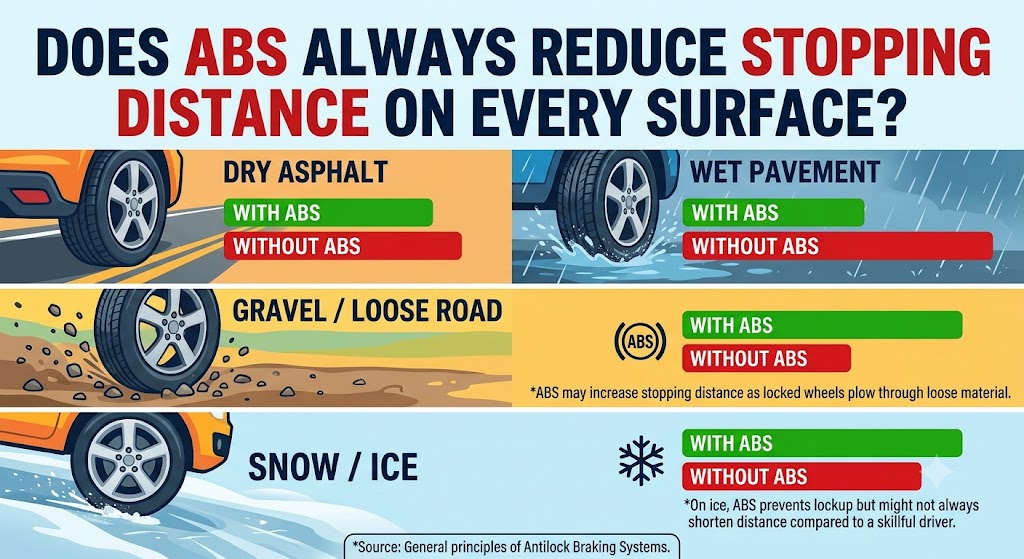
No, ABS does not always reduce stopping distance on every surface. Its primary purpose is to help prevent wheel lock and preserve steering control during hard braking. Depending on the road conditions, tyres, vehicle design and braking situation, ABS may shorten stopping distance, produce a similar result or sometimes result in a longer stopping distance than braking with locked wheels.
For example, ABS generally provides important benefits on paved roads, particularly when a driver must brake hard while steering around an obstacle. On loose gravel, deep snow or certain uneven surfaces, a locked wheel may sometimes build up material in front of the tyre, helping the vehicle stop in a shorter distance. ABS may prevent that effect.
Understanding this difference helps drivers use their brakes correctly and avoid depending entirely on electronic safety systems.
Company-Fitted vs Aftermarket Accessories: Which Is Better?
An Anti-lock Braking System is an electronic safety system designed to prevent the wheels from remaining locked during hard braking.
When a driver suddenly applies the brakes, the wheels may stop rotating even though the vehicle is still moving. This is known as wheel lock. A locked wheel can slide across the road, reducing the driver's ability to steer effectively.
ABS helps manage this situation using several components:
Wheel-speed sensors: Monitor how quickly each wheel rotates.
Electronic control unit: Processes information from the sensors and identifies potential wheel lock.
Hydraulic control unit: Adjusts brake pressure when necessary.
Brake system: Applies the braking force that slows the vehicle.
When the system detects that a wheel is about to lock, it can rapidly reduce and reapply braking pressure. This process may happen many times per second.
The driver may feel vibration or pulsing through the brake pedal during emergency braking. This can be normal ABS operation.
The main benefit is that the wheels can continue rotating rather than remaining completely locked, helping the driver retain steering control while braking.

No. ABS is not designed to guarantee the shortest possible stopping distance on every surface.
Its main objective is to help prevent wheel lock and maintain directional control during hard braking. The effect on stopping distance depends on the interaction between the tyres and the road.
On many paved surfaces, ABS can help a vehicle brake effectively while retaining the ability to steer. However, on some loose surfaces, locked wheels may push gravel, sand or snow into a small mound in front of the tyres. This can create additional resistance and sometimes shorten stopping distance.
Because ABS helps keep the wheels rotating, it may reduce this particular effect.
The result depends on the vehicle, the tyre design, the depth and consistency of the loose material, the speed and the way the brakes are applied. ABS performance should therefore not be judged by stopping distance alone.
Drivers should also consider steering control, stability and the ability to avoid an obstacle. A vehicle that stops slightly sooner but cannot be steered around a hazard may create a greater risk in an emergency.
New Car Booking Process Explained Step by Step
Road surfaces differ significantly in how much grip they provide. As a result, ABS may perform differently depending on the conditions.
Dry roads
On a dry, well-maintained road, ABS can help a driver apply strong braking force without allowing the wheels to remain locked.
The tyres generally have more available grip than they would on wet roads, although stopping distance still depends on speed, tyre condition, road quality and the braking system.
ABS is particularly useful when the driver needs to brake hard and steer around a vehicle, pedestrian or other obstacle.
It does not mean that every ABS-equipped vehicle will stop sooner than every vehicle without ABS. Differences in tyres, brakes and vehicle design remain important.
Wet roads
Wet roads reduce tyre grip, especially when water accumulates or the tyres cannot disperse it effectively.
ABS can help prevent wheel lock during hard braking and allow the driver to retain steering control. This is especially valuable when an obstacle appears suddenly.
However, ABS cannot eliminate the risk of skidding or aquaplaning. If the tyres lose contact with the road because of a layer of water, the system cannot create the missing grip.
Drivers should reduce speed, increase following distance and avoid abrupt manoeuvres in heavy rain.
Loose gravel and sand
Loose gravel and sand are examples of surfaces where ABS may sometimes produce a longer stopping distance.
When a wheel locks, it can push loose material ahead of the tyre, forming a small mound that increases resistance. A rotating wheel controlled by ABS may not create the same effect.
This does not mean drivers should deliberately lock their wheels on gravel or disable ABS without a specific reason. Maintaining steering control can be more important than achieving the shortest possible stopping distance, especially if the road curves or obstacles are present.
Drivers should follow the vehicle manufacturer's guidance for loose-surface driving.
Snow and ice
Snow and ice provide limited grip, making braking and steering more difficult.
On compacted snow or icy pavement, ABS can help reduce wheel lock and preserve steering control. However, stopping distances may still be much longer than on dry roads.
In certain deep or loose snow conditions, a locked wheel may build up snow in front of it and stop in a shorter distance. ABS may not produce the same effect.
Winter tyres, where appropriate, can improve grip. Drivers should also maintain low speeds and leave much greater distances between vehicles.
Uneven roads
On rough or uneven surfaces, wheels can briefly lose contact with the road. This can affect braking and may cause ABS to adjust brake pressure.
The performance of the system depends on the vehicle's suspension, tyre contact, surface conditions and the ABS calibration.
Drivers should not assume that ABS will compensate for potholes, loose stones or sudden changes in road level.
|
Road Surface |
How ABS Can Help |
Possible Effect on Stopping Distance |
|
Dry pavement |
Helps prevent wheel lock and preserve steering |
Often effective; the distance depends on tyres and conditions |
|
Wet pavement |
Helps maintain steering control during hard braking |
May help, but cannot overcome reduced grip |
|
Loose gravel |
Helps prevent sustained wheel lock |
Can sometimes increase stopping distance compared with locked-wheel braking |
|
Sand |
Helps manage wheel lock |
A locked wheel may build up sand and stop sooner in some situations |
|
Compacted snow |
Helps maintain steering control |
Depends on snow condition, tyres and speed |
|
Deep or loose snow |
Helps prevent sustained wheel lock |
May be longer if locked wheels build up snow |
|
Ice |
Helps preserve some steering ability |
Stopping distance can remain very long because grip is limited |
|
Uneven roads |
Adjusts braking to reduce wheel lock |
Depends on wheel contact and surface conditions |
Imagine that you are travelling on a wet road when a car suddenly stops ahead of you.
You immediately press the brake pedal. If your wheels lock, the tyres may slide instead of rolling, making it difficult to steer around the stopped vehicle.
With ABS, the system can regulate braking pressure to help keep the wheels rotating. This gives you a better opportunity to steer around the obstacle while slowing down, provided the tyres still have sufficient grip.
This is one of the most important benefits of ABS.
A short stopping distance is useful, but it is not the only measure of braking safety. The driver also needs to maintain control, avoid skidding and respond to changing road conditions.
ABS cannot guarantee that a collision will be avoided. The vehicle may still travel too far before stopping, particularly at high speeds or on ice.
Manual vs Automatic Car: Pros and Cons Explained
The basic purpose of ABS is similar in cars and motorcycles: prevent sustained wheel lock during hard braking and help maintain control.
However, the systems differ according to vehicle design.
Cars typically use ABS to manage braking at all four wheels. Motorcycles may have two-channel ABS that independently manages the front and rear brakes, while some models have more advanced cornering ABS that can also consider lean angle.
Motorcycle ABS is particularly valuable because a locked front wheel can cause a serious loss of balance. Nevertheless, ABS cannot overcome the limits of tyre grip or eliminate every risk during emergency braking.
Riders should use smooth, controlled braking, maintain suitable speeds and practise emergency stops in a safe training environment.
Myth 1: ABS always stops a vehicle in a shorter distance.
Reality: ABS does not guarantee the shortest stopping distance on every surface. Loose gravel and certain snow conditions can produce different results.
Myth 2: ABS prevents every skid.
Reality: ABS helps prevent sustained wheel lock during braking, but it cannot eliminate all skids or loss of traction.
Myth 3: Drivers should pump the brake pedal when ABS activates.
Reality: In an ABS-equipped vehicle, apply firm, continuous pressure during emergency braking and allow the system to regulate brake pressure. Follow the owner's manual for vehicle-specific guidance.
Myth 4: ABS makes it safe to drive faster in rain.
Reality: Wet roads reduce available grip. ABS is not a reason to increase speed or follow other vehicles closely.
Myth 5: ABS means tyres are less important.
Reality: Tyres remain essential. Worn, damaged or unsuitable tyres can seriously affect braking performance, even when ABS is fitted.
Drivers can get the most benefit from ABS by following a few basic safety practices.
Maintain tyres at the recommended pressure and replace worn tyres.
Keep a safe following distance, especially on wet, icy or loose surfaces.
Reduce speed before sharp turns, steep descents and slippery sections.
In an emergency, press the brake pedal firmly and continuously rather than pumping it.
Continue steering carefully to avoid obstacles if there is sufficient space.
Do not assume ABS will compensate for excessive speed or poor road conditions.
Have the braking system inspected if the ABS warning light remains illuminated after the normal start-up check.
If the ABS warning light stays on, the conventional braking system may still work, but the anti-lock function may be unavailable. Have the vehicle inspected promptly and follow the manufacturer's safety instructions.
Conclusion
ABS is an important vehicle safety technology, but the claim that it always reduces stopping distance on every surface is incorrect.
On paved roads, ABS can help drivers brake hard while maintaining better steering control. On loose gravel, sand or certain snow-covered surfaces, locked wheels may sometimes stop a vehicle sooner by building up material in front of the tyres.
However, the shortest stopping distance is not the only measure of safety. The ability to steer, maintain stability and avoid an obstacle can be equally important.
For safer driving, maintain your tyres and brakes, reduce speed when grip is limited, leave sufficient space and understand how your vehicle's braking system operates. ABS is a valuable safety aid, but careful driving remains essential on every road surface.









Mahindra
₹11.39 - 14.95 Lakh
Kia Cars
₹11.02 Lakh