Khyati Sharma 2026-10-04
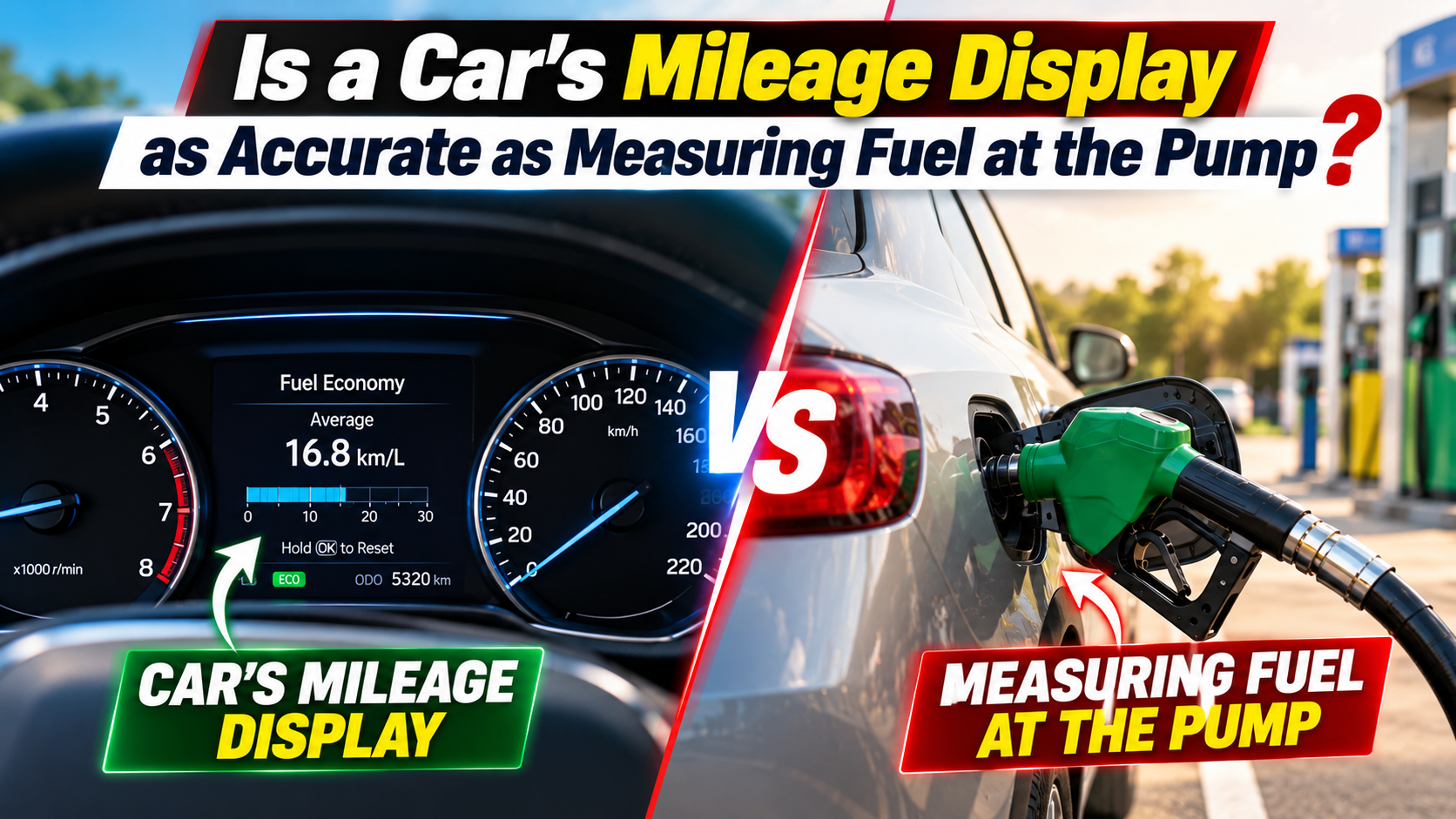
Modern cars come with digital displays that show fuel economy, average mileage, distance to empty and other useful driving information. These features help drivers understand how efficiently their vehicles are running. However, many motorists assume that the mileage shown on the dashboard is just as accurate as calculating fuel consumption using the actual amount of fuel purchased at a petrol pump.
The reality is different. A car’s mileage display is useful for tracking fuel efficiency, but it is not always as accurate as a calculation based on fuel consumed and distance travelled. Dashboard readings are estimates generated by the vehicle’s electronic systems. Their accuracy depends on the sensors, calculations and software used by the manufacturer.
Calculating mileage manually using the distance travelled and fuel consumed over several refills can provide a more realistic picture of a car’s long-term fuel economy. However, even this method has limitations if the fuel tank is not filled consistently or the distance and fuel measurements are inaccurate.
In this article, we explain how a car’s mileage display works, why its readings can differ from real-world fuel economy, how to calculate mileage at the petrol pump and which method drivers should trust.
How to Compare Car Variants: Base vs Mid vs Top Trim
A car’s mileage display typically shows one or more fuel-economy measurements. Depending on the vehicle, these may include instant fuel economy, average fuel economy and estimated driving range.
1. Instant Fuel Economy
Instant fuel economy shows how efficiently the vehicle is using fuel at a particular moment. It may change rapidly when the driver accelerates, brakes, travels uphill or maintains a steady speed.
For example, a car may show excellent mileage while moving downhill with the accelerator released. During acceleration, the displayed figure may drop because the engine needs more fuel to increase speed.
Instant readings are useful for understanding driving behaviour, but they should not be treated as a reliable measure of the car’s overall mileage.
2. Average Fuel Economy
Average fuel economy estimates how much distance the vehicle travels for a given amount of fuel over a selected period or distance.
In India, this is commonly displayed in kilometres per litre (km/l).
For example, if a dashboard shows an average of 16 km/l, it estimates that the vehicle has travelled approximately 16 kilometres for every litre of fuel consumed during the measurement period.
The result depends on how the vehicle calculates fuel consumption and when the average was last reset. A reading calculated over a short city drive may differ significantly from one calculated over a longer highway journey.
3. Distance to Empty
Distance to empty estimates how far the vehicle can travel with the fuel remaining in its tank.
This is not a direct measurement of fuel economy. The system generally uses the estimated remaining fuel and recent fuel-consumption patterns to predict the remaining range.
If driving conditions change, the estimated distance can rise or fall. For example, heavy traffic, steep climbs or higher speeds may reduce the remaining range faster than expected.

A modern car uses information from several electronic systems to estimate fuel economy. Depending on the vehicle, the engine control unit may use fuel-injection data, engine operating conditions, vehicle speed and other inputs.
The system estimates how much fuel the engine consumes and compares that figure with the distance travelled. It then calculates and displays the average fuel economy.
However, the displayed figure is still an estimate. It does not necessarily involve directly measuring every drop of fuel entering the engine.
The calculation can be affected by the accuracy of fuel-consumption estimates, distance measurements, calibration and software. Different manufacturers may use different methods, so two cars can display slightly different results even under similar driving conditions.
In petrol and diesel vehicles, fuel-injection information can be used to estimate fuel consumption. Hybrid vehicles have more complex energy-management systems because they can combine an internal-combustion engine with electric propulsion.
Electric vehicles generally display energy efficiency, such as kilometres per kilowatt-hour (km/kWh), rather than petrol or diesel mileage.
New Car Dealer Negotiation Tips That Actually Work
There are several reasons why the mileage shown on the dashboard may not match the result obtained from fuel purchases.
1. The Display Uses Estimates
The dashboard relies on calculations and vehicle data rather than necessarily measuring the exact volume of fuel consumed.
Small errors in estimating fuel use or distance can affect the final reading. The amount of variation differs between models, and there is no single percentage that applies to every car.
2. Driving Conditions Keep Changing
Fuel economy changes according to road conditions, traffic, speed, temperature, air-conditioning use and driving style.
For example, a vehicle may display an average of 18 km/l after a highway journey but deliver a lower average during repeated short trips in congested city traffic.
If the driver resets the average mileage frequently, the display may reflect only a small part of the vehicle’s overall usage.
3. The Average May Not Have Been Reset
Some drivers forget to reset the trip computer after refuelling. Others reset it after every journey.
Both approaches can produce different readings because the dashboard may be calculating fuel economy over different periods.
For a meaningful comparison, the driver should understand which average is being displayed and the period over which it has been calculated.
4. Fuel Tank Filling Can Vary
The manual fuel-pump method also has limitations. The amount of fuel dispensed before the pump automatically stops can vary slightly because of the pump's shut-off mechanism, the angle of the vehicle and the way the tank is filled.
Topping up repeatedly after the automatic shut-off is not recommended. It can create inconsistent measurements and may cause fuel spillage or damage to the vehicle's evaporative-emissions system.
5. Vehicle Modifications and Tyre Changes
Changes to tyre size, wheel specifications or other components can affect distance calculations if they differ from the manufacturer's intended configuration.
Incorrect tyre pressure, poor maintenance and wheel-alignment issues can also change actual fuel consumption, although they do not necessarily cause the dashboard itself to calculate incorrectly.
|
Factor |
Dashboard Mileage Display |
Fuel-Pump Calculation |
|
How it works |
Estimates fuel economy using vehicle data |
Divides distance travelled by fuel consumed |
|
Convenience |
Very convenient; available while driving |
Requires records of distance and refuelling |
|
Short-trip monitoring |
Useful for observing changes |
Difficult to measure accurately over very short distances |
|
Long-term average |
Useful if measured over a consistent period |
Useful when calculated across several refills |
|
Main limitation |
Depends on the vehicle's estimation and calibration |
Depends on accurate distance and fuel measurements |
|
Best use |
Monitoring driving efficiency and trends |
Checking real-world fuel economy over time |
You can estimate your vehicle’s real-world fuel economy with a simple formula.
Mileage (km/l) = Distance travelled (km) ÷ Fuel consumed (litres)
Follow these steps for a more consistent result.
Step 1: Fill the tank consistently. Refuel at a suitable station and stop when the pump automatically shuts off. Avoid repeatedly topping up.
Step 2: Reset the trip meter. Record the odometer reading or reset the trip meter to zero.
Step 3: Drive normally. Use the vehicle as you usually would. A longer measurement period generally provides a more meaningful estimate.
Step 4: Refuel again. At the next refill, use the same automatic shut-off approach and note the litres dispensed.
Step 5: Calculate the mileage. Divide the distance travelled since the previous refill by the litres required to refill the tank to a comparable level.
How to Compare Car Variants: Base vs Mid vs Top Trim
Example Calculation
Suppose a car travels 450 km between two comparable full-tank refills. At the second refill, the pump dispenses 30 litres.
The calculation is:
450 ÷ 30 = 15 km/l
The estimated real-world fuel economy for that interval is 15 km/l.
If the dashboard shows 16 km/l for the same period, the difference is approximately 1 km/l. This does not automatically mean the dashboard is faulty; the result may reflect estimation differences or variation in refuelling conditions.
For a better estimate, repeat the calculation across several refills and compare the overall distance with the total fuel consumed.
If you want to know how closely your car's display matches its real-world fuel economy, use the same measurement period as far as possible.
Reset the trip meter and the average fuel-economy display at the beginning of a refuelling interval.
Drive normally until the next refill.
Record the distance travelled and the dashboard's average mileage.
Refill using a consistent method and record the litres dispensed.
Calculate the pump-based mileage.
Repeat this process over several refuelling intervals.
Remember that the dashboard average and the fuel-pump calculation may cover slightly different periods or fuel quantities. Small differences are therefore not necessarily evidence of a malfunction.
Avoid judging the accuracy of the display using only one tank or a very short trip.

For everyday driving, the dashboard display is a convenient way to observe how driving conditions affect fuel economy. It can help you notice whether aggressive acceleration, heavy traffic or high-speed driving is reducing efficiency.
For long-term fuel-economy tracking, a consistent calculation based on distance travelled and fuel consumed is a useful independent check. Recording multiple refills reduces the influence of small variations in individual measurements.
If the dashboard consistently shows unusually high or low mileage compared with carefully recorded results, consult the owner's manual or ask an authorised service centre to check the vehicle's systems.
A sudden change in actual fuel consumption may also indicate a maintenance issue, tyre-pressure problem, fuel leak or other mechanical concern. If you notice a strong fuel smell or suspect a leak, stop driving when safe and seek professional assistance.
Manual vs Automatic Car: Pros and Cons Explained
Use the same refuelling method each time.
Stop at the pump's automatic shut-off rather than repeatedly topping up.
Record the odometer reading and litres purchased.
Calculate mileage over several refills instead of one short interval.
Reset the trip computer consistently if you want to compare its reading with the manual calculation.
Keep tyre pressures at the manufacturer's recommended levels.
Maintain the vehicle according to its service schedule.
Compare results under broadly similar driving conditions when possible.
These steps will not eliminate every measurement error, but they can make your results more consistent and useful.
A car's mileage display is a useful estimate, but it should not automatically be considered as accurate as a carefully calculated fuel-economy figure.
The dashboard uses electronic data and software to estimate fuel consumption, while the petrol-pump method calculates mileage from distance travelled and fuel used. The pump method is not perfect either, because refuelling levels and measurement conditions can vary.
The best approach is to use the dashboard for everyday monitoring and calculate fuel economy across several refuelling intervals for a more realistic long-term estimate.
A small difference between the two readings is not necessarily a problem. Consistent measurement, sensible driving habits and regular vehicle maintenance are more valuable than focusing on a single mileage figure.
1. Is dashboard mileage always correct?
No. Dashboard mileage is an estimate based on vehicle data and calculations. Its accuracy varies by model, calibration and driving conditions.
2. How can I check my car's actual mileage?
Record the distance travelled between comparable refills, note the fuel consumed and divide the distance by the litres used. Repeat the calculation across several refills for a more reliable average.
3. Why does my car show better mileage on the highway?
Highway driving often involves steadier speeds and fewer stops than congested city driving. However, very high speeds, hills and heavy loads can reduce highway fuel economy.
4. Should I reset the average mileage display after refuelling?
Resetting it after refuelling can help you monitor fuel economy over a defined period. Follow your vehicle's instructions and use the same approach when comparing readings.
5. Can a wrong dashboard mileage reading indicate a problem?
A difference alone does not prove a fault. However, a sudden or persistent unexplained change in actual fuel consumption should be investigated, particularly if accompanied by warning lights or other unusual symptoms.