




 Khyati Sharma 2026-09-30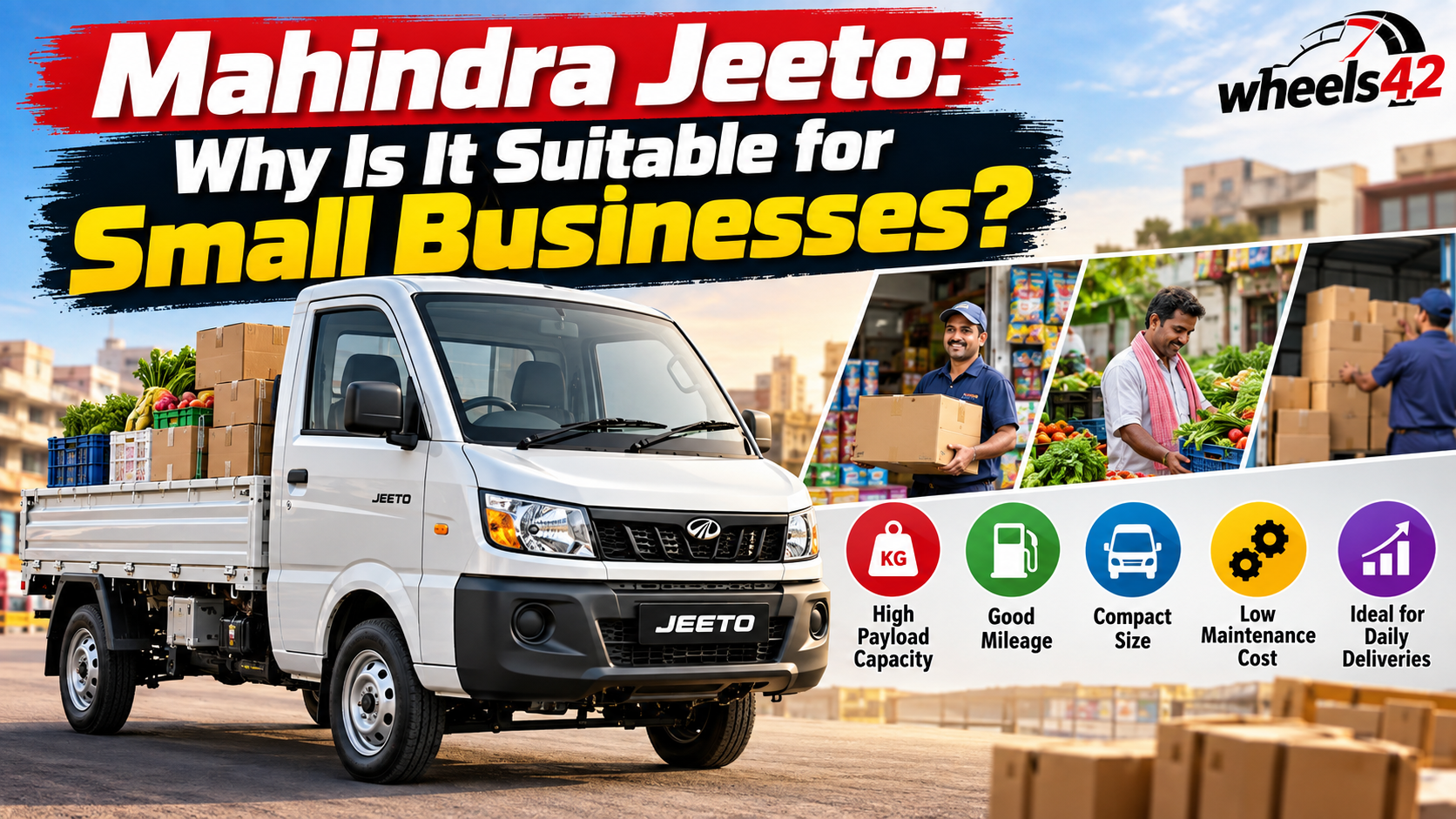
Mahindra Jeeto has become a familiar name in India's small commercial vehicle market, particularly for businesses that depend on regular last-mile transportation. Its compact dimensions, multiple fuel options and useful payload capacity make it suitable for applications ranging from grocery distribution and FMCG deliveries to agricultural produce and local goods transportation.
For small businesses, buying a commercial vehicle is not simply about the purchase price. Fuel consumption, payload, manoeuvrability, maintenance, uptime and the ability to complete more deliveries in a day can have a direct effect on operating costs.
The Jeeto range is designed around these requirements, with different petrol, diesel and CNG configurations available depending on the application. Mahindra's current cargo-vehicle information lists payload capacities across the Jeeto range from around 715 kg to 815 kg, while the Jeeto Strong diesel and CNG versions are rated at 815 kg and 750 kg, respectively.
Small businesses often operate in environments where a full-size commercial truck can be inconvenient. Narrow streets, congested markets, short delivery routes and frequent loading and unloading require a vehicle that is relatively easy to manoeuvre.
The Jeeto's compact commercial-vehicle format is intended for exactly these types of operations. Mahindra highlights its manoeuvrability and suitability for narrow lanes, while the vehicle's cargo deck provides space for regular last-mile transportation.
|
Specification |
Mahindra Jeeto / Jeeto Plus |
Jeeto Strong Diesel |
Jeeto Strong CNG |
|
Vehicle type |
Small cargo vehicle |
Small cargo vehicle |
Small cargo vehicle |
|
Payload |
Up to 715 kg* |
Up to 815 kg |
Up to 750 kg |
|
Cargo box length |
2,257 mm |
2,257 mm |
2,257 mm |
|
Wheelbase |
Up to 2,500 mm |
2,500 mm |
2,500 mm |
|
Fuel |
Petrol/Diesel/CNG depending on variant |
Diesel |
CNG |
|
Claimed mileage |
21.2 km/l* |
32 km/l* |
35 km/kg* |
|
Warranty |
Up to 3 years/72,000 km |
3 years/72,000 km |
3 years/72,000 km |
For a small retailer or distributor, making multiple trips to deliver the same quantity of goods can increase fuel consumption, driver time and vehicle running costs.
The Jeeto Strong diesel offers a payload capacity of up to 815 kg, while the CNG version offers up to 750 kg. Mahindra says this represents an increase of 100 kg over the previous Jeeto Plus diesel and CNG models.
That additional capacity can be useful for businesses transporting:
However, businesses should always operate within the vehicle's legally specified payload limits rather than treating the maximum figure as a target for every journey.
Fuel is one of the biggest recurring expenses for a commercial vehicle.
Mahindra quotes 32 km/l for the Jeeto Strong diesel and 35 km/kg for the Jeeto Strong CNG under the applicable certification conditions.
The petrol-powered Jeeto Plus listed by Mahindra's commercial-vehicle network has a claimed mileage figure of 21.2 km/l.
The actual result for a business will depend on factors such as:
For businesses covering high daily kilometres, even a relatively small difference in fuel consumption can become significant over a year.
A delivery vehicle used by a small business may spend much of its working day in congested areas rather than on highways.
The Jeeto is designed as a compact cargo vehicle, and Mahindra specifically highlights its steering control and manoeuvrability for narrow lanes.
This can be particularly useful for:
Local grocery distributors: Delivering stock to neighbourhood stores.
Fruits and vegetable suppliers: Reaching local markets and retail outlets.
Courier and parcel businesses: Moving packages between hubs and customers.
Small manufacturers: Transporting components or finished products between workshops and customers.
One of the notable aspects of the Jeeto family is the availability of different powertrain choices.
The range includes petrol, diesel and CNG configurations, depending on the particular model and variant.
This matters because business requirements differ.
A petrol model can make sense for operators who need a relatively simple vehicle for shorter urban operations, while diesel can be relevant for businesses prioritising payload and long-distance running. CNG, meanwhile, can be attractive to operators whose routes and local fuel infrastructure make CNG practical.
The right choice therefore depends on the business's daily route rather than simply choosing the variant with the highest claimed mileage.
Mahindra lists a 2,257-mm cargo box on its Jeeto cargo vehicles.
For small businesses, cargo-area usability can be just as important as engine output.
A practical cargo deck can help operators organise goods for:
Businesses should nevertheless consider the dimensions and weight of their typical goods before purchasing.
Commercial vehicles generally accumulate kilometres much faster than private cars, making warranty coverage an important consideration.
Mahindra says the Jeeto Strong comes with a 3-year/72,000-km warranty.
For a small-business owner, warranty coverage can provide a defined period of manufacturer support, although the exact terms, exclusions and service requirements should be checked with Mahindra before purchase.
Small commercial vehicles are working vehicles, but driver comfort can still influence productivity.
Mahindra's Jeeto Plus Diesel information highlights a cabin designed with additional headroom and legroom, along with steering control intended to make the vehicle easier to operate in tight spaces.
The Jeeto Strong also introduced an all-new digital cluster, while Mahindra highlighted an electric vacuum pump-assisted braking system on the Strong models.
These features are not simply about appearance. For vehicles that may be driven for several hours every day, visibility of important information and ease of operation can contribute to day-to-day usability.
|
Business Type |
Why a Jeeto Can Be Useful |
|
Grocery distribution |
Regular shop-to-shop deliveries |
|
Fruits & vegetables |
Local market transportation |
|
FMCG distribution |
Frequent short-distance deliveries |
|
Courier/logistics |
Last-mile parcel movement |
|
Dairy businesses |
Local distribution routes |
|
Hardware stores |
Transporting smaller loads |
|
Agricultural businesses |
Moving produce to nearby markets |
|
Small manufacturers |
Workshop-to-customer transportation |
|
E-commerce suppliers |
Local delivery operations |
|
Retail businesses |
Stock movement between locations |
|
Business Requirement |
How Jeeto Addresses It |
|
Carrying goods |
Up to 815-kg payload depending on variant |
|
Daily fuel costs |
Petrol, diesel and CNG choices |
|
Narrow roads |
Compact format and manoeuvrability |
|
Frequent deliveries |
Cargo-focused design |
|
Business uptime |
Commercial-oriented construction and warranty |
|
Local transportation |
Designed for last-mile cargo applications |
|
Different operating patterns |
Multiple variants and fuel choices |
Despite its practical focus, the Jeeto will not automatically be the right vehicle for every business.
Before purchasing, owners should calculate their actual requirements.
Check your average payload
If your business normally carries 300–500 kg, there may be little reason to select a higher-capacity configuration purely because it has a larger payload rating.
Calculate daily kilometres
A vehicle travelling 100 km every day will have very different running-cost requirements from one travelling only 20–30 km.
Check local fuel availability
CNG can be attractive where refuelling infrastructure is convenient. If CNG stations are not available along the regular route, the operational calculation changes.
Consider road conditions
Businesses operating on rough rural roads should examine ground clearance, suspension, tyre specifications and service availability before making a decision.
Compare the total cost of ownership
Purchase price is only one part of the calculation. Owners should also consider:
The Jeeto's strongest use case is the small business that needs a dedicated cargo vehicle for regular local or last-mile transportation.
Its combination of compact dimensions, cargo capacity and multiple fuel choices allows businesses to select a configuration around their operating pattern. The Jeeto Strong versions, in particular, add higher payload capacity, while Mahindra's claimed mileage figures are aimed at keeping running costs under control.
For an entrepreneur starting a delivery operation, a retailer expanding distribution or a local transporter replacing a smaller cargo vehicle, the important question is not simply how much the Jeeto can carry. It is whether its capacity, fuel economy and operating characteristics match the business's daily route.
Final Takeaway
Mahindra Jeeto is built around a straightforward commercial-vehicle proposition: carry useful loads, navigate local roads and keep operating costs manageable.
Its payload capacity of up to 815 kg in the Jeeto Strong diesel, claimed fuel-efficiency figures of up to 32 km/l for diesel and 35 km/kg for CNG, compact format and multiple fuel choices make the range relevant to several small-business applications.
For prospective buyers, however, the best variant depends on the actual load, distance, fuel availability and type of business rather than the headline specifications alone