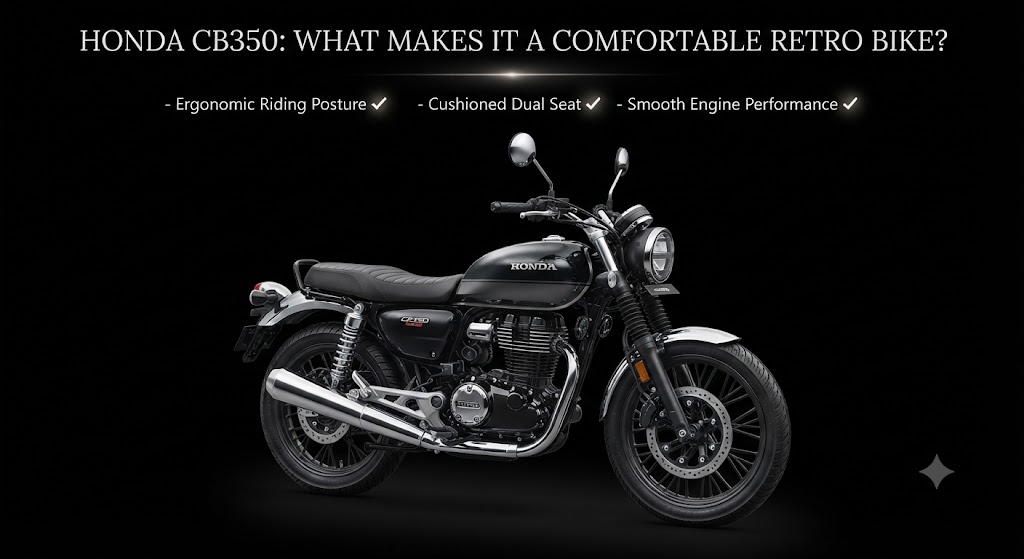
Retro motorcycles have become increasingly popular among Indian riders who want classic styling without giving up modern-day usability. The Honda CB350 is designed around this idea, combining a traditional motorcycle appearance with modern features, a refined engine and a relaxed riding position.
While its chrome-heavy styling and round headlamp give it a distinctly old-school character, the CB350 is built to work as a practical motorcycle for daily commuting as well as longer weekend rides.
So, what exactly makes the Honda CB350 comfortable? The answer comes from a combination of its riding posture, seat design, engine refinement, clutch operation, suspension setup and overall road manners.
Honda CB350: Key Specifications
|
Specification
|
Honda CB350
|
|
Engine
|
348.36cc, air-cooled, single-cylinder
|
|
Maximum Power
|
21.1 PS
|
|
Maximum Torque
|
30 Nm
|
|
Gearbox
|
5-speed
|
|
Seat Height
|
800 mm
|
|
Fuel Tank Capacity
|
15.2 litres
|
|
Front Suspension
|
Telescopic
|
|
Rear Suspension
|
Twin shock absorbers
|
|
Brakes
|
Disc brakes with dual-channel ABS
|
|
Traction Control
|
Honda Selectable Torque Control
|
|
Lighting
|
Full LED
|
|
Clutch
|
Assist & slipper clutch
|
|
Instrument Cluster
|
Semi-digital
|
|
Riding Position
|
Upright and relaxed
|
1. Upright Riding Position Makes a Difference
One of the biggest reasons behind the CB350's comfort is its riding position.
Instead of putting the rider in an aggressive forward-leaning posture, the motorcycle offers a relatively upright and relaxed riding position. The handlebar is positioned so that the rider does not need to stretch excessively, while the footpegs have a fairly neutral placement.
This makes the motorcycle suitable for riders who spend a significant amount of time commuting through city traffic.
The riding position can also work well during highway rides because the rider isn't constantly putting weight on the wrists.
2. Wide Seat Adds to Everyday Comfort
The CB350 uses a broad seat designed for both rider and pillion.
A wider seating area gives the rider more room to adjust their position, which can be useful during longer journeys. The rear portion also provides reasonable space for a passenger.
For daily commuting, this is important because comfort isn't determined only by suspension. The shape and width of the seat can have a major effect on how tiring a motorcycle feels after an extended ride.
Honda's current product information specifically highlights the CB350's split-seat design as being focused on rider and pillion comfort.
3. 800mm Seat Height Is Manageable for Many Riders
The Honda CB350 has an approximately 800mm seat height.
That places it in a range that many average-height riders can manage without excessive difficulty. Being able to put at least one foot securely down at a stop can make a noticeable difference in city traffic.
The motorcycle's proportions also give it a substantial road presence without making the riding position excessively tall.
However, seat height is only one part of overall ergonomics. Rider height, inseam length and riding experience all affect how comfortable a motorcycle feels.
4. Refined 348cc Engine Helps Reduce Fatigue
The CB350 uses a 348.36cc air-cooled single-cylinder engine producing approximately 21.1 PS and 30 Nm.
Rather than being tuned purely for outright performance, the engine focuses strongly on usable torque and smooth everyday performance.
The motor's refinement is particularly relevant to comfort. Excessive vibration through the handlebar, footpegs or seat can become tiring during longer rides.
Recent road-test coverage has noted the CB350's refined engine character and relatively low vibration levels, making it suitable for both urban use and highway cruising.
5. Assist and Slipper Clutch Helps in Traffic
Stop-and-go traffic can be one of the most tiring parts of riding a motorcycle.
The CB350 gets an assist and slipper clutch, which reduces the effort required at the clutch lever.
This can be particularly useful during:
- Traffic jams
- Frequent gear changes
- Slow-moving city roads
- Long commutes
- U-turns and congested intersections
The slipper function also helps reduce rear-wheel locking during aggressive downshifts.
For a motorcycle intended to combine retro character with everyday usability, the lighter clutch operation is an important practical feature.
6. Suspension Is Designed for Everyday Roads
The Honda CB350 uses a telescopic front fork and twin rear shock absorbers.
The suspension setup is aimed at providing a balance between stability and comfort rather than creating an extremely soft or sporty motorcycle.
On ordinary urban roads, the setup can absorb many road imperfections while maintaining composure at higher speeds.
However, the CB350 isn't designed to feel completely plush over every broken surface. Road-test feedback indicates that the ride can feel somewhat firm at lower speeds, particularly on rougher roads.
This means the CB350's comfort is better described as balanced and composed rather than exceptionally soft.
7. Stable Highway Behaviour
A comfortable motorcycle isn't only about how it performs at 30-40 km/h.
The CB350's relatively relaxed ergonomics and planted road manners make it suitable for highway riding as well.
The motorcycle can maintain cruising speeds without requiring the rider to adopt an aggressive posture. Its stable character also helps make longer journeys less demanding.
This makes the CB350 interesting for riders who want one motorcycle for both weekday commuting and occasional touring.
8. Traction Control Adds Confidence
Honda equips the CB350 with Honda Selectable Torque Control (HSTC).
The system monitors rear-wheel slip and can intervene by adjusting torque delivery when it detects a loss of traction.
This feature can be useful on:
- Wet roads
- Loose surfaces
- Gravel
- Slippery intersections
- Sudden throttle inputs
Traction control does not replace careful riding, but it adds another layer of electronic assistance.
9. Dual-Channel ABS Supports Safer Braking
The CB350 also gets dual-channel ABS.
The system helps prevent wheel lock during hard braking, particularly when road grip is compromised.
For everyday riding, this is an important safety feature because Indian roads can present unpredictable conditions, including wet patches, loose gravel and sudden obstacles.
The combination of ABS and traction control gives the CB350 a more modern safety package than its retro styling might initially suggest.
10. Retro Design Without Sacrificing Modern Features
The CB350 looks like a classic motorcycle, but its equipment is considerably more modern.
Depending on the current variant, the motorcycle offers features such as:
- Full LED lighting
- Honda RoadSync connectivity
- Smartphone integration
- Navigation functions
- Call and message alerts
- Semi-digital instrument display
- USB charging
- HSTC traction control
- Dual-channel ABS
This combination allows the CB350 to maintain its classic visual identity while remaining relevant to modern riders.
Comfort Features at a Glance
|
Comfort Element
|
Benefit
|
|
Upright riding posture
|
Reduces strain during everyday riding
|
|
Wide seat
|
Provides more room for rider and pillion
|
|
800mm seat height
|
Manageable for many riders
|
|
Assist & slipper clutch
|
Reduces clutch effort in traffic
|
|
Refined engine
|
Helps reduce vibration-related fatigue
|
|
Twin rear shocks
|
Balanced ride quality
|
|
Stable chassis
|
Adds confidence at highway speeds
|
|
Traction control
|
Helps manage rear-wheel slip
|
|
Dual-channel ABS
|
Supports controlled braking
|
|
Large fuel tank
|
Useful for longer rides
|
Is the Honda CB350 Comfortable for Long Rides?
The CB350 can work well for long rides, particularly for riders who prefer an upright riding position.
Its broad seat, neutral ergonomics, refined engine and stable handling make it a reasonable option for weekend touring.
However, no motorcycle is equally comfortable for every rider. Seat shape, rider height, body proportions and personal riding preferences can significantly affect long-distance comfort.
For particularly long journeys, taking breaks remains important even if the motorcycle itself feels comfortable.
Is It Comfortable in City Traffic?
The CB350's characteristics also make it suitable for urban use.
The upright riding posture provides good visibility, while the assist and slipper clutch helps reduce hand fatigue during repeated clutch operation.
The motorcycle's engine is refined enough for everyday riding, although its relatively tall gearing can mean that riders need to work the gearbox more frequently in very slow traffic.
Its substantial size also means that a short test ride is worthwhile before purchase, particularly for riders who are moving up from a smaller motorcycle.
Honda CB350: What Kind of Rider Is It Best Suited To?
The CB350 is aimed at riders who want a motorcycle that combines:
- Classic styling
- Relaxed ergonomics
- Refined engine performance
- Comfortable seating
- Modern safety features
- Everyday usability
- Weekend touring ability
It is particularly relevant to riders who don't want an aggressively sporty motorcycle but still want enough performance for highway use.

 Khyati Sharma 2026-09-30