 Khyati Sharma 2026-09-16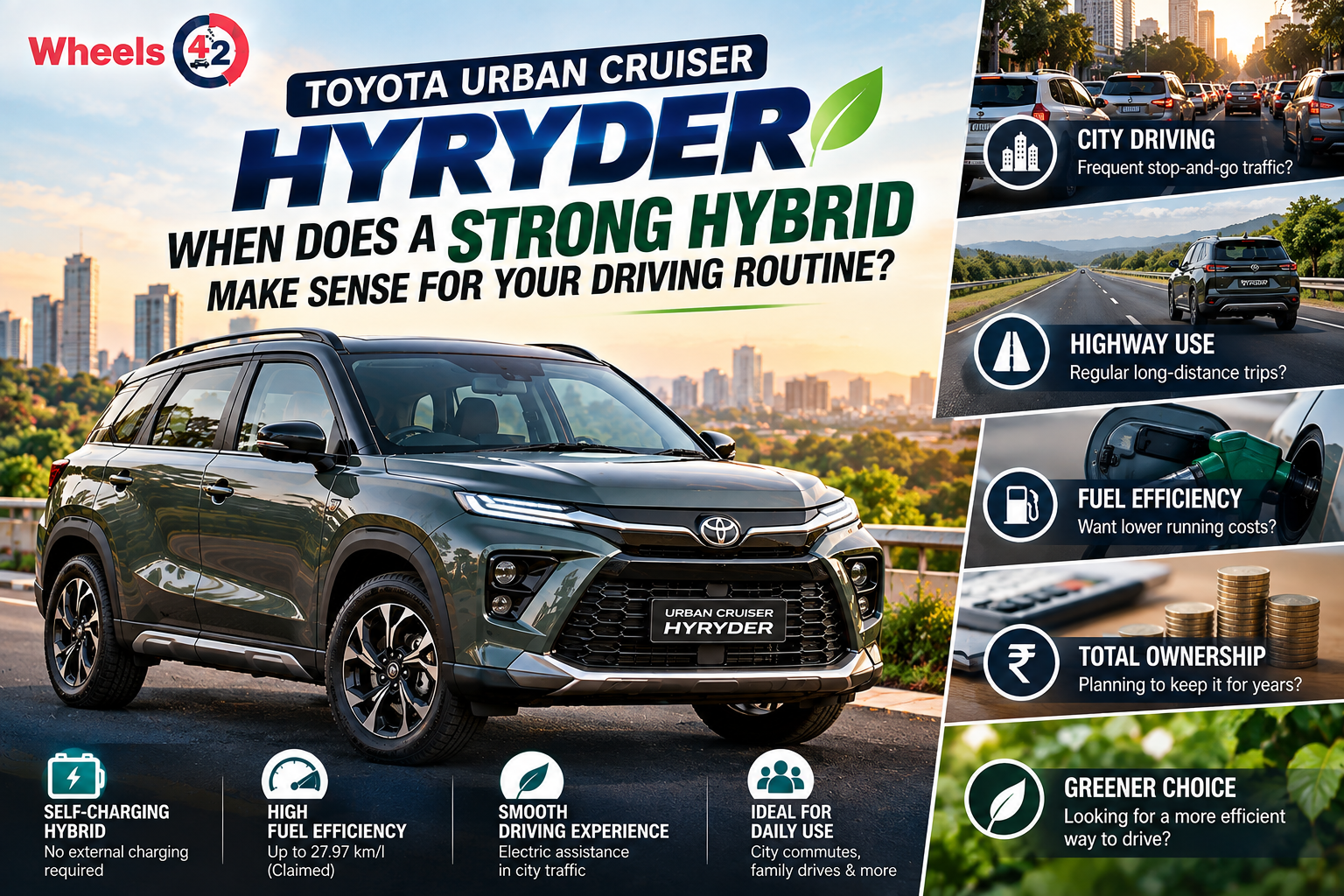
The Toyota Urban Cruiser Hyryder is one of the SUVs in India that offers buyers a choice between conventional petrol, CNG and strong-hybrid powertrains. While the strong-hybrid version comes with a higher upfront cost, its appeal lies in its ability to deliver high fuel efficiency and use electric power during suitable driving conditions.
But does that automatically make the hybrid the right choice for every buyer?
Not necessarily. The stronger case for the Hyryder strong hybrid depends largely on how much you drive, where you drive and how long you plan to keep the vehicle.
Toyota cars currently lists the Hyryder Hybrid with a 1.5-litre petrol engine paired with an electric motor, an e-Drive transmission and a lithium-ion battery. The combined system output is 85 kW (115.56 PS), while Toyota claims a fuel-efficiency figure of 27.97 km/l.
|
Specification |
Hyryder Strong Hybrid |
|
Engine |
1.5-litre petrol |
|
Engine displacement |
1,490cc |
|
Engine power |
92.45 PS |
|
Total system power |
115.56 PS |
|
Electric motor |
80.2 PS |
|
Battery |
Lithium-ion |
|
Transmission |
e-Drive |
|
Drive type |
2WD |
|
Claimed efficiency |
27.97 km/l |
|
Fuel tank |
45 litres |
|
Seating capacity |
5 |
|
Length |
4,365 mm |
|
Width |
1,795 mm |
|
Wheelbase |
2,600 mm |
|
Kerb weight |
1,265–1,295 kg |
A strong hybrid is different from a conventional mild-hybrid system.
The Hyryder's strong-hybrid system combines a petrol engine, electric motor, battery and electronic drive system. Depending on driving conditions, the vehicle can use electric power, the petrol engine or a combination of both.
This is particularly useful in stop-and-go urban traffic, where a conventional petrol engine can spend considerable time idling or operating inefficiently.
Toyota's published hybrid technology information highlights the system's ability to operate in electric mode for portions of a drive cycle and improve overall efficiency compared with a conventional petrol powertrain.
Hatchback vs Sedan vs SUV: Which Car Type Suits You Best?
The first question a potential buyer should ask is:
How many kilometres will I actually drive every month?
If your Hyryder will cover only a few hundred kilometres each month, the additional upfront cost of the hybrid may take a long time to recover through fuel savings.
However, someone driving the vehicle regularly for:
can potentially benefit more from the hybrid's higher efficiency.
Low annual running: Conventional petrol or CNG may make more sense.
High annual running: Strong hybrid becomes more attractive.
The Hyryder strong hybrid is particularly suited to urban driving.
Heavy traffic involves repeated:
The hybrid system can recover energy during deceleration and use the electric motor during suitable conditions.
This makes the technology especially relevant for buyers who spend a large part of their day in congested city traffic.
For someone whose daily route involves open highways with relatively consistent speeds, the difference may not be as significant as it is in dense urban conditions.
How to Choose Between Two Similar Car Models: A Decision Framework
Toyota officially lists 27.97 km/l for the Hyryder strong hybrid.
That figure is a major reason buyers consider the hybrid version.
However, buyers should not assume that their real-world mileage will always match the certified figure. Actual fuel economy depends on:
A smooth driver operating mainly in urban conditions may be able to extract substantial benefits from the hybrid system, while aggressive driving can reduce the efficiency advantage.
This is probably the most important financial calculation.
Suppose two versions of the Hyryder have a meaningful price difference. Instead of simply assuming that the hybrid is cheaper to run, calculate your expected annual fuel consumption.
For example:
Annual fuel requirement = Annual kilometres ÷ Real-world km/l
Then:
Annual fuel cost = Annual fuel requirement × Petrol price
Compare that figure with the expected running cost of the alternative powertrain.
This gives a much clearer picture of whether the hybrid premium is financially justified.
A buyer driving 5,000–7,000 km annually may not see the same financial benefit as someone covering 15,000–20,000 km or more every year.
The strong hybrid becomes easier to justify if you plan to keep the car for a long period.
A buyer planning to retain the Hyryder for 7–10 years has more time to potentially recover the additional purchase cost through fuel savings.
On the other hand, if you change cars every three or four years and have relatively low annual running, the economics need to be examined more carefully.
The right question is therefore not just:
“Is the hybrid more efficient?”
It is:
“Will I drive enough kilometres for that efficiency to matter financially?”
Another important point for first-time hybrid buyers is that the Hyryder strong hybrid does not require an external charger.
The system uses its petrol engine and regenerative braking to manage energy within the hybrid system.
That makes it different from a conventional EV or plug-in hybrid.
For buyers who:
a strong hybrid can provide a convenient middle ground.
A common misconception is that a strong hybrid is automatically the best choice for every type of driving.
If your routine consists primarily of long highway journeys at steady speeds, the efficiency advantage may not be as dramatic as it can be in city traffic.
However, many buyers have mixed usage.
For example:
40% city + 60% highway: Hybrid can still be worth considering.
80% city + 20% highway: Strong hybrid becomes considerably more attractive.
Mostly highway: Compare the hybrid premium carefully against a conventional petrol alternative.
The Hyryder's hybrid system produces a combined 115.56 PS, while the electric motor itself is rated at up to 80.2 PS. Toyota lists 141 Nm of motor torque available from 0–3,995 rpm.
The character is more focused on smooth and efficient everyday driving than outright performance.
The electric motor can provide responsive initial acceleration, making the SUV feel well suited to urban conditions.
Buyers looking primarily for strong acceleration and sporty driving, however, should evaluate the car through a test drive rather than choosing the hybrid purely on its power figures.
The Hyryder uses a lithium-ion hybrid battery with a nominal voltage of 177.6V.
Battery durability and replacement cost are natural concerns for buyers considering a hybrid.
Toyota provides specific warranty and service provisions for its vehicles, but buyers should confirm the current battery warranty terms, coverage period and conditions for the exact variant before booking.
This is especially important for someone planning long-term ownership.
The Hyryder is also available with a factory-fitted CNG powertrain.
CNG can offer attractive running costs where fuel availability is convenient, while the strong hybrid offers the advantage of electric assistance without requiring a charging stop.
|
Factor |
Strong Hybrid |
CNG |
|
City efficiency |
Excellent |
Very good |
|
Highway flexibility |
Excellent |
Good |
|
Refuelling convenience |
Excellent |
Depends on CNG network |
|
External charging |
Not required |
Not required |
|
Electric assistance |
Yes |
No |
|
Upfront cost |
Higher |
Generally lower than hybrid |
|
Best suited to |
High-running mixed/city use |
Cost-focused high-running users |
The strong-hybrid version makes the most sense for buyers who:
The hybrid may not be the most logical choice if you:
In these cases, comparing the conventional petrol and CNG versions can provide a more financially sensible solution.
The Toyota Urban Cruiser Hyryder strong hybrid makes the strongest case for itself when the vehicle is used regularly, particularly in urban traffic and high-mileage driving conditions.
Its 27.97 km/l claimed efficiency, electric motor assistance and self-charging hybrid system can make everyday driving more efficient without requiring the owner to install or regularly use an external charger.
But the hybrid should not be selected simply because it has the highest mileage figure.
For low-mileage users, the additional upfront cost may not be easy to justify. For high-mileage city users planning long-term ownership, the strong hybrid can make considerably more sense.
The smartest approach is to calculate your annual kilometres, real-world fuel cost, ownership period and upfront price difference before making the final decision.







Land Rover
₹64.86 - 81.85 Lakh