Electric vehicles (EVs) are becoming increasingly popular as people look for more affordable and convenient ways to travel. From electric scooters to family cars and premium electric SUVs, more vehicles can now be charged at home. However, one common misconception is that any household socket can be used to charge any electric vehicle.
At first, this may sound reasonable. After all, we use household sockets to power televisions, refrigerators, washing machines, and other electrical appliances. Why should charging an electric vehicle be different?
The answer lies in how much electricity an EV needs and how long it draws that electricity. Unlike many everyday appliances, an electric vehicle may remain connected to a power supply for several hours while drawing a continuous electrical load. This places specific demands on the socket, wiring, circuit protection, and charging equipment.
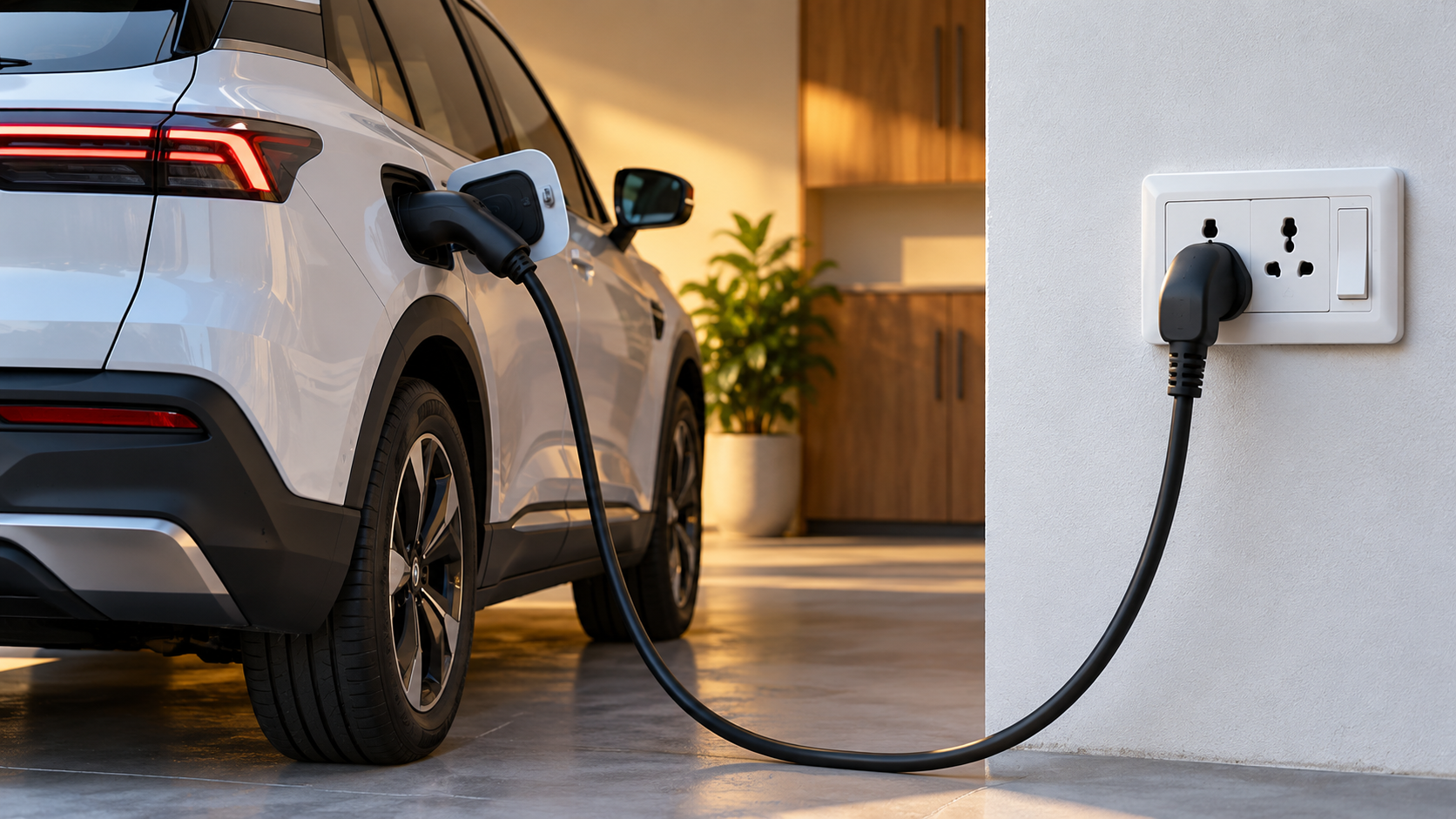
Some electric vehicles can be charged using an approved portable charger connected to a suitable domestic socket. However, not every socket is designed for this purpose, and the fact that a plug fits does not guarantee that the connection is safe.
So, is it a myth or a fact that any household socket is suitable for charging any EV? Let's understand how home charging works, what makes a socket suitable, and how EV owners can charge their vehicles safely.
How Many Airbags Do You Really Need? A Safety Primer
Is Any Household Socket Suitable for Charging Any EV?
Myth. Not every household socket is suitable for charging every electric vehicle.
The suitability of a household socket depends on several factors, including its electrical rating, the quality of the wiring, earthing, circuit protection, and the charging requirements of the vehicle.
Some manufacturers provide or approve portable chargers that allow their electric cars or scooters to be charged through compatible domestic outlets. These chargers are designed to operate within specified electrical limits and may include safety features that help manage the charging process.
However, an ordinary household socket may not be suitable for supplying electricity continuously for several hours. Old wiring, loose connections, damaged outlets, and overloaded circuits can cause overheating and create potential fire or electrical hazards.
Another important point is that electric vehicles have different battery capacities and charging requirements. An electric scooter with a small battery may require considerably less energy than a large electric SUV. Their charging equipment and electrical requirements may also differ.
Therefore, EV owners should never assume that a socket is suitable simply because the charger can be plugged into it. The vehicle manufacturer's instructions and the condition of the electrical installation must always be considered.

How Does Home EV Charging Work?
When an electric vehicle is connected to a home charging point, electricity flows from the household supply through the charging equipment and into the vehicle's charging system.
Most electric cars use an onboard charger to convert alternating current (AC) from the home supply into the direct current (DC) required by the battery.
The charging equipment helps control the connection and communicates with the vehicle where applicable. Depending on the system, it may also provide protection against certain electrical faults.
There are two common options for charging an EV at home.
1. Charging Through a Domestic Socket
Some electric vehicles support charging through a compatible household socket using an approved portable charging cable.
This can be a convenient option for owners who travel relatively short distances each day or have vehicles with smaller batteries. However, charging speeds are generally lower than those available from many dedicated home chargers.
The socket, wiring, earthing, and circuit protection must be suitable for the charging equipment. A standard household outlet should not be used for EV charging without confirming its suitability.
2. Using a Dedicated Home EV Charger
A dedicated home EV charger, often installed on a wall in a garage or parking area, is designed specifically for charging electric vehicles.
Depending on its power rating and the vehicle's capabilities, it can provide faster charging than a typical domestic socket. Many units also offer useful features such as scheduled charging, charging status monitoring, and energy management.
The charger must be compatible with the vehicle and installed by a qualified professional on an appropriately rated electrical circuit.
For people who regularly charge an electric car at home, a dedicated charger can provide greater convenience and a more suitable long-term arrangement.
Why Is Charging an EV Different From Using Ordinary Appliances?
The main difference is the duration and nature of the electrical load.
A household appliance may operate for a short period or switch its power consumption on and off during use. An EV charger, on the other hand, may draw electricity continuously for several hours.
For example, a vehicle with a partially discharged battery might need to remain connected overnight to obtain enough energy for the following day's journey.
If a socket has loose contacts, unsuitable wiring, or an inadequate electrical rating, prolonged use can cause excessive heat. This problem may not be obvious when the same outlet is used for lower-power appliances.
The risk becomes greater when people use cheap adapters, unsuitable extension cables, or multi-plug boards to connect an EV charger.
A charger should therefore be treated as a significant electrical load rather than an ordinary small appliance. The entire circuit must be capable of supporting the required load safely.
Company-Fitted vs Aftermarket Accessories: Which Is Better?
What Should You Check Before Charging an EV at Home?
Before connecting an electric vehicle to a household outlet, owners should consider the following factors.
Socket rating: The outlet must support the current required by the approved charging equipment. A socket's physical appearance alone does not establish its suitability.
Wiring condition: Old, damaged, undersized, or poorly installed wiring can overheat when subjected to a prolonged load.
Proper earthing: A correctly installed earth connection is an important part of electrical safety. A qualified electrician should verify that the installation meets the requirements of the charging equipment.
Circuit protection: The installation must have appropriate protective devices, as required by the charger and applicable electrical standards.
Charger compatibility: The portable charger must be approved or recommended for the vehicle and intended electrical connection.
Other electrical loads: If several high-power appliances share the same circuit, the combined demand may exceed its capacity.
These checks are particularly important in older homes, rented properties, and buildings where the electrical installation was not originally designed for EV charging.
Does a 15A Socket Make EV Charging Safe?
Many people assume that a 15A household socket is automatically suitable for charging an electric car. Although a suitably rated outlet may support certain approved portable charging arrangements, its rating alone does not guarantee safety.
The wiring connected to the socket, the condition of the contacts, the circuit breaker, earthing, and the charging cable must also be appropriate.
For example, an outlet may be marked with a particular current rating, but damaged contacts or unsuitable wiring behind the wall can still create overheating risks.
The charger must also be configured for the electrical supply it is connected to. Using an adapter to make an incompatible plug fit does not increase the circuit's capacity.
Owners should consult their EV manufacturer's instructions and have the installation checked by a qualified electrician before regular charging.
Household Socket vs Dedicated EV Charger
|
Feature
|
Compatible household socket
|
Dedicated home EV charger
|
|
Charging speed
|
Usually slower
|
Often faster, depending on the power rating
|
|
Installation
|
Existing outlet may be used if verified as suitable
|
Requires appropriate installation
|
|
Daily use
|
Can suit some vehicles and driving needs
|
Convenient for regular charging
|
|
Electrical safety
|
Depends on socket condition, wiring, earthing, and protection
|
Depends on correct installation and suitable circuit protection
|
|
Charging features
|
Depends on the portable charger and vehicle
|
May include scheduling and energy monitoring
|
|
Best suited for
|
Certain approved portable charging setups
|
Many regular home-charging requirements
|
Can You Use an Extension Cord to Charge an EV?
Using an ordinary extension cord may seem like an easy solution when the parking space is far from a household socket. However, this can introduce additional electrical risks.
An unsuitable extension cable may have insufficient current capacity, poor-quality connectors, or inadequate protection against heat and environmental exposure. Prolonged charging can cause a cable or connection to overheat.
Multi-plug adapters and improvised wiring arrangements can create similar problems.
For this reason, avoid ordinary extension cords unless the vehicle or charger manufacturer explicitly permits a suitable arrangement. If the existing socket is too far away, it is better to have a properly located charging point installed by a qualified electrician.
Never use damaged cables, loose plugs, or connectors that become unusually hot during charging.

How Long Does It Take to Charge an EV at Home?
Charging time depends on battery capacity, charging power, the vehicle's onboard charger, and the amount of energy needed.
A smaller electric scooter battery may take only a few hours to charge, depending on its capacity and charger. A larger electric car battery can take considerably longer when connected to a low-power domestic outlet.
For illustration, consider an EV that needs 20 kWh of energy and receives an average charging power of 2 kW.
The simple calculation is:
20 kWh ÷ 2 kW = 10 hours.
This is an estimate rather than a guaranteed charging time. Actual charging may take longer because of energy losses, variations in charging power, and vehicle-specific charging limits.
A compatible higher-power home charger may reduce charging time if the vehicle supports it and the home's electrical supply can safely provide the required power.
Best Time of the Year to Buy a New Car in India
Best Practices for Safe Home EV Charging
EV owners can reduce charging risks by following a few straightforward precautions.
First, read the vehicle's owner's manual and use only the recommended or approved charging equipment. Do not assume that a charger supplied for one vehicle is suitable for another.
Second, have the electrical installation inspected when necessary. A qualified electrician can check the wiring, socket rating, earthing, circuit capacity, and protective devices.
Third, keep charging cables and connectors in good condition. Stop using the equipment if you notice damaged insulation, loose connections, discolouration, sparks, burning smells, or unusual heat.
Fourth, avoid overloading a circuit with multiple high-power appliances. If a circuit breaker trips repeatedly during charging, do not simply reset it and continue. Have the cause investigated.
Finally, keep the charging area organised and protect equipment from physical damage. Outdoor charging equipment must be suitable for its intended environment and installed according to its instructions.
These precautions help make home charging more convenient while reducing avoidable electrical hazards.
Final Verdict: Any Household Socket Is Suitable for Charging Any EV
Myth. Not every household socket can safely charge every electric vehicle. Some EVs support charging through an approved portable charger connected to a suitable domestic outlet, but the socket rating, wiring, earthing, circuit protection, and charger compatibility must all be considered.
For regular electric car charging, a dedicated home charger can be a convenient option. However, even a dedicated charger requires correct installation and suitable electrical protection.
The most important lesson is that a plug fitting into a socket does not mean the connection is safe. EV charging places a sustained electrical load on the installation, so the entire circuit must be suitable for the job.
Before charging at home, check your vehicle manufacturer's instructions and consult a qualified electrician if you are unsure about your electrical setup.

 Khyati Sharma 2026-09-06