
 Khyati Sharma 2026-09-09
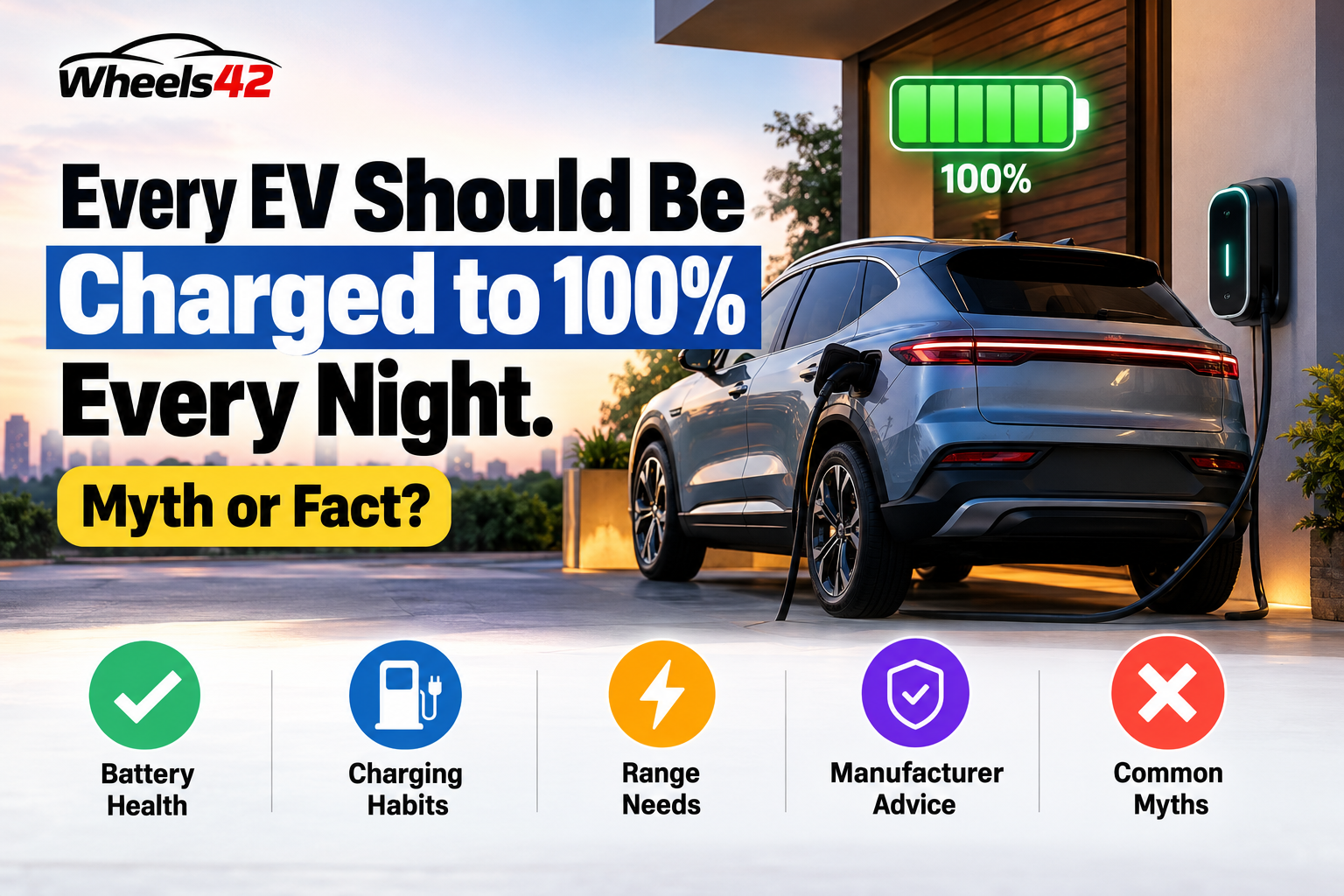
The claim that every electric vehicle should be charged to 100% every night is a common EV myth. The ideal charging limit depends on battery chemistry, manufacturer recommendations, driving habits, and how much range you need.
Electric vehicles (EVs) are becoming increasingly popular in India as buyers look for lower running costs, quieter driving experiences, and alternatives to petrol and diesel cars. However, as more people switch to electric mobility, questions about battery charging and long-term battery health continue to create confusion.
One of the most common beliefs is that every EV should be charged to 100% every night to maintain battery performance and ensure maximum driving range. While a fully charged battery provides the greatest available range, charging to 100% daily is not always necessary or ideal for every electric car.
Modern EV batteries use advanced battery management systems to control charging, monitor temperatures, and protect battery cells. Nevertheless, charging habits can influence long-term battery degradation, particularly when a vehicle spends extended periods at a very high state of charge.
Petrol vs Diesel vs CNG vs Electric Cars: How to Choose the Right Fuel Type
No, charging every EV to 100% every night is not necessary. Most electric car owners can maintain convenient daily driving range without fully charging their batteries each night.
For many EVs equipped with nickel manganese cobalt (NMC) or similar nickel-rich lithium-ion batteries, maintaining a moderate state of charge during everyday use can help reduce battery ageing. Owners can generally set a daily charging limit according to their manufacturer's recommendations and charge to 100% before longer journeys.
However, lithium iron phosphate (LFP) batteries have different characteristics. Some manufacturers recommend charging certain LFP-powered vehicles to 100% periodically, sometimes more frequently, to help calibrate the battery management system and improve the accuracy of the displayed range.
This distinction is important because there is no single charging rule that applies to every electric vehicle.
The best approach is to follow the vehicle manufacturer's guidance rather than assuming that a full charge every night is beneficial for all battery types.

Most modern electric cars use rechargeable lithium-ion battery packs. These packs contain numerous individual cells that store electrical energy and supply power to the electric motor.
When an EV is plugged into a charger, electricity flows into the battery and is stored chemically. During driving, the battery releases this energy to power the motor and other vehicle systems.
The battery management system, commonly called the BMS, monitors important parameters such as cell voltage, temperature, current, and state of charge. It helps maintain safe operating conditions and can limit charging when necessary.
However, battery cells gradually lose some of their original capacity through normal ageing and repeated use. This process is called battery degradation.
Several factors can influence degradation:
Spending long periods at a very high state of charge.
Frequent exposure to extreme temperatures.
Repeated high-power DC fast charging, especially under unfavourable conditions.
Regularly running the battery to a very low charge level.
The battery's chemistry, design, age, and charging controls.
Charging to 100% does not automatically damage an EV battery. The concern is mainly how often the battery reaches a high state of charge, how long it remains there, and whether the vehicle is exposed to unsuitable temperatures.
1. High State of Charge Can Increase Battery Stress
Lithium-ion batteries can experience additional chemical stress when kept near a full charge for extended periods. The degree of stress depends on battery chemistry, temperature, cell design, and the vehicle's control systems.
For many nickel-rich lithium-ion batteries, maintaining a moderate charge level for daily driving can help reduce this stress.
For example, an owner who drives 40–60 km daily may not need the entire battery capacity every morning. Charging to a recommended daily limit can provide sufficient range without routinely keeping the battery fully charged.
2. Leaving the Battery Fully Charged for Long Periods
Charging to 100% before a long journey is generally reasonable when recommended by the manufacturer. However, charging to full capacity every night and then leaving the vehicle parked for many hours may be unnecessary if the additional range is not required.
Battery ageing can be affected by the time spent at high charge levels, especially in hot conditions.
A practical solution is to use the vehicle's scheduled charging feature, if available, so charging finishes closer to departure time. This helps avoid leaving the battery at 100% for longer than necessary.
3. Heat Can Affect Battery Health
Temperature is another major factor in EV battery performance. High temperatures can accelerate chemical ageing, particularly when combined with a high state of charge.
In hot weather, drivers should follow the manufacturer's charging instructions and use available battery thermal-management features. Parking in a shaded or covered location can also help reduce exposure to direct sunlight.
Cold temperatures can temporarily reduce driving range and slow charging. This does not necessarily mean that the battery has permanently lost capacity.
Car Loan in India 2026: EMI, Rates, Eligibility and Steps
4. Full Charging May Not Be Needed for Daily Travel
Many EV owners drive predictable daily distances, such as commuting to work, travelling to college, or completing local errands.
If an electric car offers a real-world range of 300 km and the driver typically travels 50 km per day, charging to 100% every night may provide little practical benefit.
A suitable daily charging limit can keep enough energy available for regular journeys while allowing the driver to charge fully when additional range is needed.
The correct limit depends on the actual range required, weather conditions, driving speed, and the manufacturer's recommendations.
The answer depends on the battery chemistry and the vehicle's instructions.
For many EVs with NMC or other nickel-rich lithium-ion batteries, an approximately 80% daily charging limit is a useful starting point when it provides sufficient range. Some vehicles allow owners to select different limits, while others recommend a different routine.
For some LFP-equipped EVs, manufacturers recommend regular charging to 100%, including for battery management system calibration. Owners should follow the specific guidance provided for their model rather than automatically applying an 80% rule.
|
Charging practice |
Potential benefit |
Important consideration |
|
Charging to around 80% |
Can reduce time spent at high charge levels |
May not provide enough range for every journey |
|
Charging to 90% |
Provides additional daily range |
Follow the manufacturer's recommended limit |
|
Charging to 100% before a long trip |
Maximises available starting range |
Plan charging so the battery does not remain full unnecessarily |
|
Charging to 100% periodically for an LFP battery |
May support battery charge estimation on some vehicles |
Follow the model-specific instructions |
|
Frequently charging from very low levels to full |
Provides a full battery when needed |
Usually unnecessary for routine daily driving |

Two common lithium-ion battery chemistries used in electric cars are nickel manganese cobalt (NMC) and lithium iron phosphate (LFP).
Both offer advantages, but their charging recommendations can differ.
NMC Batteries
NMC batteries are widely used in electric vehicles because they can offer high energy density. This allows manufacturers to store substantial energy in a relatively compact and lightweight battery pack.
For many NMC-powered vehicles, limiting routine charging to the level recommended by the manufacturer can help preserve long-term battery health. A full charge remains useful before long trips when additional range is required.
LFP Batteries
LFP batteries use lithium iron phosphate as their cathode material. They are known for their durability and generally strong cycle-life characteristics under suitable operating conditions.
Some LFP battery management systems benefit from periodic full charging because it can help estimate the battery's state of charge more accurately. This is not a universal requirement for every LFP vehicle, so owners should check the manufacturer's guidance.
Battery Chemistry Comparison
|
Feature |
NMC battery |
LFP battery |
|
Energy density |
Generally higher |
Generally lower |
|
Routine charging limit |
Often below 100%, as specified by the manufacturer |
Model-dependent; some manufacturers recommend regular 100% charging |
|
Full charging |
Useful when additional range is needed |
May be recommended for calibration on certain vehicles |
|
Temperature sensitivity |
Sensitive to high temperatures and prolonged high charge |
Also affected by temperature; not immune to degradation |
|
Best charging approach |
Follow the vehicle's daily charge-limit guidance |
Follow the vehicle's specific charging and calibration instructions |
Yes. Charging an electric car overnight is generally safe when the vehicle, charging equipment, electrical installation, and charging procedure meet the manufacturer's requirements.
The key issue is not simply whether the car is plugged in overnight. It is whether the battery is charged appropriately and the charging setup is safe.
Most modern EVs include charging controls and a battery management system that stop or regulate charging when the selected limit is reached. However, drivers should use approved equipment and a properly installed charging point.
Follow these precautions:
Use the manufacturer's recommended home charger or a compatible, certified charging unit.
Have the charging point installed by a qualified electrician.
Avoid damaged cables, loose sockets, and unsuitable extension leads.
Keep connectors protected from water and physical damage according to the equipment instructions.
Avoid charging in excessively hot conditions when the manufacturer advises against it.
Set a suitable charging limit and schedule through the vehicle or charger, if available.
Follow any warnings or charging restrictions displayed by the vehicle.
A properly installed home charging point is generally a better long-term solution than relying on an ordinary domestic socket without confirming its suitability.
Documents Required to Buy a New Car in India (Complete Checklist)
Charging to 100% does not automatically or immediately damage an electric car battery. Modern EVs are designed to handle full charging within their specified operating limits.
However, repeatedly keeping certain lithium-ion batteries at a very high state of charge for long periods can accelerate capacity loss. The effect varies with chemistry, temperature, cell design, and battery management software.
It is also important to distinguish between normal battery ageing and damage. Every rechargeable battery gradually loses some capacity over time, even when treated carefully.
Drivers should not become overly concerned about occasionally charging to 100%. If a long journey requires a full battery, charging fully according to the manufacturer's instructions is a sensible choice.
The goal is to avoid unnecessary charging habits, not to prevent the battery from ever reaching full capacity.
A simple charging routine can make electric car ownership easier while supporting battery longevity.
1. Choose a Suitable Daily Charging Limit
Check the owner's manual or vehicle settings for the recommended daily charge limit. For many nickel-rich battery EVs, a limit around 80% may be appropriate if it provides sufficient range.
For LFP vehicles, check whether the manufacturer recommends periodic or regular charging to 100%.
2. Charge According to Your Daily Driving Distance
Estimate how much range you use on an average day. If you drive short distances, you may not need to recharge to a high level every night.
For example, a driver who uses only 15% of the battery daily can often recharge as needed rather than aiming for 100% every evening.
3. Use Scheduled Charging
If your EV supports scheduled charging, set it to finish near your usual departure time. This can reduce the time the battery spends sitting at a high charge level.
Also consider any electricity tariff that offers lower rates during off-peak hours, while ensuring the charging schedule suits your travel needs.
4. Charge Fully Before Long Journeys
Before a road trip, charging to 100% can maximise your starting range when allowed or recommended by the manufacturer.
For longer journeys, plan charging stops based on the vehicle's real-world range, route, weather, and the availability of compatible charging stations.
5. Avoid Extreme Battery Levels When Practical
Where convenient, avoid repeatedly leaving the battery nearly empty or storing it fully charged for long periods. Use the battery-level guidance in your owner's manual, particularly if the car will remain parked for an extended period.
There is no need to worry about every percentage point. Consistent, sensible charging habits are more useful than constantly trying to maintain an exact battery percentage.
DC fast charging allows drivers to add substantial range in a relatively short period. It is particularly useful during road trips and when home charging is unavailable.
Fast charging is not inherently harmful when used within the vehicle's operating limits. However, repeated high-power charging can increase battery stress under certain conditions, particularly when the battery is very hot or cold.
Modern EVs often reduce charging power as the battery approaches a high state of charge. This is one reason why charging from a low level to around 80% can be quicker than charging from 80% to 100%.
For everyday use, home AC charging is convenient for many owners. DC fast charging remains valuable for longer journeys, and drivers should use whichever method suits their needs while following the manufacturer's recommendations.
|
Myth |
Fact |
|
Every EV must reach 100% every night |
Charging needs vary by battery chemistry and driving distance |
|
Charging to 100% always damages the battery |
Full charging is permitted and sometimes recommended |
|
Every EV should stop charging at 80% |
Some models, particularly certain LFP vehicles, have different recommendations |
|
Overnight charging is always unsafe |
Properly installed and compatible charging equipment is generally safe |
|
Fast charging should never be used |
It is useful when needed, provided the vehicle's instructions are followed |
|
Leaving an EV plugged in always overcharges the battery |
Modern systems regulate charging, but long periods at a high charge level may still affect battery ageing in some vehicles |
Myth. Every electric vehicle does not need to be charged to 100% every night. The best charging routine depends on the battery chemistry, the manufacturer's instructions, daily driving requirements, and the time the vehicle spends at a high state of charge.
For many EVs with NMC batteries, a daily charging limit around 80% can be suitable when it provides enough range. For some LFP-powered vehicles, regular charging to 100% may be recommended to help maintain accurate battery-level estimates.
Drivers should use the full battery capacity when they need it, especially before longer journeys, and avoid treating one charging rule as universal.
Ultimately, the smartest EV charging strategy is to charge according to your vehicle's requirements and your actual driving needs—not simply to reach 100% every night.










Land Rover
₹91.05 Lakh