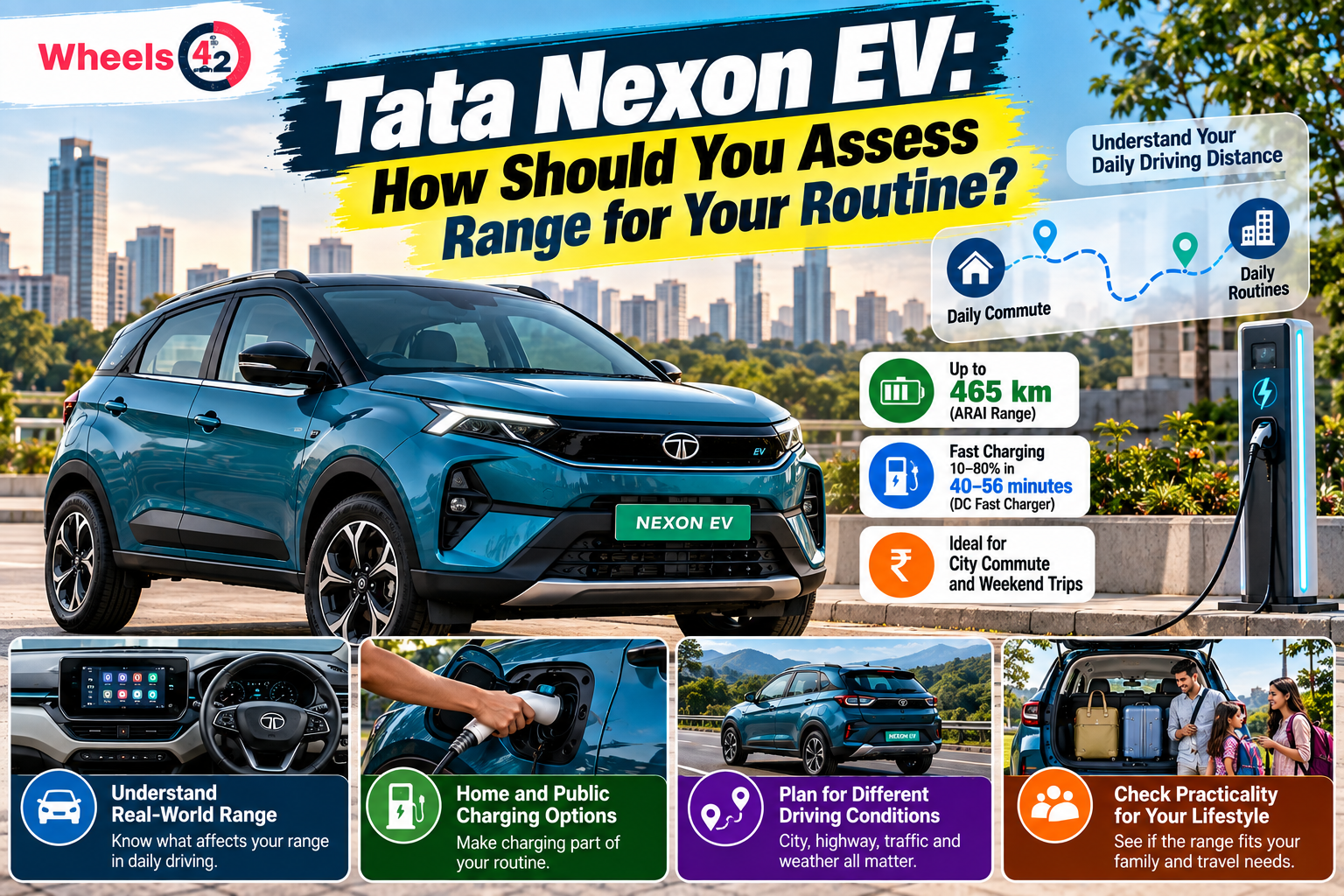
For many Indian buyers considering an electric SUV, range is one of the most important factors to understand before making a purchase. But the number shown in a brochure should not be treated as the distance every owner will achieve in everyday driving.
The Tata Nexon.ev 45 kWh currently has a certified MIDC range of 489 km, while Tata lists a C75 real-world range of around 350–375 km. The SUV uses a 45 kWh battery and produces 106 kW of power and 215 Nm of torque.
So, how should a potential buyer assess whether the Nexon EV's range is suitable for their routine? The answer starts with understanding your actual daily distance, charging access and driving conditions.
Tata Nexon EV Range at a Glance
|
Specification
|
Tata Nexon.ev 45
|
|
Battery
|
45 kWh
|
|
Certified Range
|
489 km MIDC
|
|
C75 Range
|
350–375 km
|
|
Motor Power
|
106 kW
|
|
Torque
|
215 Nm
|
|
Seating Capacity
|
5
|
|
Boot Space
|
350 litres
|
|
DC Fast Charging
|
10–80% in about 40 minutes
|
|
7.2 kW AC Charging
|
10–100% in about 6 hours 36 minutes
|
Tata's current specifications list a 45 kWh battery, 106 kW motor and 215 Nm of torque. The company quotes 489 km under the MIDC Part 1 + Part 2 certification cycle and approximately 350–375 km under its C75 real-world range measure.
Don't Plan Your Routine Around the Maximum Claimed Range
The first step is to separate certified range from real-world range.
The 489 km figure is a certified test-cycle figure. It provides a useful basis for comparing EV specifications, but actual range can vary according to traffic, speed, temperature, road conditions, air-conditioning use, driving style and the amount of load in the vehicle.
Tata's own C75 figure for the Nexon.ev 45 is approximately 350–375 km, which gives buyers a more practical reference point when thinking about everyday use.
For example, someone travelling 40 km every day would have very different charging requirements from someone regularly covering 120–150 km per day.
Calculate Your Actual Daily Distance
Before choosing an EV, track your driving for at least a week.
Consider:
- Home-to-office distance
- School or college trips
- Shopping and local errands
- Weekend driving
- Regular highway journeys
- Additional kilometres driven unexpectedly
Suppose your normal weekday driving is 50 km. A 350–375 km real-world reference range represents roughly seven days of driving in idealised arithmetic. However, owners do not need to wait until the battery is almost empty before charging.
Keeping a charging buffer is useful, particularly before longer journeys.
How Much Does Highway Driving Affect Range?
Highway driving can produce different energy consumption from slow-moving city traffic. Higher sustained speeds generally require more energy, while frequent acceleration and braking in heavy traffic can also affect consumption.
The Nexon EV provides multiple drive modes, including Eco, City and Sport, along with multi-mode regenerative braking. Tata says its regenerative-braking system can help increase range by recovering energy during deceleration.
For someone who drives primarily in the city, the driving pattern may therefore be quite different from someone who spends most of their time on highways.
Air Conditioning and Weather Matter
India's weather can vary considerably between regions and seasons. Using the air conditioner for extended periods, especially during very hot weather, can influence energy consumption.
Cold weather can also affect EV efficiency.
Therefore, buyers should consider their local climate when estimating range rather than using a single number throughout the year.
Charging at Home Can Change the Ownership Routine
For an EV owner, charging convenience can be as important as range.
The Nexon.ev supports multiple charging options. Tata lists a 7.2 kW AC wall-box charger, a 3.3 kW AC option and DC fast charging. With the 7.2 kW AC charger, Tata quotes approximately 6 hours 36 minutes for 10–100% charging on the 45 kWh version.
This means owners with access to overnight home charging can potentially start many mornings with a substantially replenished battery.
What About Fast Charging?
For longer journeys, DC fast charging becomes more relevant.
Tata says the Nexon.ev 45 can charge from 10% to 80% in around 40 minutes using a 60 kW DC fast charger.
The actual charging experience can vary depending on charger availability, battery temperature, charger output and other conditions.
For road trips, it is therefore sensible to identify charging points along the route before leaving.
A Simple Way to Assess Your Range Requirement
You can use this basic approach:
Step 1: Calculate your average daily kilometres.
Step 2: Identify your longest regular day.
Step 3: Check whether you have reliable overnight charging at home.
Step 4: Consider your typical highway usage.
Step 5: Keep a reasonable battery buffer instead of planning around 0% charge.
Step 6: Check charging stations on your regular intercity routes.
For example, if your regular daily travel is 40–60 km and home charging is available, your charging routine may be relatively straightforward. If you regularly drive 200–300 km in a day, charging access and trip planning become more important.
Family Buyers Should Consider More Than Range
The Nexon EV is a five-seat SUV and offers 350 litres of boot space according to Tata's current specifications.
For family use, buyers should also consider:
- Number of passengers
- Luggage requirements
- Child-seat usage
- Daily commute distance
- Weekend travel
- Availability of charging at home
- Access to charging during road trips
An EV that has sufficient range on paper may still be inconvenient if charging is difficult at the owner's home or workplace.
Battery Warranty Adds Another Consideration
Tata currently lists a Lifetime HV Battery Warranty for the Nexon.ev 45 kWh for the first registration, subject to its stated terms and conditions. For subsequent registrations, the listed coverage is eight years or 1.6 lakh km. Tata defines "lifetime" in this context as 15 years from the vehicle's first registration.
Buyers should review the detailed warranty terms before purchasing, particularly if they expect to keep the vehicle for a long period or plan to sell it later.
Tata Nexon EV: What Should You Check Before Buying?
|
Check
|
Why It Matters
|
|
Daily distance
|
Helps determine your actual range requirement
|
|
Home charging
|
Makes regular charging easier
|
|
Highway usage
|
May require additional charging planning
|
|
Climate
|
Temperature and AC use can affect consumption
|
|
Driving style
|
Speed and acceleration influence energy use
|
|
Passenger load
|
Extra weight can affect efficiency
|
|
Public chargers
|
Important for long-distance travel
|
|
Battery buffer
|
Provides flexibility during unexpected trips
|
Final Takeaway
The Tata Nexon EV 45 should be assessed according to your real driving pattern rather than its maximum certified range alone.
Its 489 km MIDC-certified range provides a useful official benchmark, while Tata's 350–375 km C75 range gives another reference for thinking about everyday usage.
For buyers with predictable urban commutes and convenient home charging, range management can become a relatively simple part of the daily routine. For frequent highway travellers, the availability and location of fast chargers should be considered alongside the vehicle's range.

 Khyati Sharma 2026-09-27