
2026-09-28
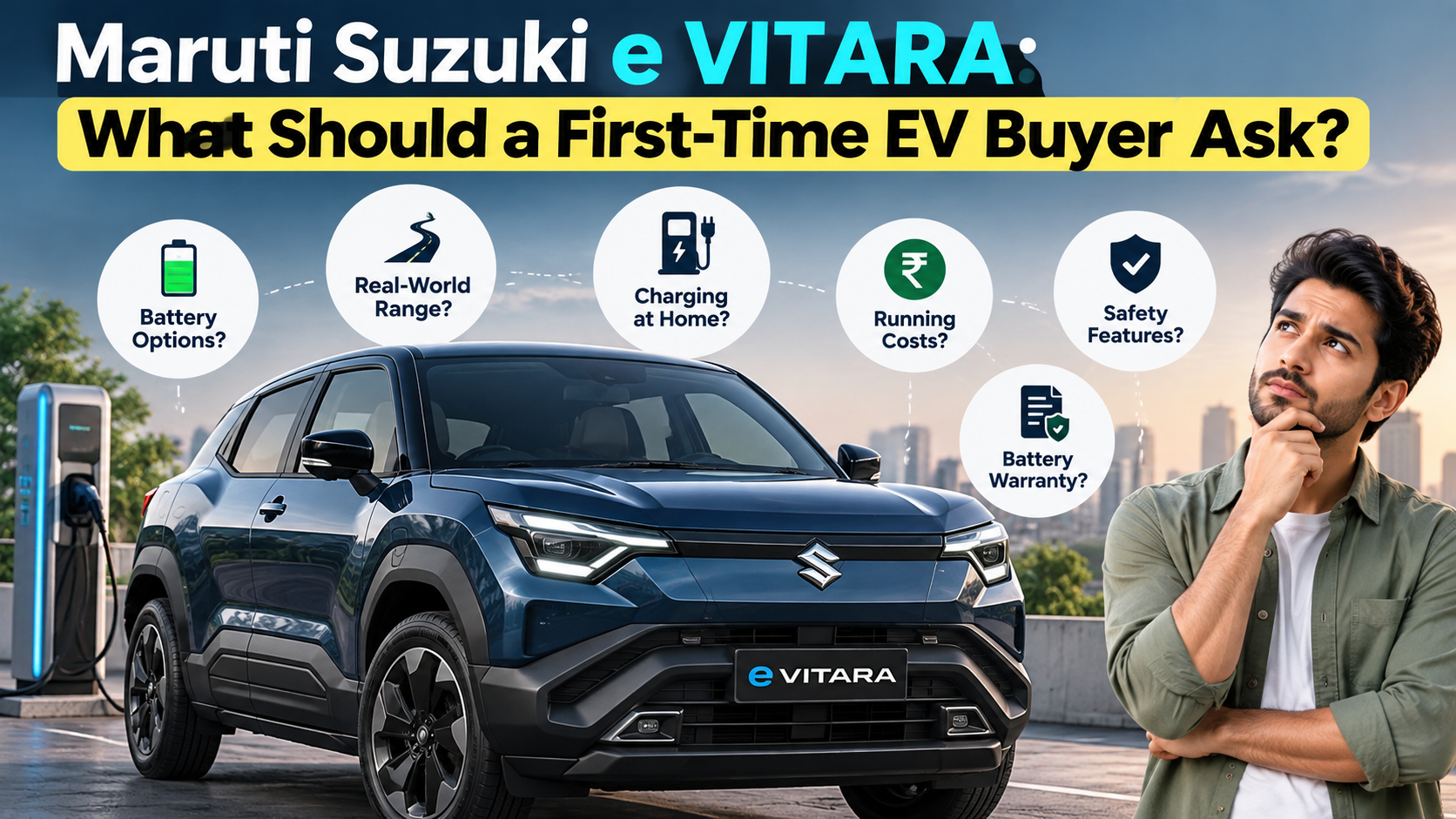
Buying an electric car for the first time can feel very different from buying a petrol or diesel vehicle. Instead of focusing only on engine performance, mileage and fuel costs, EV buyers also need to understand battery capacity, charging, real-world range, home electricity requirements, warranty coverage and long-distance usability.
The Maruti Suzuki e VITARA enters this space as the brand's first battery-electric vehicle in India. It is built on Suzuki's dedicated HEARTECT-e EV platform and is offered with two battery options: 49kWh and 61kWh. The 61kWh version has a certified driving range of up to 543km, although actual range can vary depending on driving conditions, road conditions and other factors.
For someone buying an EV for the first time, the important question is therefore not simply, "How much range does it offer?" Instead, buyers should ask a much wider set of questions.
The e VITARA is available with two battery capacities: 49kWh and 61kWh. The larger battery is naturally more relevant to buyers who regularly cover longer distances and want greater range between charging stops.
However, a larger battery may not be necessary for every buyer.
Someone who primarily drives 30–50km a day in the city may have very different requirements from a person who regularly travels between cities.
Before choosing a variant, buyers should calculate their normal weekly driving distance rather than selecting a battery purely on its maximum range figure.
This is perhaps the most important question for a first-time EV buyer.
Maruti Suzuki quotes a certified range of up to 543km for the 61kWh battery version. The company also clearly notes that actual results can differ depending on driving, road and other conditions.
Real-world range can be influenced by:
A buyer should therefore ask the dealership for a realistic expectation based on their typical route instead of assuming that the certified figure will always be achievable.
For many first-time EV owners, home charging is more important than public charging.
Maruti Suzuki's current e VITARA ownership package includes a 7.4kW AC wall-box charger with installation, subject to the applicable terms and conditions.
Before purchasing, buyers should ask:
"Can a charger be installed at my parking location?"
They should also confirm the electrical requirements, installation process, cable routing, parking arrangement and whether any additional electrical work is needed.
If home charging is available and the car is plugged in regularly, daily EV ownership can become considerably more convenient.
Long-distance EV travel depends heavily on charging infrastructure.
Maruti Suzuki has developed its "e for me" ecosystem around home and public charging. The company says its platform can be used to locate, schedule and pay for charging, while its dealer and service network has also been prepared for EV support.
Still, first-time buyers should check the charging situation along their own frequently used routes.
Ask:
These questions can provide a much more realistic picture of EV ownership than simply counting the number of chargers in a city.
Charging time depends on the charging equipment, battery state of charge, battery temperature and other conditions.
A first-time buyer should ask the dealership for charging times for both AC home charging and DC fast charging for the exact battery and variant being considered.
It is also useful to understand that EV charging is not always comparable to filling a petrol tank. Owners may normally charge at home overnight rather than waiting for a battery to reach full capacity at a public charger.
Battery warranty is one of the biggest concerns for people moving from an internal-combustion vehicle to an EV.
Maruti Suzuki says the e VITARA's 49kWh and 61kWh battery packs are covered by an 8-year or 1,60,000km warranty, whichever comes first, subject to the applicable terms.
Buyers should still ask the dealership exactly what the warranty covers and what exclusions or conditions apply.
Questions worth asking include:
Safety should be one of the first questions asked when buying any family car.
The e VITARA has received a 5-star Bharat NCAP safety rating. Maruti Suzuki says the vehicle comes with seven airbags as standard, including a driver knee airbag, along with features such as Level 2 ADAS, ESP, hill-hold control, ABS with EBD and brake assist.
The vehicle is built on the HEARTECT-e platform, which was specifically designed for battery-electric vehicles and incorporates high-voltage battery protection measures.
For buyers, the important step is to understand which safety and driver-assistance features are available on the exact variant they are considering.
The purchase price is only one part of an EV's ownership equation.
A buyer should calculate:
Purchase/finance cost + charging cost + insurance + servicing + tyres + other running expenses.
The e VITARA is also being offered with different ownership schemes. Maruti Suzuki announced a BaaS option starting at ₹10.99 lakh plus a battery EMI calculated at ₹3.99/km for the specified 49kWh model and usage assumptions, subject to financing and scheme terms.
Because such plans have conditions and usage assumptions, buyers should compare the complete five-year ownership cost rather than looking only at the headline price.
The e VITARA measures 4,275mm in length, 1,800mm in width and 1,640mm in height, with a 2,700mm wheelbase.
Before buying, families should sit in both rows, check rear-seat comfort and assess whether the boot can accommodate their normal luggage.
This is especially important for buyers who frequently take highway trips or travel with children.
The e VITARA includes a digital-focused cabin and connected-car technology. Maruti Suzuki says its latest Suzuki Connect system offers more than 60 features. The vehicle also offers a premium audio system and a 10-way power-adjustable driver's seat on applicable specifications.
However, first-time buyers should distinguish between features that look impressive on a specification sheet and features they will genuinely use.
During the test drive, try:
|
Specification |
Maruti Suzuki e VITARA |
|
Vehicle type |
Electric SUV |
|
Platform |
HEARTECT-e |
|
Battery options |
49kWh / 61kWh |
|
Maximum certified range |
Up to 543km |
|
Motor |
Permanent Magnet Synchronous Motor |
|
Maximum power |
Up to 128kW |
|
Maximum torque |
192.5Nm |
|
Transmission |
Single-speed electric drive |
|
Length |
4,275mm |
|
Width |
1,800mm |
|
Height |
1,640mm |
|
Wheelbase |
2,700mm |
|
Home charger |
7.4kW AC wall box, as offered under applicable package |
|
Safety rating |
5-star Bharat NCAP |
|
Airbags |
7 standard |
|
ADAS |
Level 2 |
|
Battery warranty |
8 years/1,60,000km, whichever |
Certified range is for the 61kWh version and actual range can vary according to driving, road and other conditions. Specifications can vary by variant.
Before booking the e VITARA, ask these questions at the dealership:
Charging
Battery
Ownership
Practicality
Technology and safety
The Maruti Suzuki e VITARA gives first-time EV buyers several important things to evaluate: two battery choices, a claimed range of up to 543km for the 61kWh version, home-charging support, a dedicated EV platform, connected technology and a 5-star Bharat NCAP safety rating.
But the most important question is not whether the e VITARA has a particular feature or range figure.
It is whether the vehicle's charging, range and ownership setup matches your daily routine.
If most charging can be done at home, daily driving is predictable and the usual long-distance routes have convenient charging options, the transition to an EV can be much easier. For buyers who frequently undertake unpredictable long-distance journeys or do not have convenient home charging, the charging plan deserves especially careful consideration before booking.
For a first-time EV buyer, a good test drive should therefore include more than acceleration. Check the seating, driving position, charging process, technology, visibility, luggage space and route-planning experience. Those details will tell you far more about whether the e VITARA fits your lifestyle than a brochure specification alone.