 Khyati Sharma 2026-09-28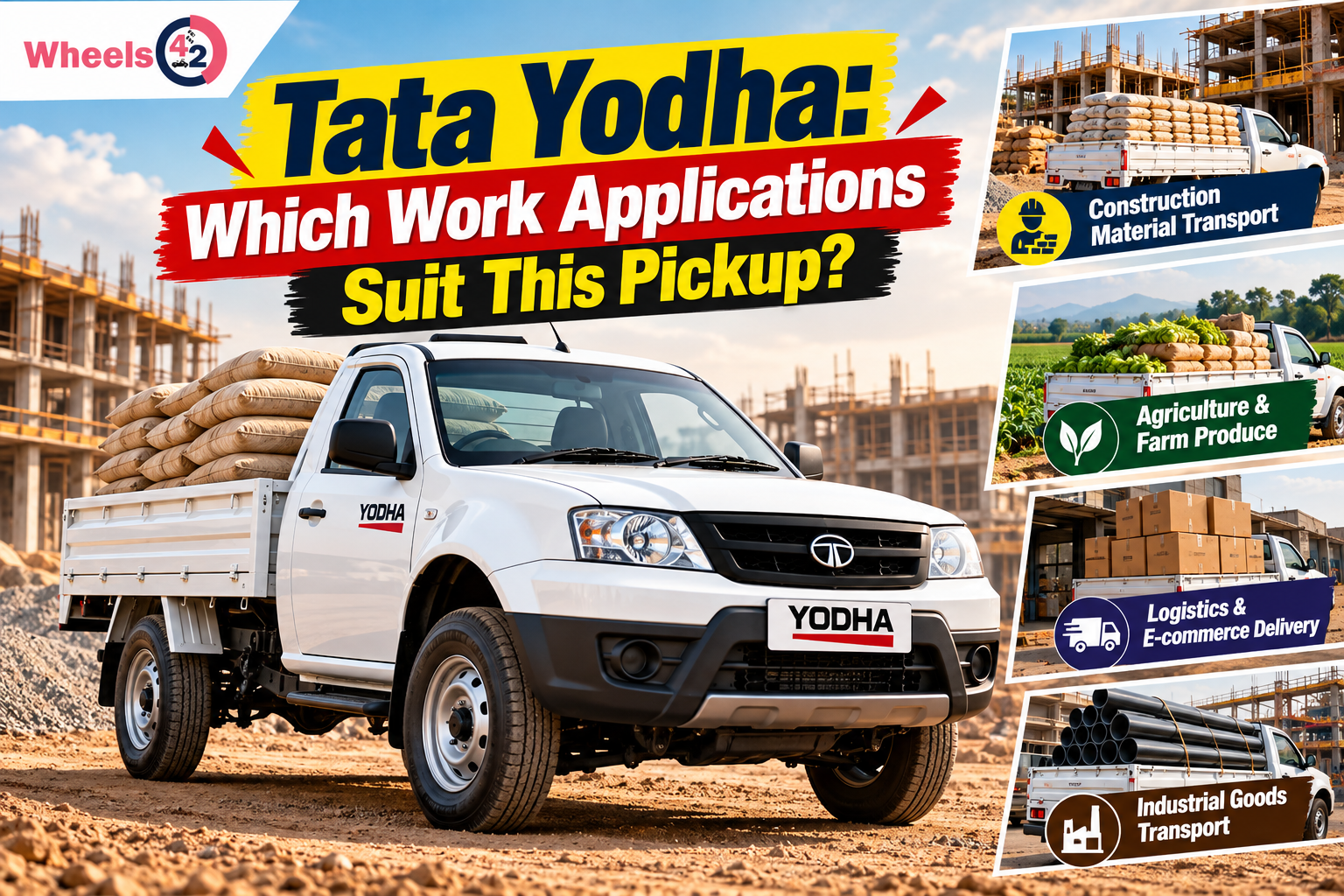
A commercial vehicle earns its keep when it can handle the kind of work a business actually does. For operators moving agricultural produce, construction materials, FMCG goods or other heavy and bulky cargo, a pickup needs more than a large loading area. It needs the right payload capacity, usable performance, durability and the ability to work across different road conditions.
The Tata Yodha has been developed around this idea. Tata Motors offers the Yodha range in different configurations, with applications spanning agriculture, construction, logistics, FMCG, dairy, fisheries and other cargo-intensive businesses. Depending on the version, the range also includes different payload and drivetrain configurations.
So, which work applications suit the Tata Yodha best? The answer depends on the variant and the type of cargo being transported.
Agricultural transportation is one of the most natural applications for a pickup such as the Yodha.
Farmers, traders and agricultural businesses may need to move vegetables, fruits, grains, sacks and other farm produce between farms, collection points, mandis and storage locations.
The Yodha 2.0 is listed with a payload capacity of up to 2,050kg in Tata's current specification material, giving it the ability to handle substantially heavier loads than smaller cargo vehicles.
For businesses operating outside major cities, ground clearance and road capability can also be important. The Yodha 2.0 is listed with 210mm ground clearance, while Tata offers Yodha variants with 4x4 capability.
Construction is another application where a rugged pickup can prove useful.
Materials such as cement bags, tools, equipment, pipes and other supplies often have to travel between warehouses, dealers and construction sites.
The Yodha's payload-focused design and large cargo area make it relevant for this type of work. Tata's current Yodha 2.0 brochure specifically lists construction material among its applications.
However, operators should always calculate the actual weight of their typical cargo rather than assuming that the maximum rated payload applies to every configuration.
The Tata Yodha can also be used for transporting packaged consumer products.
Businesses distributing:
may use a pickup to move goods between distributors, warehouses and local markets.
Tata Motors lists FMCG and logistics among the applications supported by its pickup range.
For operators who make several deliveries during the day, the ideal Yodha configuration will depend on the required payload, body arrangement and route conditions.
Milk cans and dairy products require regular movement, often beginning early in the morning and involving rural roads as well as town routes.
Tata specifically includes milk among the Yodha's applications, while its Yodha material also shows milk cans as a cargo use case.
A pickup can be particularly useful for dairy operators who need to collect milk from multiple villages before transporting it to a collection centre or processing facility.
The growth of e-commerce has increased demand for commercial vehicles capable of moving packages between hubs, warehouses and local delivery points.
The Yodha's larger cargo capacity can make it suitable for businesses that need to transport a substantial volume of packages rather than making individual last-mile deliveries.
Tata's current Yodha 2.0 brochure lists e-commerce among its intended applications.
For highly congested urban routes with narrow lanes and frequent stops, however, operators should compare the Yodha with smaller commercial vehicles before purchasing.
Businesses involved in poultry and fisheries often need dependable transportation between production areas, markets and distribution points.
Tata's Yodha application information specifically includes poultry and fisheries.
Depending on the business, the vehicle may also require a specialised body or equipment. Buyers should confirm that the proposed body modification is compatible with the vehicle's payload and legal requirements.
One of the Yodha's strongest use cases is transporting cargo that is either heavy, bulky or both.
The current Yodha 2.0 specification lists:
depending on the specification.
This combination makes the vehicle relevant for businesses where carrying capacity and rugged-road ability are more important than having a compact footprint.
Not every commercial vehicle operates exclusively on smooth highways.
A pickup may need to travel through villages, farms, construction sites, hilly areas or poorly surfaced roads. Tata offers Yodha configurations with 2WD and 4WD, giving operators the opportunity to select a drivetrain suited to their operating environment.
The 4x4 option can be particularly relevant where traction is a recurring requirement, although it should not be selected solely for occasional use without considering the additional operating requirements.
|
Specification |
Tata Yodha 2.0 |
|
Engine |
2.2-litre VARICOR turbocharged diesel |
|
Engine capacity |
2,179cc |
|
Maximum power |
74.8kW / 100 hp |
|
Maximum torque |
250Nm |
|
Transmission |
5-speed manual |
|
Fuel tank |
52 litres |
|
GVW |
Up to 3,890kg |
|
Payload |
Up to 2,050kg* |
|
Ground clearance |
210mm |
|
Cargo box |
2,645 × 1,843 × 415mm |
|
Tyres |
215/75 R16 |
|
Seating |
Driver + 1 |
|
Warranty |
3 years / 3 lakh km* |
|
Business Application |
Why Yodha Can Be Relevant |
|
Agriculture |
Suitable for farm produce and mandi transport |
|
Construction |
Useful for heavy materials and equipment |
|
FMCG |
Suitable for distributor and market loads |
|
Dairy |
Useful for milk-can transportation |
|
E-commerce |
Suitable for hub and cargo movement |
|
Logistics |
Useful for heavier commercial loads |
|
Poultry |
Can support farm-to-market transportation |
|
Fisheries |
Suitable for transporting fish and related cargo |
|
Rural operations |
Useful where roads can be challenging |
|
Heavy/bulky cargo |
High payload variants support heavier loads |
A commercial vehicle should be selected according to the business rather than simply its maximum payload figure.
Calculate Your Typical Load
If your normal cargo weighs 800–1,000kg, buying a much higher-capacity vehicle may not always provide the best operating economics.
Consider Your Roads
If most trips happen on highways and paved city roads, a 2WD configuration may be sufficient. Businesses operating regularly on difficult terrain may have different requirements.
Check Body Requirements
Different businesses need different load bodies. A dairy operator, construction supplier and e-commerce distributor may require different cargo setups.
Calculate Running Costs
Fuel, tyres, servicing, insurance, financing and downtime all affect the actual cost of operating a commercial vehicle.
Think About Turnaround Time
A truck that can carry more cargo per trip may reduce the number of daily trips required. For businesses with regular high-volume routes, this can be an important factor.