
 Khyati Sharma 2026-06-22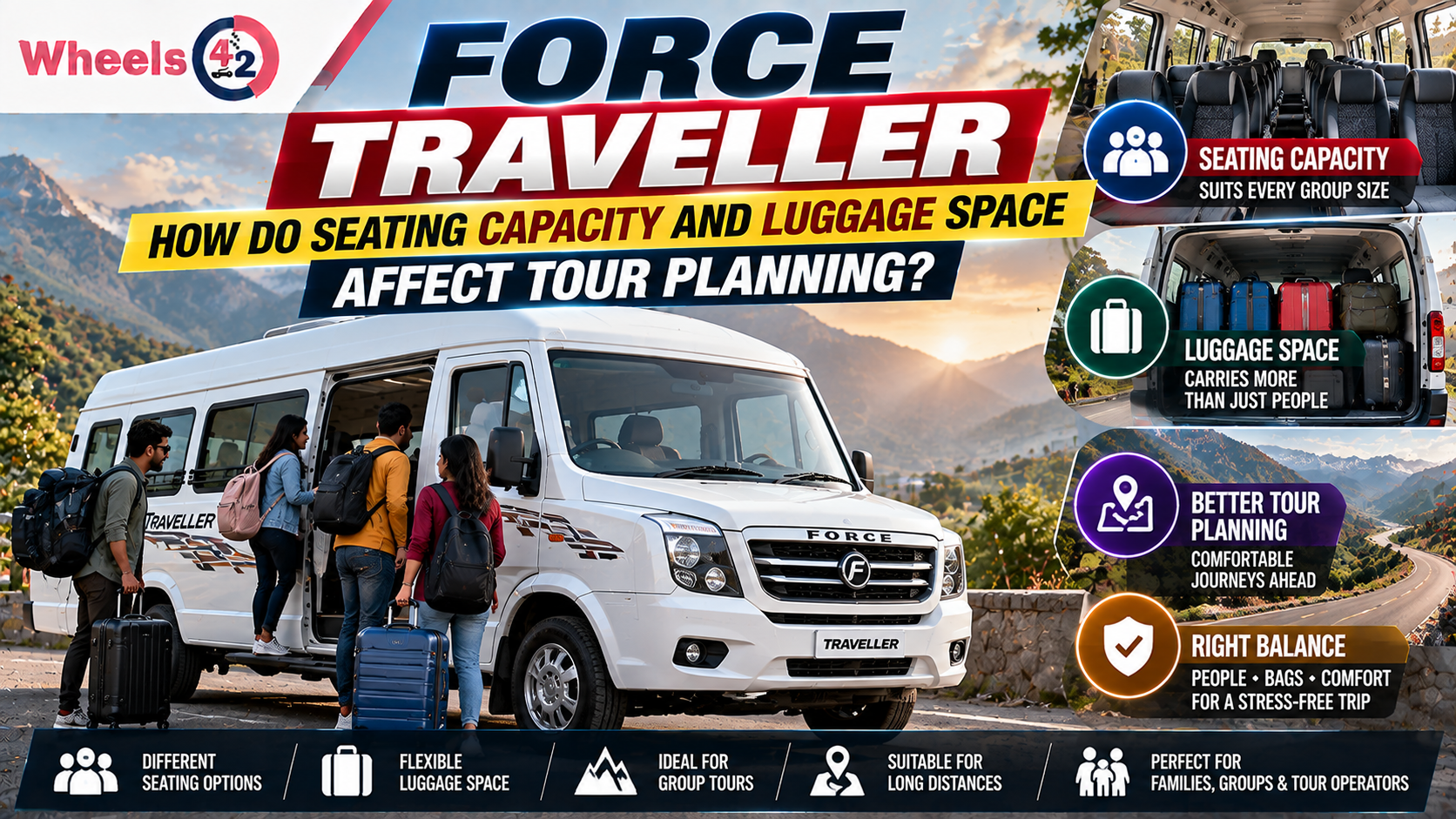
Planning a group tour is not only about choosing a vehicle with enough seats. The amount of luggage each passenger carries can significantly affect comfort, practicality and even the way the journey needs to be organised.
The Force Traveller is available in multiple passenger configurations, making it a popular option for family trips, tourist operators, employee transport and group travel. Depending on the version and wheelbase, passenger configurations include options such as 12+D, 17+D, 19+D, 22+D and 25+D, giving operators considerable flexibility.
For tour planning, however, the right Traveller is not necessarily the one with the highest seating capacity. The key is finding the right balance between passenger count, luggage requirements and cabin comfort.
The first step in planning a tour is calculating how many people will actually travel.
The current Traveller range provides different seating configurations depending on the wheelbase and body configuration. For example, the 3700mm wheelbase Traveller is offered in 12+D and 17+D configurations, while the wider 4020mm version is available in 19+D, 22+D and 25+D layouts.
This means a tour operator can select a configuration based on the size of the group rather than using one vehicle for every type of journey.
Typical Planning Approach
|
Group Size |
Suitable Approach |
|
Small family/group |
Lower-capacity Traveller |
|
Medium group |
12+D or 17+D configuration |
|
Larger group |
19+D or 22+D configuration |
|
Large tour group |
25+D configuration |
|
Large group with substantial luggage |
Consider capacity and luggage requirements together |
A higher seating capacity can reduce the number of vehicles required for a tour, but it can also change the amount of personal space available for luggage.
For example, a group of 20 passengers may technically fit into a 22+D configuration. However, if everyone is carrying large suitcases for a multi-day trip, the operator should assess the available luggage arrangement before finalising the vehicle.
This is particularly important for:
A vehicle that comfortably carries the passengers but cannot accommodate their bags can create problems throughout the journey.

Luggage requirements depend heavily on the duration and purpose of the trip.
A one-day sightseeing tour may require only small bags and backpacks. A week-long holiday, on the other hand, can involve large suitcases for every passenger.
Therefore, tour operators should estimate luggage before selecting the seating configuration.
A useful planning formula is:
Total luggage requirement = Number of passengers × Average luggage per passenger
The calculation does not have to be exact, but it provides a useful starting point.
For example, a 20-person group carrying large suitcases will have very different space requirements from 20 passengers carrying only backpacks.
The safest approach is to physically inspect the specific Traveller configuration being considered.
The Traveller is available in different body lengths and passenger layouts, so luggage arrangements can vary depending on the version.
Operators should check:
Luggage should never be positioned in a way that compromises passenger safety or blocks required access.
The Traveller range uses different wheelbase configurations, including 3050mm, 3350mm, 3700mm and 4020mm versions in the current lineup. The longer and wider configurations allow Force Motors to offer different passenger and application layouts.
For tour operators, this means wheelbase selection should be based on the entire trip rather than simply the number of seats.
A longer vehicle may make more sense when the itinerary involves more passengers and luggage, while a smaller configuration can be easier to operate in narrow city streets and crowded tourist destinations.
A successful tour is not simply one where everyone fits inside the vehicle.
Passengers may spend several hours inside the Traveller, making seat comfort, cabin cooling, entry and exit and noise levels important considerations.
The newer Traveller N range brings an updated cabin with redesigned seats, improved NVH, a new HVAC system and a more modern cockpit. Force Motors says the new range is intended to improve comfort, convenience and overall passenger experience.
For long-distance tours, these improvements can be just as important as seating capacity.
Tour vehicles can spend several hours on the road, often with the cabin fully occupied.
The Traveller's passenger configurations can be equipped with HVAC solutions designed for larger passenger cabins. Some versions offer features such as twin-blower or individual-duct air-conditioning, depending on configuration.
When selecting a vehicle for a tour, operators should consider the climate and route.
For example, a summer tour through northern or central India will place considerably more demand on the air-conditioning system than a short winter journey.
Passenger movement becomes increasingly important as group size grows.
If a tour involves frequent sightseeing stops, passengers may repeatedly enter and exit the vehicle. Easy access can therefore save time at every stop.
The Traveller is designed with easy entry and exit as one of its convenience considerations, but operators should still evaluate the specific body and seat configuration before purchasing or booking a vehicle.
This is especially important when the group includes:
1. Short Sightseeing Trips
For a local sightseeing tour, luggage requirements are usually low.
Here, maximising passenger capacity can make sense because passengers are unlikely to carry large suitcases.
2. Weekend Trips
A weekend trip usually requires more luggage, including overnight bags and personal items.
The operator should leave sufficient practical space rather than selecting a vehicle purely based on the number of seats.
3. Long-Distance Holidays
For multi-day tours, luggage becomes a major consideration.
A slightly lower passenger load may sometimes provide a more comfortable overall experience if it allows better luggage management.
4. Airport Transfers
Airport tours are particularly luggage-intensive because passengers may carry large suitcases.
In this situation, luggage capacity should be evaluated before finalising the passenger configuration.
5. Pilgrimage Tours
Pilgrimage groups can vary considerably in luggage requirements. Some passengers may carry small bags, while others may travel with multiple items.
Operators should estimate luggage requirements based on the actual group rather than assuming that every passenger will carry the same amount.
Not necessarily.
The maximum available seating configuration is attractive when the priority is carrying more passengers in a single vehicle. However, a tour operator should not assume that the highest seat count will always be the most practical choice.
Consider two groups:
Group A: 25 passengers on a short city tour with small backpacks.
Group B: 20 passengers travelling for seven days with large suitcases.
The first group may benefit from a higher-capacity configuration, while the second group needs much more attention to luggage management and passenger comfort.
This is why seat count and luggage requirements should always be evaluated together.
The Traveller's size also needs to be considered against the route.
A larger vehicle can be useful on highways and major tourist routes, but narrow roads, crowded markets, steep access roads and small parking areas can make vehicle dimensions important.
Before starting a tour, operators should check:
This can help prevent situations where the vehicle is suitable for the passengers but unsuitable for the route.
Bottom Line
The Force Traveller can be configured for a wide range of group-tour requirements, but selecting the right version requires more than counting seats.
Passenger numbers, luggage, trip duration, road conditions, cabin comfort and frequency of stops should all be considered together. The current range offers multiple seating configurations, including 12+D, 17+D, 19+D, 22+D and 25+D, allowing operators to choose a layout suited to different group sizes.
For short trips with limited luggage, maximising seating capacity may be the priority. For longer holidays, however, passenger comfort and practical luggage management can be more important than filling every available seat.
For Wheels42 readers considering the Traveller for tourism or group transportation, the best configuration is therefore the one that provides the right balance between people, bags and comfort—not simply the highest seating capacity.