 Khyati Sharma 2026-10-01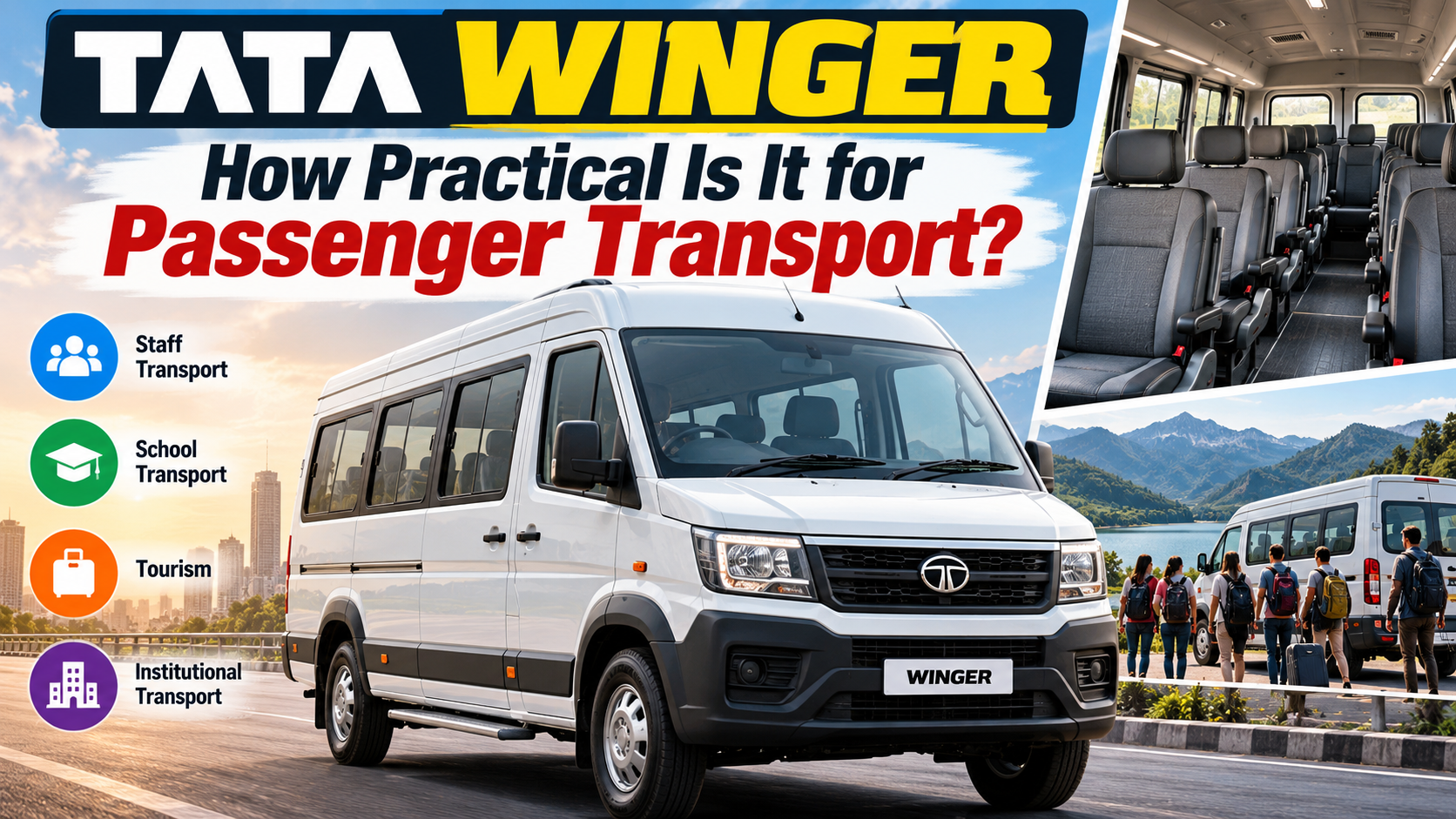
The Tata Winger has established itself as a versatile passenger vehicle for businesses and operators who need to move people comfortably and efficiently. Available in multiple configurations, the Winger can be used for staff transportation, school services, tourism, institutional transport and other passenger-focused applications.
Its combination of a diesel engine, multiple seating layouts, relatively car-like driving characteristics and a monocoque body makes it different from conventional bus-based passenger vehicles.
But how practical is the Tata Winger for day-to-day passenger transport? The answer depends on the number of passengers, route conditions and the operator's priorities.
One of the biggest advantages of the Tata Winger is the availability of different seating configurations.
Tata Motors currently lists Winger variants ranging from smaller passenger configurations to versions capable of carrying 20 passengers plus an attendant and driver. The range also includes the premium Winger Plus 9-seater, aimed particularly at staff transportation and travel and tourism applications.
This allows operators to choose a configuration according to their specific business requirement rather than using one vehicle for every application.
|
Tata Winger Configuration |
Typical Application |
|
9-seater |
Premium staff transport, tourism |
|
12/13-seater |
Staff and institutional transport |
|
15/18-seater |
Larger passenger operations |
|
20-seater |
School and high-capacity passenger transport |
|
Winger Plus |
Premium staff and tourist transport |
Tata Motors describes the Winger range as suitable for tourism, education and healthcare, while individual versions are also offered for staff and school transportation.
The Winger range uses Tata's 2.2-litre DiCOR diesel engine in the configurations listed by Tata Motors.
The engine produces approximately 74.8kW, or around 100hp, at 3,750rpm, while maximum torque is rated at 200Nm between 1,250 and 3,500rpm.
The broad torque band is useful for a passenger vehicle because operators frequently drive with a full load. Strong low- and mid-range torque can reduce the need for frequent gear changes, particularly on routes involving traffic, inclines and varying passenger loads.
|
Specification |
Tata Winger |
|
Engine |
2.2-litre DiCOR diesel |
|
Displacement |
2,179cc |
|
Maximum Power |
74.8kW @ 3,750rpm |
|
Maximum Torque |
200Nm @ 1,250–3,500rpm |
|
Gearbox |
5-speed manual |
|
Fuel Type |
Diesel |
|
Drive Layout |
Front-wheel drive |
|
Front Suspension |
McPherson strut with coil spring |
|
Rear Suspension |
Parabolic leaf spring |
|
Steering |
Power-assisted rack and pinion |
|
Fuel Tank |
60 litres |
|
Front Brakes |
Disc |
|
Rear Brakes |
Drum with ABS |
The exact equipment can vary between Winger variants, so operators should check the specifications of the particular configuration they intend to purchase.
Passenger comfort is particularly important for vehicles used for staff transportation and tourism.
The Winger's monocoque construction is one of the factors that gives it a more car-like driving and ride character compared with traditional body-on-frame passenger vehicles.
Tata Motors also highlights low vibration and comfortable seating as important aspects of the Winger's passenger experience.
The premium Winger Plus goes further with reclining captain seats, adjustable armrests, individual USB charging points, individual AC vents and additional legroom.
For companies transporting employees over relatively long distances, these features can make a noticeable difference to the passenger experience.
The Winger can make sense for operators running regular intercity or longer-distance passenger routes.
The diesel engine's torque delivery is suited to carrying multiple passengers, while the relatively large body provides useful interior space.
Depending on the variant, operators can also get features such as air conditioning, luggage space and passenger-focused interior equipment.
The Winger Plus, for example, is specifically positioned for staff transportation and travel and tourism, making it relevant to corporate transport operators, hotels, tour companies and similar businesses.
Passenger transport is not only about seating capacity. For tourism applications, luggage space can be equally important.
Some Winger configurations provide dedicated luggage capacity, while the exact amount varies depending on the seating layout and body configuration.
This makes the vehicle more suitable for tourist operations than a passenger van designed purely around maximum seating capacity.
Operators should therefore select the configuration based on the expected balance between passenger count and luggage requirements.
The larger Winger configurations have a wheelbase of around 3,488mm, with an overall length of approximately 5,478mm and width of 1,905mm.
These dimensions provide a spacious cabin but also mean that operators need to consider parking space, narrow roads and turning areas when planning routes.
|
Dimension |
Winger 3,488 WB |
|
Wheelbase |
3,488mm |
|
Length |
5,478mm |
|
Width |
1,905mm |
|
Height |
Up to 2,670mm depending on variant |
|
Ground Clearance |
Around 180mm |
|
Fuel Tank |
60 litres |
The larger dimensions are beneficial for passenger capacity, although they can become a consideration in congested urban areas.
Safety is another important consideration for commercial passenger vehicles.
Depending on the variant, the Winger range is equipped with features including ABS, disc front brakes, rear drum brakes and a dual-circuit hydraulic braking system.
Tata also offers safety and fleet-management-related technologies across the range.
For operators, safety equipment should be considered alongside seating capacity, maintenance requirements and route conditions rather than simply focusing on purchase cost.
For commercial operators, keeping track of vehicles is just as important as the vehicle itself.
Tata Motors offers Tata Fleet Edge on relevant Winger configurations. The system can provide information such as vehicle tracking, fuel consumption, fuel-theft monitoring, maintenance reminders and driver-related information, depending on the vehicle and system configuration.
For a fleet operator managing multiple passenger vehicles, this can help improve visibility over vehicle utilisation and operating costs.
The Winger's flexibility makes it suitable for several applications.
Staff Transportation
Companies can use the Winger to transport employees between residential areas, offices and industrial facilities.
The premium Winger Plus is particularly focused on this use case, offering a more comfortable 9-seat configuration.
School Transportation
Higher-capacity Winger versions can be configured for school transport.
The combination of passenger capacity, dedicated seating layouts and commercial-vehicle construction makes the Winger suitable for institutions that need regular student transportation.
Tourism
Tour operators can use the Winger for group travel, particularly where passenger comfort and luggage capacity are important.
The availability of premium seating in the Winger Plus makes it a more suitable option for higher-comfort tourist applications.
Tata Motors also lists healthcare among the Winger's applications. The platform's flexible interior makes it possible to adapt configurations for specific institutional requirements.
Despite its size, the Winger is designed with features intended to make everyday operation easier.
Power steering, a front-wheel-drive layout and the vehicle's monocoque construction contribute to its relatively car-like driving characteristics.
However, the larger versions are still substantially bigger than conventional passenger cars. Drivers operating them in narrow streets, crowded markets or tight parking areas will need to account for the vehicle's length and width.
For commercial operators, driver training therefore remains important.
For a passenger transport business, the purchase price is only one part of the equation.
Fuel consumption, maintenance, tyres, insurance, permits, driver costs and downtime all contribute to the total operating cost.
The Winger's diesel engine and commercial-vehicle architecture are intended for regular usage, while Tata promotes fuel efficiency and operating economics as part of the Winger proposition.
Actual fuel consumption, however, can vary considerably depending on passenger load, traffic, road conditions, driving style, air-conditioning usage and route profile.
Therefore, operators should calculate running costs based on their own routes instead of relying solely on an advertised efficiency figure.
|
Advantages |
Considerations |
|
Multiple seating configurations |
Larger variants can be difficult to manoeuvre in tight spaces |
|
2.2-litre diesel engine |
Diesel running costs depend heavily on route and load |
|
200Nm torque |
Vehicle dimensions require experienced drivers |
|
Monocoque construction |
Exact features vary by variant |
|
Suitable for staff transport and tourism |
Higher-capacity versions prioritise passenger volume over premium comfort |
|
Fleet-management technology available |
Operators need to choose configuration carefully |
|
Premium Winger Plus available |
Premium variants have higher acquisition costs |
There is no single configuration that suits every passenger transport business.
A 9-seater Winger Plus can make more sense for premium staff transportation or tourism, where passenger comfort is a priority.
A 12- or 13-seater configuration can offer a balance between passenger capacity and interior space.
Operators transporting larger groups may prefer the 15-, 18- or 20-seater configurations, particularly for school or institutional applications.
The best configuration ultimately depends on the number of passengers transported on a typical trip, the amount of luggage required and the type of roads on which the vehicle will operate.