
 Khyati Sharma 2026-10-20
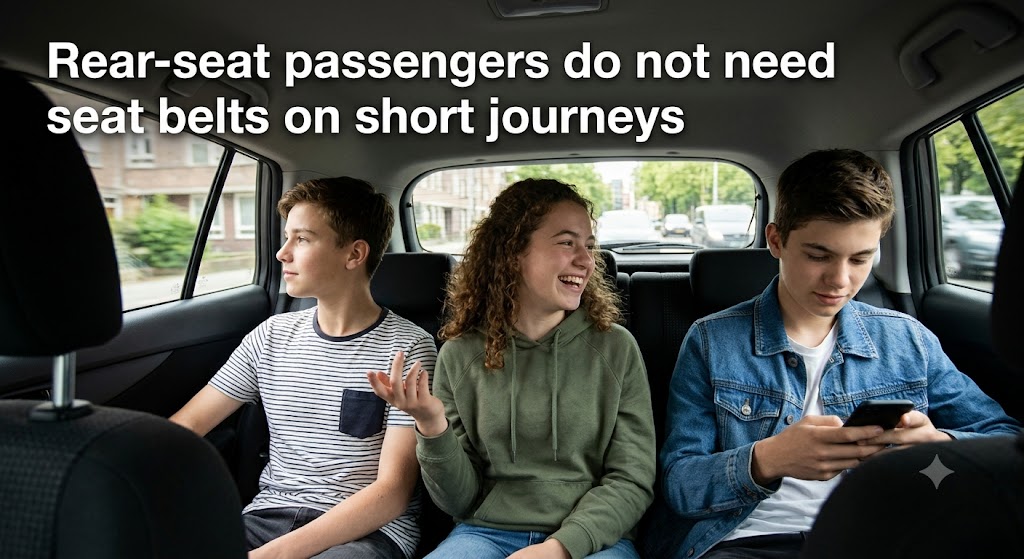
Many people believe that rear-seat passengers do not need to wear seat belts when travelling short distances. They may think that a quick drive to the local market, a nearby office, a school or a friend's house is too short to be dangerous. Because the journey may last only five or ten minutes, wearing a seat belt can seem unnecessary.
However, this belief is a road-safety myth. Rear-seat passengers should wear seat belts on every journey, regardless of the distance. Accidents can happen on familiar roads, near home and even when a vehicle is travelling at a relatively low speed. Seat belts help keep occupants securely positioned and reduce the risk of serious injuries during a collision.
In India, rear-seat seat belt use is also covered by traffic rules. Understanding the risks and the legal requirements can help families and everyday commuters make safer decisions.
Car Loan in India 2026: EMI, Rates, Eligibility and Steps
There are several reasons why passengers avoid using rear seat belts, especially during short trips.
Some people assume that the back seat is naturally safer than the front seat. Others believe that a driver travelling slowly through residential streets can stop in time if something unexpected happens. Passengers may also find seat belts uncomfortable, forget to buckle up or assume that seat belts are necessary only on highways.
Another common reason is habit. If someone has travelled for years without wearing a rear seat belt and has never experienced an accident, they may believe the practice is safe.
But the absence of an accident in the past does not guarantee safety in the future. A vehicle can encounter sudden braking, an unexpected obstacle, a side impact or a collision with another vehicle at any point during a journey.
A short trip reduces the time spent on the road, but it does not eliminate the possibility of an accident.
The rear seat can offer important safety advantages in some situations, but those advantages depend on passengers using the available safety equipment correctly.
During a sudden stop or collision, an unrestrained passenger continues moving forward because of inertia. Without a seat belt, the passenger can strike the front seat, door, window or another occupant.
In a severe collision, an unrestrained person may even be thrown out of the vehicle. A rear-seat passenger can also injure the driver or front passenger by being thrown forward.
Seat belts are designed to hold the occupant in place, spread crash forces across stronger parts of the body and reduce the chance of being thrown around inside the cabin. Research indicates that correctly worn rear seat belts substantially reduce the risk of death and serious injury.
Therefore, sitting in the rear seat should not be treated as a reason to ignore seat belt safety.
Yes. The duration of a journey does not determine whether a collision will occur.
Imagine a family travelling two kilometres to a nearby supermarket. The driver approaches an intersection when another vehicle suddenly enters the road. Even if the driver brakes immediately, the car may not stop before impact.
An unbelted rear passenger could be thrown forward, potentially striking the front seat or another occupant. A correctly worn seat belt helps prevent this uncontrolled movement.
Similar situations can occur when a vehicle brakes suddenly for a pedestrian, a cyclist, an animal or a vehicle changing lanes unexpectedly.
Short journeys often involve local streets, junctions, parking areas and frequent stops. These conditions still require attention to road safety.
The safest habit is simple: buckle up before the vehicle starts moving, even when the destination is nearby.
New Car Delivery Day: What to Check Before You Drive Off
Indian traffic rules require occupants of applicable front-facing rear seats to wear seat belts while a vehicle is moving.
In a written answer in the Rajya Sabha dated March 25, 2026, the Ministry of Road Transport and Highways referred to Rule 138(3) of the Central Motor Vehicles Rules, 1989, which requires occupants of covered front-facing rear seats to wear seat belts while the vehicle is in motion. Section 194B of the Motor Vehicles Act provides for a ₹1,000 fine for specified seat belt violations.
The practical message for motorists is clear: do not assume that a short journey creates an exemption from seat belt requirements.
Drivers should ensure that passengers buckle up before departure. Passengers should also take responsibility for their own safety rather than relying entirely on the driver.
|
Situation |
Without a seat belt |
With a correctly worn seat belt |
|
Sudden braking |
Passenger may slide or move forward |
Passenger is restrained in the seat |
|
Front collision |
Greater risk of hitting the cabin interior |
Helps reduce impact injuries |
|
Side collision |
Passenger may strike the door or window |
Helps keep the occupant in position |
|
Collision involving other occupants |
Passenger may be thrown into someone else |
Reduces uncontrolled movement |
|
Short city journey |
Crash risk still exists |
Adds protection throughout the trip |
Wearing a seat belt is not enough if it is positioned incorrectly. Passengers should make sure the belt fits properly before the vehicle starts moving.
Follow these steps:
Sit upright: Keep your back against the seat rather than leaning sideways or slouching.
Position the lap belt low: It should sit snugly across the hips and pelvis, not across the soft stomach area.
Place the shoulder belt correctly: The diagonal section should cross the middle of the chest and shoulder, away from the neck.
Remove twists: Make sure the belt is flat and not twisted.
Check the buckle: Listen for the buckle to click into place and gently pull the belt to ensure it is secured.
Keep the belt on: Do not unbuckle it while the vehicle is moving, even if the destination is only a few streets away.
Never place the shoulder belt behind your back or under your arm. These positions can compromise protection in a collision.
New Car Booking Process Explained Step by Step
Children also need appropriate protection when travelling in a car. However, an adult seat belt may not fit a small child correctly.
Young children should use an age- and size-appropriate child restraint, installed according to the manufacturer's instructions. Older children should use a seat belt only when it fits correctly, with the lap section across the hips and the shoulder section across the chest.
Parents should avoid allowing children to share one seat belt or travel on an adult's lap. A child sitting on a passenger's lap can be seriously injured during sudden braking or a crash.
The rear seat is often a suitable place for children, but the correct restraint is essential. Always follow the vehicle and child-seat manufacturer's instructions and applicable local rules.
Myth 1: Seat belts are necessary only on highways.
Reality: Collisions can happen on city streets, residential roads and near intersections. Wear a seat belt on every trip.
Myth 2: The rear seat is completely safe without a seat belt.
Reality: An unrestrained rear passenger can strike the vehicle interior or another occupant during a crash.
Myth 3: A slow-moving car does not need seat belts.
Reality: Low speed does not eliminate the possibility of a sudden collision. The consequences depend on the impact and circumstances.
Myth 4: Airbags make seat belts unnecessary.
Reality: Airbags are supplemental safety devices. They are not substitutes for seat belts.
Myth 5: Wearing a seat belt is uncomfortable on a five-minute journey.
Reality: A correctly adjusted seat belt should fit snugly without unnecessary discomfort. Adjust the seating position and belt where possible rather than travelling unrestrained.
Hatchback vs Sedan vs SUV: Which Car Type Suits You Best?
Drivers can make seat belt use a normal part of every journey by establishing a few simple habits.
Before moving the car, check that all passengers have fastened their seat belts. If a passenger has not buckled up, wait until they do. Parents should help children use the correct restraint and explain why it matters.
Car owners should also check that rear seat belts are not damaged, tangled or blocked by luggage. Heavy items should be secured so they do not move around the cabin during sudden braking.
Modern vehicles may have seat belt reminders, but passengers should not rely solely on warning systems. Older vehicles may not provide reminders for every rear seat, and some systems may have limitations.
The easiest approach is to make buckling up automatic: enter the car, sit properly, fasten the belt and only then begin the journey.
Conclusion
The idea that rear-seat passengers do not need seat belts on short journeys is a dangerous misconception. A five-minute drive can involve unexpected braking, traffic conflicts or a collision, and an unrestrained passenger can suffer serious injuries even when travelling close to home.
Seat belts help keep occupants in place, reduce uncontrolled movement and improve protection during a crash. Indian traffic rules also require seat belt use for occupants of covered rear-facing seats while the vehicle is moving.
Whether travelling to the market, dropping children at school, commuting to work or taking a long highway trip, the advice remains the same: every passenger should buckle up before the car moves. No journey is too short for basic safety.






.avif)
Hyundai
₹65.00 Lakh