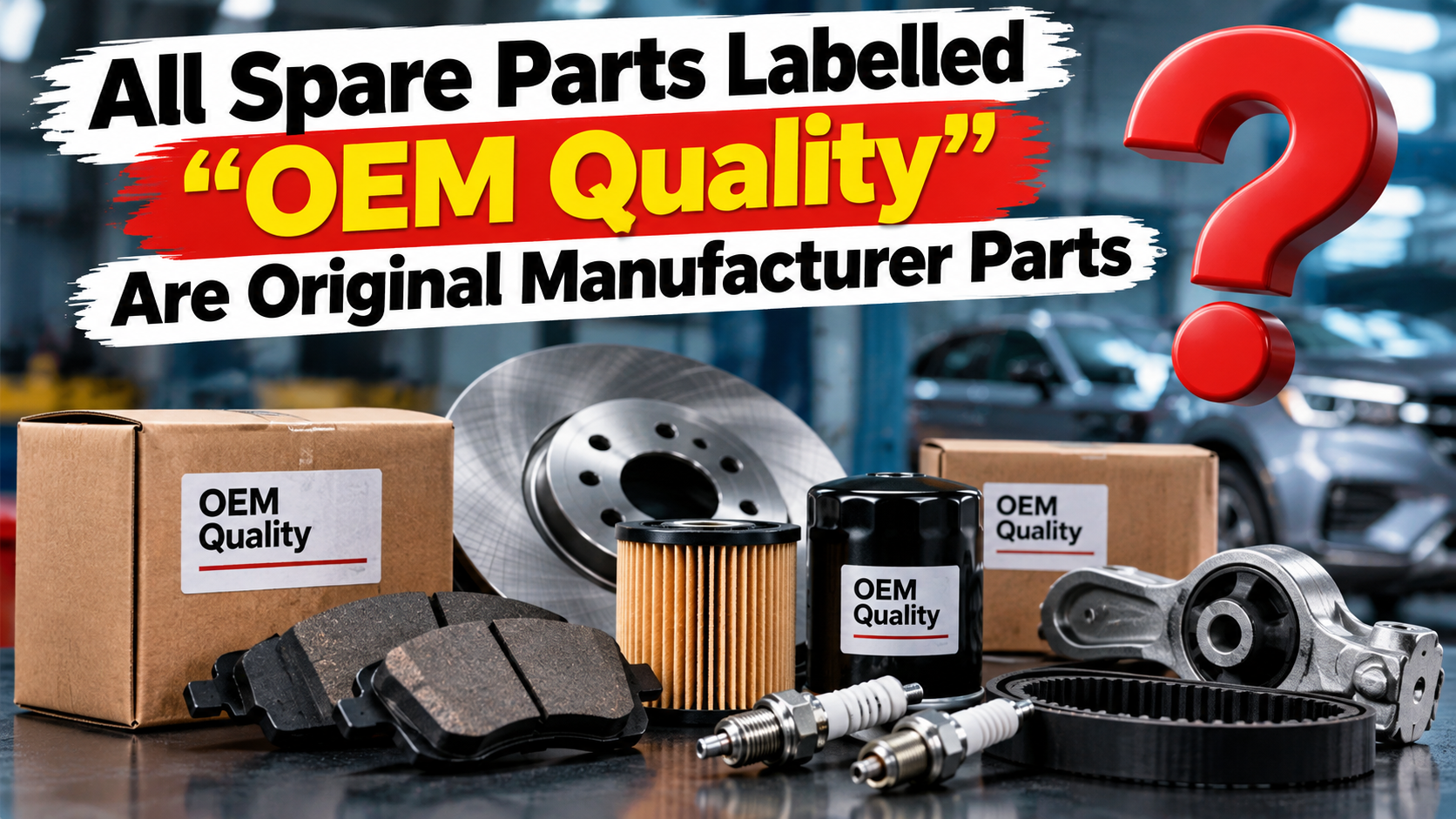
Spare parts labelled “OEM quality” are not automatically original manufacturer parts. The term is often used to suggest that an aftermarket component offers a similar level of quality, fit, or performance to an original part. However, the label alone does not prove who manufactured the component, whether it meets the vehicle manufacturer's specifications, or whether it has been approved by the manufacturer.
When replacing car parts, understanding the difference between genuine, OEM, and aftermarket components can help you make a better buying decision, avoid misleading claims, and maintain your vehicle's reliability.
New Car vs Used Car: Which One Should You Buy?
What Does “OEM” Actually Mean?
OEM stands for Original Equipment Manufacturer. In the automotive industry, an OEM is a company that manufactures components or equipment used by a vehicle manufacturer.
For example, a car manufacturer may source braking components, filters, sensors, electrical equipment, or other parts from specialist suppliers. Some of these suppliers manufacture components specifically for a vehicle brand under a supply agreement.
However, the term can be confusing when it appears on spare parts sold in the replacement market. A seller might describe a component as “OEM quality” without establishing that it was made by the original supplier or supplied through the vehicle manufacturer's authorised parts network.
That distinction is important. A product that claims to have OEM-level quality is not necessarily an original part.
What Is the Difference Between Genuine, OEM, and OEM-Quality Parts?
Drivers often encounter several similar terms when shopping for replacement components. Although they may sound interchangeable, they do not always mean the same thing.
1. Genuine Parts
Genuine parts are generally sold as vehicle-brand replacement parts through the manufacturer's authorised supply network. They typically carry the vehicle brand's packaging, part number, or identifying marks.
These parts are intended to meet the manufacturer's requirements for the specific vehicle application. Depending on the brand, they may be sourced from the manufacturer itself or from approved suppliers.
Genuine parts can be more expensive than some alternatives, but buyers benefit from clearer identification and access to the manufacturer's parts support and applicable warranty terms.
2. OEM Parts
OEM parts are components made by an original equipment manufacturer. In some cases, the same supplier may produce components for a vehicle manufacturer and sell similar products through other channels.
However, buyers should not assume that every replacement part sold under the OEM label is identical to the component originally fitted to their vehicle. The supplier, product specification, production batch, distribution channel, and applicable warranty can differ.
A seller should be able to explain exactly what they mean by OEM and provide evidence to support the claim.

3. OEM-Quality Parts
OEM-quality is generally a descriptive marketing term used to suggest that a replacement component offers quality comparable to an original equipment part.
It does not, by itself, confirm that the component was made by the original supplier, is an approved product, or has passed the same testing and quality-control processes as the original part.
Some OEM-quality aftermarket parts can perform very well. Others may differ in materials, design, durability, fitment, or manufacturing standards.
The key point: A claim about quality is not the same as proof of original manufacture.
Genuine vs OEM vs OEM-Quality vs Aftermarket Parts
|
Part type
|
What the term generally means
|
What buyers should check
|
|
Genuine part
|
Sold as an original vehicle-brand replacement part
|
Brand packaging, part number, authorised seller and authenticity
|
|
OEM part
|
Associated with an original equipment manufacturer
|
Actual manufacturer, product identity and compatibility
|
|
OEM-quality part
|
Claims to offer quality comparable to original equipment
|
Independent evidence, specifications, testing and warranty
|
|
Aftermarket part
|
Produced for the replacement market outside the vehicle brand's genuine-parts channel
|
Manufacturer reputation, fitment, quality standards and warranty
|
Why Do Sellers Use the Term “OEM Quality”?
The phrase can make an aftermarket component sound equivalent to an original part. This can attract customers who want reliable replacements without paying the price of a genuine component.
There are several reasons sellers may use this wording.
To communicate expected quality: A seller may want to indicate that the component is designed to offer good fitment, performance, or durability.
To compete on price: Some aftermarket products cost less than genuine parts, making them attractive to owners who want to reduce maintenance expenses.
To describe compatibility: The phrase may be used to suggest that a component is designed for the same vehicle application as an original part.
To improve sales: Terms such as “OEM quality,” “OEM standard,” and “original quality” can sound reassuring, even when the seller provides limited technical evidence.
The problem arises when buyers interpret these descriptions as proof that the component is genuine or made by the original supplier.
A trustworthy seller should clearly identify the product's manufacturer and explain the basis for any quality claims.
New Car Dealer Negotiation Tips That Actually Work
Are OEM-Quality Spare Parts Always Bad?
No. An OEM-quality label does not automatically mean that a part is poor, counterfeit, or unsafe.
The aftermarket includes established manufacturers that produce reliable components for a wide range of vehicles. Some aftermarket parts may offer performance, durability, and fitment comparable to genuine alternatives.
The important consideration is the actual product rather than the wording on the packaging.
Before purchasing an aftermarket component, check the manufacturer's reputation, technical specifications, compatibility information, applicable certifications, and warranty conditions. Independent test results or credible quality documentation can provide additional confidence.
For less critical components, a reputable aftermarket alternative may be a sensible choice. For safety-critical or electronically sensitive parts, careful verification is particularly important.

How Can You Check Whether a Spare Part Is Genuine?
You do not need to be a professional mechanic to carry out some basic checks. The following steps can help you reduce the risk of buying a misrepresented or unsuitable component.
1. Check the Part Number
Genuine replacement parts usually have identifiable part numbers that can be checked against the vehicle's official parts catalogue or through an authorised dealer.
Confirm that the number corresponds to your exact model, engine, variant, and production year. Similar-looking parts may not be interchangeable.
A matching number is useful evidence, but it is not conclusive proof of authenticity because labels and packaging can be copied.
2. Verify the Seller
Purchase genuine parts from authorised dealerships or reputable sellers with a clear business identity and return policy.
If buying online, review the seller's history, invoice details, product descriptions, and customer feedback. Be cautious if the seller refuses to disclose the manufacturer or provides vague answers about the product's origin.
3. Inspect the Packaging and Labels
Look for inconsistent printing, spelling mistakes, damaged seals, unusual packaging, missing identification details, or labels that appear to have been replaced.
These signs do not independently prove that a part is counterfeit, but they are reasons to investigate further.
Where available, use the manufacturer's official authentication process, such as a verification code or QR code. Check the code through an official channel rather than relying only on the printed label.
4. Ask for the Manufacturer's Name
If a product is advertised as OEM quality, ask who actually manufactured it.
Request the brand name, product code, technical specifications, and documentation supporting any claim that it is an original-supplier component. If the seller says the part is made by the same supplier as the original, ask for verifiable evidence.
A vague assurance such as “same quality as company parts” is not enough to establish the product's origin.
5. Check the Warranty
Review the warranty period, exclusions, installation requirements, and procedure for making a claim.
A clear warranty can provide some protection if a component fails, but a warranty alone does not prove that a part is genuine or high quality. Also confirm whether installation by an authorised workshop is required.
Car Loan in India 2026: EMI, Rates, Eligibility and Steps
Which Car Parts Require Extra Care?
Some components have a more direct effect on vehicle safety, engine operation, or electronic systems. Choosing replacements for these items requires particular attention to specifications and manufacturer recommendations.
Brake components: Brake pads, discs, calipers, and related hydraulic components must be suitable for the vehicle and meet appropriate performance requirements. An incorrectly specified or poorly manufactured component can compromise braking performance.
Engine oil and oil filters: Incorrect oil specifications or low-quality filters may affect lubrication and engine protection. Always follow the vehicle manufacturer's recommended oil grade and specification.
Airbags and seat-belt components: These are safety-critical restraint-system parts. Use properly verified components that meet the vehicle's requirements, and have installation carried out by a qualified professional.
Sensors and electronic modules: Incorrect compatibility can lead to warning lights, malfunctioning systems, diagnostic problems, or poor engine performance.
Suspension and steering parts: Ball joints, tie rods, control arms, and related components influence handling and stability. Their quality, fitment, and suitability should not be compromised merely to save money.
This does not mean every aftermarket part is unsuitable. It means that buyers should place greater emphasis on verified quality and compatibility when a failure could create a safety risk.
Car Waiting Period: How to Get Your New Car Faster
Can OEM-Quality Parts Save You Money?
Yes, potentially. A well-made aftermarket component may cost less than a genuine replacement and still provide satisfactory performance.
However, the lowest purchase price does not always represent the lowest overall cost.
A cheaper component that wears out quickly, causes another part to fail, or requires repeated labour can become more expensive over time. Conversely, a reputable aftermarket product with a suitable warranty may deliver good value.
Consider the following before making a decision:
-
Purchase price: Compare the cost of genuine and reputable aftermarket options.
-
Expected service life: Look for reliable information about durability rather than relying on advertising claims.
-
Installation costs: Some parts require specialised tools, calibration, or additional labour.
-
Warranty: Understand what is covered and whether installation conditions apply.
-
Compatibility: Verify the correct part for your exact vehicle.
-
Safety: Give priority to verified specifications for safety-critical components.
The best option depends on the part, vehicle, manufacturer recommendations, and evidence available about the replacement product.
Does Using OEM-Quality Parts Affect Your Car Warranty?
The answer depends on the warranty terms, the type of component, local consumer law, and whether the replacement part or its installation caused a problem.
An aftermarket component does not automatically prove that a vehicle's entire warranty is invalid. However, a manufacturer may dispute coverage for a particular failure if it can establish that an unsuitable part or improper installation caused or contributed to the damage.
Before replacing an important component on a new or under-warranty vehicle, check the warranty booklet and consult the authorised service centre if necessary. Keep invoices, part details, and installation records.
For vehicles covered by an extended warranty or service contract, review the specific conditions because these arrangements may have their own requirements.

Common Mistakes to Avoid When Buying Spare Parts
Many buyers make decisions based on packaging or price instead of verifying the product.
Avoid these common mistakes:
-
Assuming that “OEM quality” means “genuine OEM.”
-
Buying a part without checking its compatibility with the exact vehicle variant.
-
Trusting a seller's claim without asking for the manufacturer's identity.
-
Choosing a safety-critical component solely because it is cheaper.
-
Ignoring warranty exclusions and installation requirements.
-
Treating a logo, QR code, or part number as definitive proof without verification.
-
Assuming every aftermarket component is inferior to a genuine part.
A little research before purchasing can help prevent unnecessary expenses and reduce the risk of fitting an unsuitable component.
Final Verdict: Myth or Fact?
Myth. All spare parts labelled “OEM quality” are not original manufacturer parts.
The phrase generally suggests that a component is intended to offer quality comparable to original equipment, but it does not independently verify the manufacturer's identity, authenticity, approval status, or performance.
Genuine parts, OEM-supplier products, and aftermarket alternatives can all have a place in vehicle maintenance. The right choice depends on the component, its specifications, the reliability of the manufacturer, the quality evidence available, and your vehicle's requirements.
Before buying, verify the part number, identify the actual manufacturer, check compatibility, review the warranty, and purchase from a trustworthy seller. For safety-critical components, give priority to properly documented parts that meet the vehicle's required specifications.
Remember: Do not judge a spare part by the words “OEM quality” alone. Judge it by its verified origin, technical specifications, and proven reliability.

 Khyati Sharma 2026-09-15









_11zon.jpg)