
 Khyati Sharma 2026-09-25
Driving at night can be difficult, especially on Indian highways without streetlights, roads with sharp turns, and streets where pedestrians or animals can suddenly appear. Because visibility plays an important role in road safety, many car owners consider upgrading their factory-fitted headlights to brighter aftermarket LED or HID bulbs.
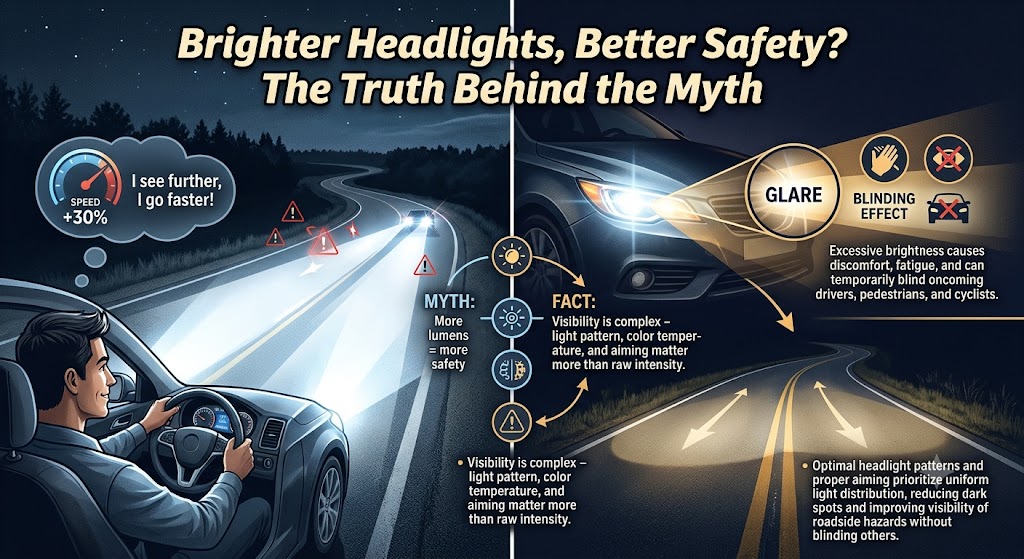
The idea sounds logical: if headlights produce more light, drivers should be able to see farther and react sooner. However, brighter aftermarket headlights do not always improve safety. In some situations, they can make visibility worse by creating glare, scattering light in the wrong direction or leaving important areas of the road poorly illuminated.
A headlight's performance depends on more than how bright it looks. Its beam pattern, alignment, colour characteristics, compatibility with the headlamp housing and ability to illuminate the road evenly all matter. A powerful bulb installed in an unsuitable headlight assembly may look impressive but fail to provide useful visibility.
This article explains when brighter headlights can help, when they can become dangerous, and how drivers can improve night-time visibility without putting other road users at risk.
Hatchback vs Sedan vs SUV: Which Car Type Suits You Best?
Many vehicles are supplied with halogen headlights, while newer models may offer factory-designed LED lighting. Drivers who regularly travel at night sometimes feel their existing headlights are not powerful enough, especially on poorly lit roads.
There are several common reasons for upgrading.
Better visibility on highways: Drivers want to identify road edges, potholes, animals and obstacles earlier, particularly where there is no street lighting.
Replacing old bulbs: Ageing bulbs, cloudy headlamp lenses, damaged reflectors and electrical problems can reduce the light reaching the road. Some drivers assume they need more powerful bulbs when maintenance may be the real solution.
A modern appearance: White LED lighting is often associated with newer vehicles, encouraging owners to replace warmer-coloured halogen bulbs.
The promise of higher brightness: Aftermarket products frequently advertise impressive lumen figures. However, a higher advertised light output does not automatically mean that more useful light reaches the places where the driver needs it.
Before upgrading, drivers should understand the difference between a headlight that looks brighter and a lighting system that actually helps them recognise hazards safely.
A car's headlight system is designed to direct light onto the road, not simply produce as much light as possible. The bulb or LED light source works with reflectors, projector lenses and the headlamp housing to create a controlled beam.
Low beams are intended for everyday night driving. They illuminate the road ahead while limiting light that could shine directly into the eyes of oncoming drivers. High beams provide longer-range visibility when the road is clear and their use is appropriate.
If the light source does not match the headlamp's optical design, the beam may become scattered or uneven. This can create bright patches close to the car while leaving distant areas poorly illuminated.
That is why a properly designed factory headlamp can sometimes provide better real-world visibility than a much brighter aftermarket bulb installed incorrectly.
How to Set a Realistic Car Buying Budget (On-Road Price Explained)
Brighter headlights can be beneficial when the upgrade improves useful illumination without creating excessive glare.
1. Better visibility on unlit roads
On highways and rural roads with limited street lighting, a suitable headlight upgrade can help drivers identify bends, road edges, signs and obstacles. Better illumination may provide more time to respond to a hazard.
2. Improved lighting from modern LED technology
A properly engineered LED headlamp can provide efficient illumination, precise beam control and a long service life. However, these benefits depend on the quality of the complete lighting system—not simply the fact that it uses LEDs.
3. Replacing worn-out bulbs
If existing bulbs have deteriorated, replacing them with the correct specification can restore expected performance. Cleaning cloudy lenses and repairing damaged wiring can also improve illumination without installing higher-output bulbs.
4. Better illumination when correctly aligned
Even a high-quality headlight can perform poorly if it points too high or too low. Correct alignment helps place the available light where the driver needs it.
The important point is that a successful upgrade should improve visibility on the road, not merely make the front of the vehicle look brighter.
More light can create new problems if it is poorly controlled.
Glare for oncoming drivers: Excessive light entering another driver's eyes can make it harder to identify pedestrians, lane markings and roadside hazards.
Uneven illumination: A mismatched bulb may create bright spots and dark areas, reducing the driver's ability to see the entire road clearly.
Discomfort in bad weather: Rain, mist and fog can complicate visibility. Light scattering from water droplets and wet surfaces may create distracting reflections, depending on the conditions and beam pattern.
False confidence: Drivers may assume that powerful headlights allow them to travel faster. However, stopping distance, reaction time, tyre grip and road conditions still determine whether a vehicle can stop safely.
Poor installation: Incorrect wiring, unsuitable components or badly fitted bulbs may compromise performance and reliability.
Brighter headlights are not automatically dangerous, but poorly selected, installed or adjusted headlights can put both the driver and other road users at risk.
Manual vs Automatic Car: Pros and Cons Explained
|
Headlight type |
Main benefit |
Possible drawback |
Best approach |
|
Halogen |
Affordable and widely available |
Usually less energy-efficient than LEDs |
Use the correct approved bulb and replace it when needed |
|
LED |
Can offer efficient, precise and long-lasting illumination |
Incompatible retrofits can cause glare and poor beam patterns |
Choose a compatible, road-legal system |
|
HID/Xenon |
Can provide strong illumination in a properly designed system |
Requires suitable optics and components |
Use a complete compatible setup and correct alignment |
|
Factory adaptive LED |
Can adjust light distribution in equipped vehicles |
Performance depends on design, calibration and conditions |
Maintain the system according to the vehicle manufacturer's guidance |
If you are considering a headlight upgrade, follow these practical steps.
Check the original bulb specification. Consult the owner's manual or a qualified technician before buying a replacement.
Verify compatibility. A bulb that physically fits is not necessarily optically compatible with the existing reflector or projector.
Look for applicable approvals. Check whether the product and installation meet the requirements for road use in your location.
Avoid choosing by advertised lumens alone. Light output figures do not tell you how effectively the beam illuminates the road.
Get the beam professionally aligned. This is especially important after replacing bulbs, repairing the headlamp assembly or changing suspension height.
Inspect the whole lighting system. Check lenses, reflectors, wiring, connectors and electrical components.
Test the result responsibly. Confirm that the road is illuminated evenly and that the headlights are not dazzling other drivers.
For vehicles used in India, check the applicable motor vehicle rules and approval requirements before making modifications. A product being available for sale does not automatically mean every installation is legal for road use.
New Car vs Used Car: Which One Should You Buy?
Not necessarily. Visibility depends on the weather, road surface, headlight design and the driver's ability to distinguish objects against the surroundings.
In fog, high beams can reflect off suspended water droplets and create a bright veil that makes it harder to see ahead. Low beams are generally more appropriate in these conditions. Where a vehicle is equipped with suitable fog lamps, use them according to the manufacturer's instructions and local rules.
On wet roads, reflections from the road surface can also affect visibility. Drivers should reduce speed, increase following distance and avoid relying on brighter headlights to compensate for poor weather.
Good lighting helps, but it cannot eliminate the risks caused by fog, heavy rain or reduced traction.
Myth: More watts always mean more useful light. Electrical power alone does not establish the quality of the beam.
Myth: Whiter or bluer headlights are always better. Colour appearance does not guarantee improved visibility.
Myth: Every LED upgrade is better than halogen. A mismatched LED bulb can perform worse than the original bulb.
Myth: If I can see better, my headlights must be safe. The beam must also avoid unnecessarily dazzling other road users.
Myth: Brighter lights mean I can drive faster. Speed must remain appropriate for visibility, road conditions and stopping distance.
Do brighter aftermarket headlights always improve safety?
No. They can improve visibility when the lighting system is compatible, correctly aimed and designed to produce a useful beam without excessive glare.
Are LED headlights safer than halogen headlights?
A well-designed LED system can offer excellent illumination and efficiency. However, an incompatible LED retrofit may create glare or uneven lighting, so the technology alone does not guarantee safety.
Can aftermarket headlights blind other drivers?
Yes. Excessive brightness, poor alignment or an unsuitable bulb and housing combination can cause glare for oncoming drivers.
What should I check before upgrading my headlights?
Check bulb compatibility, product approval, beam pattern, headlamp condition and alignment. A qualified technician can help verify the installation.
What is the simplest way to improve headlight performance?
Start by cleaning the lenses, checking the bulbs and electrical system, and having the beam alignment inspected. These steps may resolve visibility problems without requiring a more powerful bulb.
The belief that brighter aftermarket headlights always improve safety is a myth. Additional light can help drivers see hazards earlier, but only when it is distributed correctly and the headlamp system is suitable for the vehicle.
An incompatible bulb or poorly aligned headlight can cause glare, uneven illumination and reduced visibility for other road users. Drivers should therefore prioritise beam quality, compatibility, legal compliance and correct adjustment instead of choosing a bulb based on brightness claims alone.