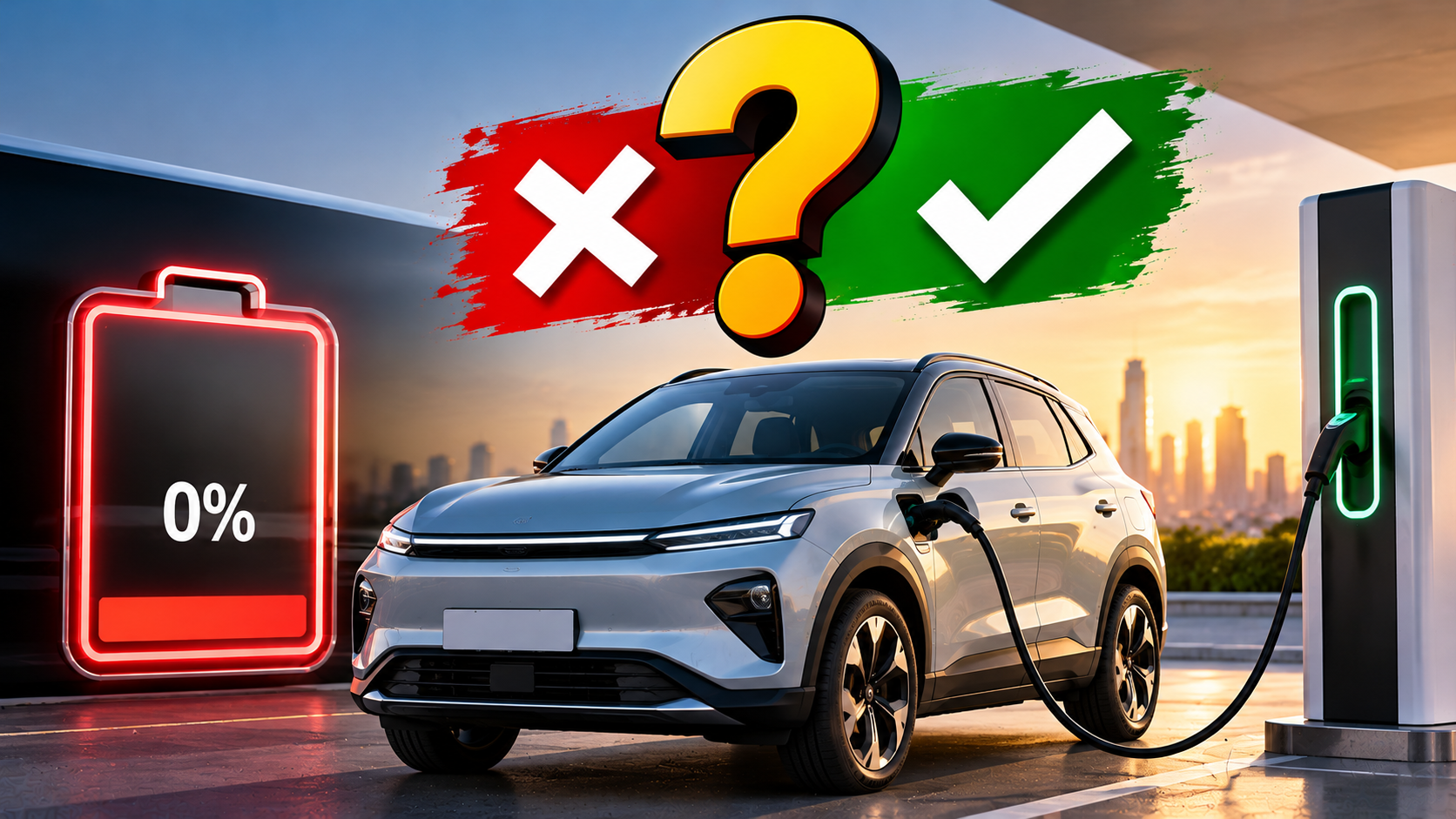
You should not drain an electric vehicle (EV) battery to zero before charging it. Unlike older battery technologies that sometimes benefited from full discharge cycles, modern electric cars generally use lithium-ion batteries that work best when charged according to the manufacturer's recommendations.
Allowing an EV battery to reach a critically low charge level regularly can increase battery stress and may leave you stranded if a charging station is not nearby. For everyday driving, charging before the battery becomes very low is usually a more practical approach.
However, the ideal charging routine depends on the battery chemistry, vehicle design and your driving requirements. Let's explore why completely draining an EV battery is unnecessary, how charging habits affect battery health, and what owners should do instead.
Hatchback vs Sedan vs SUV: Which Car Type Suits You Best?
Why Is Draining an EV Battery to Zero a Myth?
The belief that an EV battery must be fully discharged before recharging is a common misunderstanding. Some older rechargeable battery technologies suffered from a memory effect, which could reduce their usable capacity under certain charging patterns.
Modern electric cars generally use lithium-ion battery packs. These batteries do not require regular full discharge cycles to maintain their capacity. In fact, repeatedly running a lithium-ion battery down to a very low charge level may contribute to additional stress over time.
EV manufacturers design battery management systems to monitor the battery's voltage, temperature, charging rate and other important parameters. These systems help protect the battery from operating outside its intended limits.
The percentage displayed on the dashboard also does not necessarily represent the battery's absolute chemical state. Manufacturers typically reserve some capacity at the top and bottom of the battery's operating range to help protect it.
Therefore, reaching 0% on the dashboard does not necessarily mean the battery cells have been completely discharged. Nevertheless, it is best not to make very low charge levels a regular part of your driving routine.

How Do Modern EV Batteries Work?
Most electric cars use lithium-ion batteries because they offer a useful combination of energy density, efficiency and durability. Some newer and existing models use lithium iron phosphate (LFP) batteries, while others use nickel-rich lithium-ion chemistries.
During charging, electrical energy is stored through electrochemical reactions inside the battery cells. During driving, the battery releases that energy to power the electric motor.
Every battery experiences some ageing as it is used. Battery degradation depends on several factors, including temperature, time, charging conditions, depth of discharge and the particular battery chemistry.
Repeatedly moving between very low and very high states of charge can be less favourable for some lithium-ion batteries than operating within a moderate charge range. However, there is no single charging percentage that is ideal for every EV.
For example, some vehicles with LFP batteries have manufacturer recommendations that include charging to 100% periodically to help calibrate the battery's state-of-charge estimate. Other battery types may have different recommendations.
The safest approach is to follow the charging guidance provided in your vehicle's owner's manual.
Manual vs Automatic Car: Pros and Cons Explained
What Is the Ideal Battery Level for Charging an EV?
For many electric vehicles, charging before the battery becomes critically low is a sensible everyday habit. Some owners choose to recharge when the battery reaches around 20–30%, but this is a general guideline rather than a universal requirement.
If you have a home charger, you can often recharge overnight or whenever the battery reaches a convenient level. You do not need to wait until the battery is almost empty.
The ideal charging limit also depends on how much range you need. If you are preparing for a long journey, charging to a higher level may be practical. For daily commuting, a lower charging limit may be sufficient.
Many EVs allow owners to set a charging limit through the infotainment system or mobile application. Using this feature can make it easier to follow the manufacturer's recommendations without constantly monitoring the battery.
EV Battery Charging: Myth vs Fact
|
Common belief
|
Actual fact
|
|
Always drain the battery to 0% before charging
|
Modern EV batteries generally do not need full discharge cycles
|
|
Charging at 20–30% is harmful
|
Recharging at moderate levels is generally a sensible practice
|
|
Every EV should charge to 100% daily
|
Recommended limits vary by battery chemistry and manufacturer
|
|
A dashboard reading of 0% means the cells are completely empty
|
The vehicle usually maintains protective operating buffers
|
|
Fast charging always damages the battery
|
Battery impact depends on temperature, charging power, frequency and battery management
|
|
The same charging routine works for every EV
|
Charging recommendations differ by vehicle and battery type
|
Does Charging an EV Before 0% Improve Battery Life?
Avoiding repeated deep discharges can help reduce battery stress in many lithium-ion EV batteries. However, charging early does not guarantee that a battery will last a particular number of years.
Battery health depends on several interacting factors. A vehicle driven in extreme heat, frequently charged under demanding conditions or stored for long periods at an unsuitable charge level may experience different degradation from one used in moderate conditions.
Battery management systems help protect the cells, but they cannot eliminate all ageing.
For most drivers, it makes sense to recharge when convenient rather than deliberately running the battery down to zero. This approach also provides a useful safety margin if a journey takes longer than expected or a charging station is unavailable.
It is important to distinguish between a dashboard reading of 0% and a physically over-discharged battery. The vehicle's battery management system normally attempts to prevent the cells from reaching unsafe conditions during ordinary use. However, leaving a vehicle at a critically low charge level for an extended period can create problems.
Is It Safe to Charge an EV to 100%?
Charging to 100% is not automatically harmful. The important consideration is how often you do it, how long the battery remains at a high charge level, and what the manufacturer recommends.
For many nickel-rich lithium-ion batteries, keeping the battery at a very high state of charge for extended periods can accelerate ageing. This is why some manufacturers recommend a lower daily charging limit for routine use.
Charging to 100% can still be useful before a long journey when you need the maximum available range. Ideally, follow the manufacturer's instructions about when to complete the charge and how long the vehicle should remain fully charged.
LFP batteries may have different recommendations. Some manufacturers advise periodic full charging to maintain accurate state-of-charge estimates. Owners should not apply charging rules from one EV to another without checking the battery specifications.

What Happens If Your EV Battery Reaches 0%?
If your EV's dashboard reaches 0%, the vehicle may still have a small protective reserve, depending on its design. However, you should not rely on this reserve to continue driving.
The remaining range can disappear quickly due to traffic, steep roads, high speeds, low temperatures or heavy air-conditioning use. Once the vehicle can no longer deliver sufficient power, it may stop and require roadside assistance.
If the battery becomes completely depleted, you may need to arrange recovery to a charging point. Some vehicles also require specific procedures before they can resume charging after a deep discharge.
Leaving a battery at a critically low state of charge for a prolonged period can cause further problems. The battery may continue to lose a small amount of energy while parked, and some vehicle systems may consume power even when the car is not being driven.
If your EV reaches a critically low charge level, recharge it as soon as it is safe and practical to do so. If the vehicle displays a battery fault or refuses to charge, contact an authorised service centre.
Best Practices for EV Battery Charging
Developing sensible charging habits can help preserve battery health and make everyday driving more convenient.
1. Follow Your Manufacturer's Recommendations
Start with the charging guidance in your owner's manual. Check the recommended daily charging limit, battery-specific requirements and instructions for long-term parking.
These recommendations are more reliable than general advice that assumes all EV batteries are identical.
2. Avoid Repeated Deep Discharges
You do not need to wait until the battery is almost empty before connecting a charger. Recharging at a convenient level helps maintain a reserve for unexpected journeys.
If you regularly drive long distances, plan charging stops before the battery reaches a critically low level.
3. Use Scheduled Charging
Many electric vehicles allow owners to schedule charging during convenient hours. This can help you start the day with enough range without leaving the battery at a very high charge level for longer than necessary.
Scheduled charging may also help you take advantage of lower electricity tariffs where available.
4. Be Careful With Extreme Temperatures
High temperatures can accelerate battery ageing, while cold conditions may temporarily reduce available range and slow charging. Modern EVs often use battery thermal-management systems, but temperature still affects performance.
Where possible, park in a shaded or covered area during very hot weather and follow the manufacturer's advice on battery preconditioning.
5. Plan Long Trips Carefully
Before a long journey, check your expected range, charging locations and driving conditions. Hills, high speeds, heavy loads and cold weather can increase energy consumption.
Allowing a reasonable battery reserve helps reduce the risk of running out of charge between stations.
6. Understand Your Battery Chemistry
Different battery chemistries may require different charging practices. Some LFP vehicles benefit from occasional full charging according to the manufacturer's instructions, while other vehicles recommend lower routine charging limits.
Do not assume that a charging rule suitable for one model applies to every electric car.

Petrol vs Diesel vs CNG vs Electric Cars: How to Choose the Right Fuel Type
Should You Fully Discharge an EV Battery Occasionally?
In most cases, there is no need to deliberately discharge a modern EV battery to 0% for maintenance. Full discharge cycles do not restore lost battery capacity and are not a general requirement for lithium-ion batteries.
Some vehicles may need occasional charging to a specified level to help calibrate the displayed state of charge. If your manufacturer recommends a full charge for this purpose, follow its instructions rather than deliberately driving the battery to empty.
If the displayed battery percentage seems inaccurate, the range estimate changes unusually or the vehicle repeatedly shows charging errors, consult an authorised service centre.
Final Verdict: Myth or Fact?
Myth! You should not routinely drain an EV battery to zero before charging. Modern electric vehicles use battery management systems and generally do not require complete discharge cycles.
For everyday driving, charging when convenient, avoiding prolonged periods at very low or very high charge levels where recommended, and following the manufacturer's guidance are sensible practices.
The right charging routine depends on your EV's battery chemistry and design. By understanding those recommendations and planning journeys carefully, you can help maintain battery health while enjoying the convenience of electric driving.

 Khyati Sharma 2026-09-09