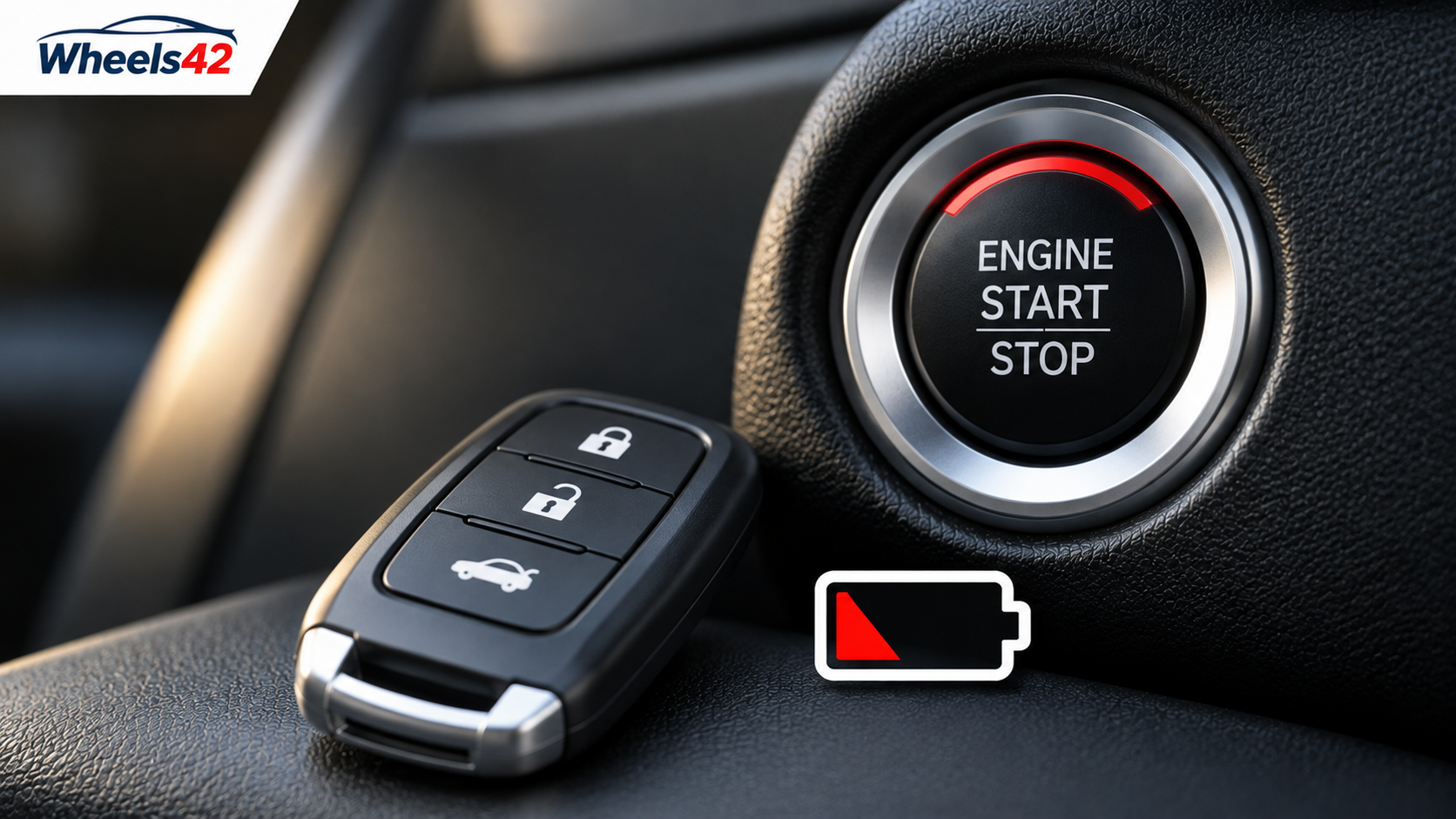
A push-start button makes starting a car more convenient, but does it mean the vehicle can run even when the key-fob battery is completely dead? Many modern cars feature keyless entry and push-button ignition systems, creating the impression that the vehicle does not depend on the key-fob battery once the driver enters the cabin.
However, the reality is slightly different. A push-start system generally requires the vehicle to recognise an authorised smart key before allowing the engine to start. The key-fob battery normally helps transmit the signal used for keyless entry and vehicle recognition. If that battery becomes weak or completely discharged, the vehicle may fail to detect the key through its normal wireless communication system.
Fortunately, many modern vehicles have an emergency key-detection feature that allows the driver to start the engine even when the key-fob battery is dead. This is possible because smart keys often contain a passive transponder or backup identification system that can communicate with the vehicle over a very short distance.
Therefore, the statement that a push-start button means a car can run without a healthy key-fob battery is partly true, but it is not universally correct.
Ex-Showroom vs On-Road Price: What's the Real Difference?
1. How Does a Push-Button Start System Work?
A push-button start system allows drivers to start and stop their vehicles without inserting a traditional ignition key.
Instead of turning a physical key, the driver carries a smart key or key fob. When the driver enters the vehicle and presses the brake pedal, the car checks whether an authorised key is present inside the cabin.
Once the system recognises the key, the driver can press the engine start/stop button to start the engine.
The process generally involves three important components:
-
Smart Key: The electronic key carried by the driver.
-
Vehicle Antenna: Detects and communicates with the smart key.
-
Immobiliser System: Checks whether the key is authorised to start the engine.
The smart key communicates with the vehicle through radio-frequency signals. Depending on the vehicle, the system may use low-frequency signals for detecting the key and radio-frequency communication for transmitting identification information.
If the vehicle successfully authenticates the key, the immobiliser allows the engine to start.
This system improves convenience and also provides an additional layer of vehicle security.

2. Does Push-Button Start Work When the Key-Fob Battery Dies?
Yes, in many modern cars, the engine can still be started even when the key-fob battery is completely discharged. However, this depends on the vehicle's design and whether it includes an emergency key-recognition system.
A common misunderstanding is that the push-start button itself can start the engine without requiring any communication from the smart key.
That is incorrect.
The push-start button only sends a starting request to the vehicle's electronic control system. Before allowing the engine to start, the immobiliser must confirm that an authorised key is present.
When the key-fob battery is healthy, the vehicle can normally detect it wirelessly from inside the cabin.
When the battery becomes weak or stops working, the normal detection process may fail. However, many manufacturers provide an alternative identification method that works without relying on the key-fob's regular battery.
This is why some cars can still start with a dead smart-key battery.
3. How Can a Car Detect a Key With a Dead Battery?
Most vehicles equipped with an emergency smart-key detection feature use a passive transponder system or a dedicated backup communication method.
Unlike normal keyless entry, this system does not necessarily depend on the key-fob battery.
The vehicle produces a short-range electromagnetic field through a dedicated antenna. When the smart key is placed near the designated detection area, its passive transponder can receive energy from this field and respond with identification information.
The vehicle then checks whether the identification information matches an authorised key.
If the authentication succeeds, the immobiliser permits the engine to start.
This backup process is designed to help drivers when the key-fob battery becomes weak or completely discharged.
However, the exact technology and emergency detection position vary between manufacturers and models.
Some vehicles require the smart key to be placed directly against the start/stop button, while others have a specific location inside the centre console, cup holder or steering-column area.
Drivers should check their owner's manual to identify the correct emergency starting procedure.
Manual vs Automatic Car: Pros and Cons Explained
4. What Happens When the Key-Fob Battery Becomes Weak?
A weak key-fob battery does not always stop the vehicle from recognising the smart key immediately.
In many cases, the driver may notice several warning signs before the battery completely fails.
Common symptoms include:
-
Reduced keyless entry operating range.
-
Repeated difficulty unlocking the doors.
-
Delayed response when pressing remote buttons.
-
A key-not-detected warning on the dashboard.
-
Intermittent problems with push-button starting.
-
The need to bring the key closer to the vehicle.
Some vehicles also display a warning message asking the driver to replace the smart-key battery.
Ignoring these signs may eventually leave the driver unable to unlock the vehicle or start it through the normal procedure.
Replacing the key-fob battery before it completely fails is generally the easiest solution.

5. Emergency Starting Procedure for Cars With Dead Key Batteries
The emergency starting process differs depending on the vehicle manufacturer. However, many push-start cars follow a similar procedure.
Here is a general method that applies to several smart-key systems:
Step 1: Enter the vehicle
If the remote unlocking function is not working, use the hidden mechanical key inside the smart key, if your vehicle provides one.
Most smart keys have a small release mechanism that allows the physical key blade to be removed.
Use it to unlock the driver's door through the mechanical lock cylinder. The lock may be hidden behind a small cover near the door handle.
Step 2: Sit in the driver's seat
Once inside, close the door and ensure the smart key is available.
Step 3: Press the brake pedal
For automatic vehicles, press and hold the brake pedal. For manual vehicles, follow the manufacturer's clutch-pedal starting instructions.
Step 4: Position the smart key near the emergency detection area
Depending on the manufacturer, this may be directly against the start/stop button or in a dedicated key-detection compartment.
Step 5: Press the start/stop button
The vehicle should attempt to authenticate the smart key through its backup detection system.
If the key is recognised and the vehicle's other systems are functioning correctly, the engine should start.
Important: This procedure is not universal. Always follow the emergency starting instructions provided in your vehicle's owner's manual.
Petrol vs Diesel vs CNG vs Electric Cars: How to Choose the Right Fuel Type
6. Difference Between a Dead Key-Fob Battery and a Dead Car Battery
One of the most important things drivers should understand is that a dead key-fob battery and a dead vehicle battery are two completely different problems.
A key-fob battery powers the remote functions and, in many designs, the normal wireless communication of the smart key.
The vehicle's 12V battery powers essential electrical systems, including control modules, dashboard electronics, immobiliser components and starting-related systems.
If the key-fob battery dies, the vehicle may still recognise the key through its emergency backup system.
However, if the vehicle's 12V battery is completely discharged, the car may not have enough electrical power to operate its electronic systems or activate the starter.
|
Feature
|
Dead Key-Fob Battery
|
Dead 12V Car Battery
|
|
Remote locking
|
May stop working
|
May stop working
|
|
Dashboard display
|
Usually works
|
May not work
|
|
Interior lights
|
Usually work
|
May not work
|
|
Emergency key detection
|
May work, if supported
|
Usually cannot operate without vehicle power
|
|
Engine starting
|
Often possible with backup detection
|
Generally not possible
|
|
Main solution
|
Replace key-fob battery
|
Recharge or replace vehicle battery
|
7. Does Every Push-Start Car Have Emergency Key Detection?
No. Not every push-start vehicle uses the same backup technology.
Many modern cars offer emergency key recognition, but the exact implementation depends on the manufacturer, vehicle generation and equipment level.
Some vehicles have a passive transponder that can communicate without the key-fob battery. Others use a dedicated backup antenna and a specific emergency key position.
There can also be differences between older smart-key systems and newer digital-key technologies.
Drivers should not assume that every push-start vehicle can start with a completely dead smart-key battery.
The best way to confirm this feature is to check the owner's manual or contact an authorised service centre.
8. Can You Drive the Car After Starting It With a Dead Key-Fob Battery?
In many vehicles, yes.
Once the smart key has been successfully authenticated and the engine has started, the vehicle can generally continue running even if the key-fob battery is completely discharged.
However, the vehicle may display a key-not-detected warning if the key is not recognised during subsequent checks.
Some vehicles may also prevent restarting after the engine is switched off until the key is detected again.
This is particularly important when stopping at a fuel station or taking a break during a journey.
If the key-fob battery is dead, it is advisable to replace it as soon as possible rather than depending on emergency detection for an extended period.

9. How to Maintain Your Smart-Key Battery
Smart-key batteries usually last for several years, but their lifespan depends on usage, battery quality and environmental conditions.
Drivers can follow a few simple practices to reduce unexpected key-fob problems.
-
Replace the battery when the vehicle displays a low-key-battery warning.
-
Use the correct battery type specified by the manufacturer.
-
Avoid exposing the smart key to water or excessive heat.
-
Do not keep pressing remote buttons unnecessarily.
-
Keep a spare smart key in a safe location.
-
Learn the emergency starting procedure before an unexpected failure occurs.
Most smart keys use small coin-cell batteries, such as CR2032 or CR2025, but the correct type varies by vehicle.
Always confirm the battery specification before replacing it.
10. What Should You Do If the Car Still Does Not Start?
If the vehicle refuses to start even after using the emergency key-detection procedure, the problem may not be limited to the key-fob battery.
Possible causes include:
-
A completely discharged 12V vehicle battery.
-
A damaged or faulty smart key.
-
A malfunctioning immobiliser system.
-
A problem with the vehicle's key-detection antenna.
-
An electronic control module fault.
-
Incorrect use of the emergency starting procedure.
If the spare smart key is available, try using it according to the manufacturer's instructions.
If neither key works, it is better to contact an authorised workshop or roadside assistance service rather than attempting to bypass the immobiliser.
Conclusion
The statement that a push-start button means a car can run without a healthy key-fob battery is partly correct.
Many modern push-button start vehicles include an emergency key-detection system that allows the engine to start even when the smart-key battery is completely discharged.
This works because the vehicle can identify the authorised key through a passive transponder or another backup communication method that does not depend on the normal key-fob battery.
However, this feature is not available in exactly the same way across every vehicle. Drivers must follow the emergency starting instructions provided by their manufacturer.
The most important thing to remember is that a dead key-fob battery does not necessarily mean you are stranded. But a dead 12V vehicle battery is an entirely different problem and may prevent the car from starting altogether.

 Khyati Sharma 2026-11-03