Khyati Sharma 2026-09-26
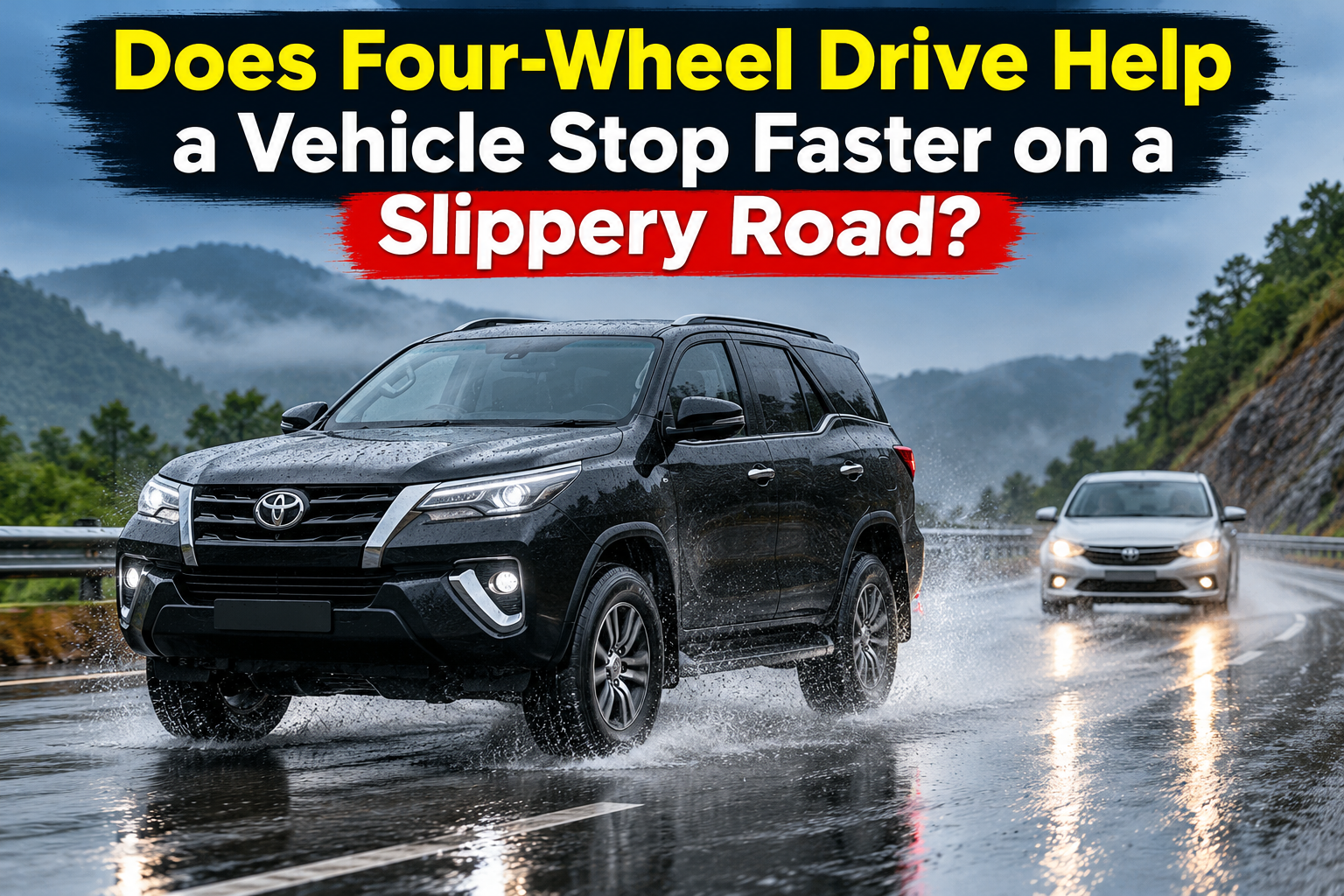
Four-wheel drive (4WD) is often associated with better traction, improved control and safer driving on challenging roads. Vehicles equipped with four-wheel drive are popular among SUV buyers, adventure enthusiasts and drivers who regularly travel through hilly regions, muddy tracks or snow-covered areas. However, a common misconception is that a four-wheel-drive vehicle can also stop faster than a two-wheel-drive vehicle when travelling on a slippery road.
The reality is different. Four-wheel drive primarily helps a vehicle transfer engine power to the road through all four wheels. It does not automatically reduce braking distance. When a driver applies the brakes, the vehicle's tyres, braking system, speed, weight and road surface play much more important roles in determining how quickly it stops.
For example, an SUV cars with four-wheel drive may accelerate more confidently on a wet road than a two-wheel-drive car. However, if both vehicles have similar tyres, comparable braking systems and similar speeds, four-wheel drive does not inherently give the SUV a shorter stopping distance.
Understanding this difference is important for anyone driving on wet highways, muddy roads, icy surfaces or mountain routes. Let's explore how four-wheel drive works, what actually affects stopping distance and how drivers can remain safe on slippery roads.
Four-wheel drive is a drivetrain system that can deliver engine power to all four wheels. Depending on the vehicle, the system may operate in four-wheel drive continuously or allow the driver to select it when additional traction is required.
Many traditional off-road SUVs use selectable 4WD systems with settings designed for different driving conditions.
Four-wheel drive is particularly useful when a vehicle needs to move over loose, uneven or slippery surfaces. Distributing engine power across four wheels can reduce the likelihood that one or two driven wheels will spin excessively while accelerating.
For example, when driving on a muddy trail, a two-wheel-drive vehicle may struggle because its driven wheels lose grip. A suitable 4WD vehicle may be able to distribute power to the other wheels and maintain forward movement.
However, four-wheel drive is not a substitute for proper tyres, careful driving or an effective braking system.
New Car Booking Process Explained Step by Step
Main benefits of four-wheel drive
Improved traction when accelerating on loose surfaces.
Better ability to move through mud, gravel and certain snow-covered roads.
Greater capability on challenging off-road routes.
Improved mobility when some wheels have less grip than others, depending on the drivetrain and traction-control system.
These benefits mainly concern moving the vehicle. They do not guarantee that the vehicle will stop quickly when the brakes are applied.

To understand why 4WD does not necessarily improve braking performance, it is important to distinguish between acceleration and deceleration.
During acceleration, the engine sends power through the drivetrain to the driven wheels. A four-wheel-drive system can distribute this power across all four wheels, potentially helping the vehicle move forward without excessive wheelspin.
During braking, the process is different. The braking system uses friction at the brakes to slow the rotating wheels, while the tyres must generate enough grip against the road to slow the vehicle itself.
A vehicle's ability to stop depends heavily on the friction available between its tyres and the road surface. If the road is covered in ice, water, mud or loose gravel, that friction may be significantly reduced.
Even if a vehicle has four-wheel drive, its tyres can still lose grip when the driver brakes too hard or encounters an especially slippery surface.
Consider two SUVs travelling on a wet road. One has 4WD, while the other has two-wheel drive. If their tyres and braking systems are comparable, the 4WD SUV does not automatically stop sooner simply because power can reach all four wheels.
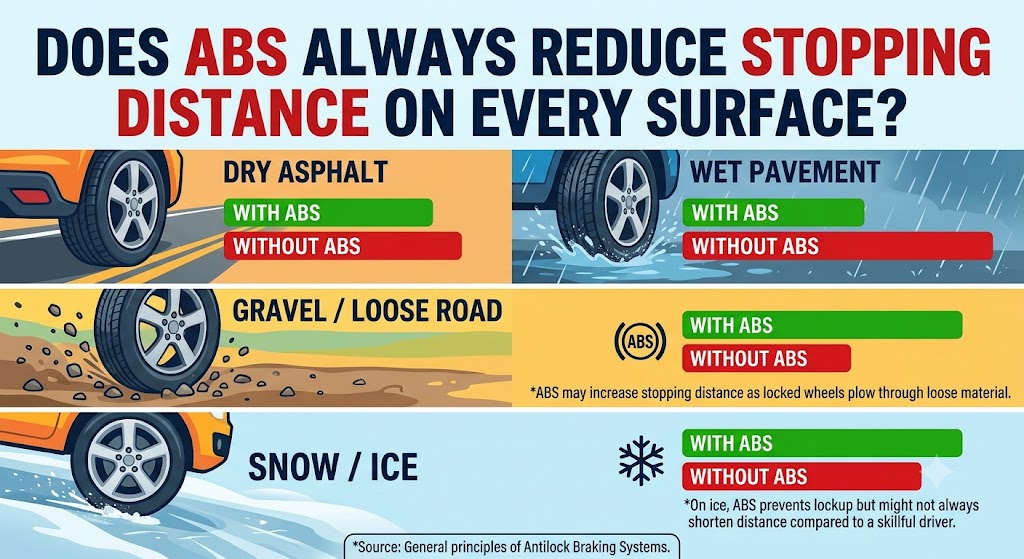
Modern braking systems, including anti-lock braking systems (ABS), are designed to help drivers maintain steering control during hard braking. However, ABS also cannot create additional grip when the road surface offers very little traction.
|
Feature |
Four-Wheel Drive (4WD) |
Two-Wheel Drive (2WD) |
|
Power delivery |
Engine power can reach all four wheels |
Engine power reaches two wheels |
|
Acceleration on slippery surfaces |
Can offer better traction |
Driven wheels may lose grip more easily |
|
Braking distance |
Not automatically shorter |
Not automatically longer |
|
Off-road capability |
Generally better on suitable terrain |
More limited in demanding conditions |
|
Tyre grip during braking |
Depends on tyre-road contact |
Depends on tyre-road contact |
|
Fuel consumption |
Often higher, depending on the vehicle |
Often lower in comparable vehicles |
|
Driver confidence |
Can improve mobility but may encourage overconfidence |
Requires careful throttle control in low-grip conditions |
Stopping distance is the total distance a vehicle travels from the moment a driver identifies a hazard until the vehicle comes to a complete stop.
It consists of two main parts:
Stopping distance = Reaction distance + Braking distance
Reaction distance is the distance travelled while the driver recognises a hazard and responds. Braking distance is the distance travelled after the brakes are applied until the vehicle stops.
Several factors influence these distances.
Tyre condition and tyre type
Tyres are one of the most important factors in vehicle safety. They form the only direct contact between the vehicle and the road, so their condition strongly influences grip during acceleration, cornering and braking.
Worn tyres may struggle to channel water away from the contact patch, increasing the risk of losing traction on wet roads. Incorrect tyre pressure can also affect handling and braking performance.
On snow and ice, tyres designed for winter conditions can provide substantially better grip than unsuitable standard tyres. In India, drivers travelling to snowy mountain destinations should check whether their tyres are appropriate for the prevailing conditions and follow local safety requirements.
Four-wheel drive cannot compensate for tyres that have inadequate grip.
Vehicle speed
Speed has a major effect on braking distance. At higher speeds, a vehicle generally needs much more distance to stop.
For instance, under otherwise comparable conditions, doubling the speed can approximately quadruple the kinetic energy that the brakes must dissipate. Actual stopping distance depends on several factors, but the relationship illustrates why reducing speed is so important on slippery roads.
Drivers should slow down before entering a sharp bend, approaching standing water or travelling over a snow-covered section.
Road surface
A dry, clean road generally offers more grip than a wet, muddy, icy or snow-covered road.
Water can reduce tyre-road friction, particularly when tyres cannot effectively disperse it. Ice can reduce available grip dramatically, making both braking and steering more difficult.
Loose gravel and mud can also affect braking because the tyres may move over the surface rather than maintain consistent grip.
Braking system
The condition of brake pads, discs, callipers, brake fluid and other braking components affects braking performance.
A well-maintained braking system helps the vehicle slow consistently. Drivers should investigate warning lights, unusual brake noises, vibrations or changes in pedal feel instead of ignoring them.
ABS can help prevent wheel lock during hard braking and allow the driver to retain more steering control. It does not eliminate the need for safe following distances.
Vehicle weight
Heavier vehicles carry more kinetic energy at a given speed. Their braking performance depends on the braking system, tyre grip and vehicle design, not just their drivetrain.
Some four-wheel-drive SUVs are heavier than comparable two-wheel-drive versions because of additional drivetrain components. That extra weight does not automatically mean they will stop more slowly in every situation, but it is another reason not to assume that 4WD provides a braking advantage.
How to Compare Car Variants: Base vs Mid vs Top Trim
Driver reaction time
A distracted, tired or inexperienced driver may take longer to react to a sudden hazard. During that time, the vehicle continues travelling without the benefit of braking.
Maintaining concentration, keeping a safe distance and anticipating hazards can reduce the likelihood of an emergency stop.

All-wheel drive (AWD) and four-wheel drive are related concepts, but their designs and intended uses can differ.
AWD systems commonly distribute power automatically between the wheels according to driving conditions. Traditional 4WD systems often provide selectable modes for challenging terrain, although many modern systems operate differently.
Both can improve traction during acceleration. Neither system inherently guarantees a shorter braking distance.
Some AWD and 4WD vehicles may include advanced electronic stability control, traction control, brake-based torque management and sophisticated ABS systems. These technologies can help manage the vehicle under certain conditions, but their benefits depend on the system and the situation.
When comparing two vehicles, drivers should consider tyre quality, braking hardware, safety technology, weight and overall vehicle design rather than relying solely on whether the vehicle has AWD or 4WD.
Safe braking begins before the driver needs to stop suddenly. On slippery roads, smooth inputs and adequate space are especially important.
Reduce speed early
Slow down before approaching a hazard, a sharp bend, an intersection or a steep descent. Avoid waiting until the last moment to brake.
Increase the following distance
Leave more space between your vehicle and the one ahead. The normal following distance may be insufficient when the road is wet, icy or covered with loose material.
There is no single distance suitable for every condition, so adjust the gap to the speed, visibility, road surface and vehicle.
Avoid sudden steering and braking
Abrupt inputs can exceed the available tyre grip. Brake progressively when conditions allow, and avoid sudden manoeuvres that could cause the vehicle to skid.
If an emergency requires hard braking in a vehicle equipped with ABS, apply firm, continuous pressure to the brake pedal and steer as needed to avoid the hazard. Do not repeatedly pump the brake pedal in a conventional ABS-equipped vehicle.
Use the correct gear on steep descents
When driving downhill, an appropriate lower gear can help control speed through engine braking and reduce reliance on continuous brake application. Follow the vehicle manufacturer's guidance, particularly when using 4WD low-range gearing.
Do not select a drivetrain mode that is unsuitable for the speed or road conditions.
Check tyres and brakes regularly
Before a long journey, inspect tyre tread, tyre pressure and the condition of the braking system. If travelling to a snowy region, check local road conditions and whether additional equipment, such as suitable winter tyres or approved traction devices, is required.
Several misconceptions can lead drivers to take unnecessary risks.
Myth 1: A 4WD SUV can stop faster on ice.
Reality: Ice offers very little tyre grip. Four-wheel drive does not remove this limitation.
Myth 2: Four-wheel drive prevents skidding.
Reality: A 4WD vehicle can skid when cornering, braking or accelerating beyond the available traction.
Myth 3: All-wheel drive eliminates the need for suitable tyres.
Reality: Tyres remain essential for grip. AWD cannot compensate fully for worn or inappropriate tyres.
Myth 4: Bigger SUVs are always safer on slippery roads.
Reality: Safety depends on many factors, including tyres, brakes, electronic safety systems, vehicle stability, speed and driver behaviour.
Myth 5: ABS guarantees a short stopping distance.
Reality: ABS helps maintain wheel rotation and steering control during hard braking, but stopping distance can still be long on ice, loose gravel or other low-grip surfaces.
How to Choose Between Two Similar Car Models: A Decision Framework
For Indian drivers, four-wheel drive can be useful when travelling through mountainous areas, muddy rural roads, loose gravel or challenging off-road terrain. It can also help in certain snow-covered conditions when the vehicle is equipped with appropriate tyres and driven carefully.
However, many everyday journeys take place on paved urban roads and highways, where a well-maintained two-wheel-drive vehicle can be entirely suitable.
Drivers should consider their usual routes, weather conditions, vehicle costs and maintenance requirements before choosing a drivetrain.
If a vehicle is frequently used for off-road travel, 4WD may provide valuable capability. If it is primarily used for commuting, family travel and highway driving, other factors—such as tyre quality, braking performance, crash protection and electronic safety features—may be more relevant to the buying decision.
Regardless of the drivetrain, drivers must remember that a vehicle capable of accelerating confidently on a slippery surface may still need considerable distance to stop.
Four-wheel drive is a valuable technology that improves a vehicle's ability to transfer engine power to all four wheels. It can help with acceleration and mobility on slippery or uneven terrain, making it useful for SUVs and vehicles designed for off-road driving.
However, it does not automatically help a vehicle stop faster on a slippery road. Braking performance depends primarily on available tyre grip, vehicle speed, tyre condition, the braking system, road conditions and driver reaction time.
For safer driving, reduce speed when grip is limited, maintain a generous following distance, keep tyres and brakes in good condition, and use the correct braking technique for the vehicle.
Ultimately, the best safety advantage comes from understanding your vehicle's limitations. Whether you drive a 4WD SUV, an AWD crossover or a conventional two-wheel-drive car, careful driving and suitable tyres remain essential for stopping safely on slippery roads.